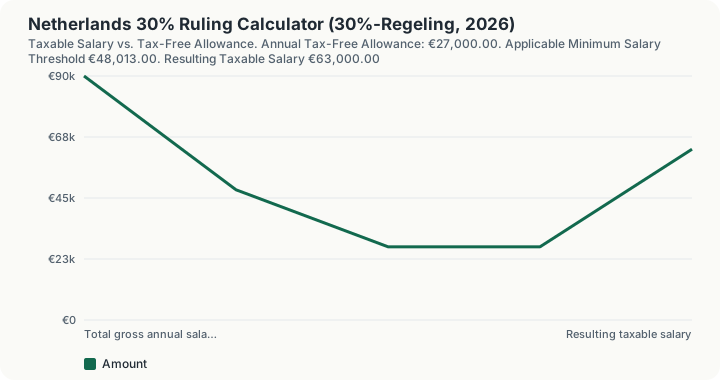
Quick Answer: An eligible expat employee in the Netherlands earning €90,000.00 in total gross salary in 2026 receives a €27,000.00 tax-free allowance under the 30%-regeling, leaving €63,000.00 as taxable salary -- with no threshold or WNT-norm capping applied at this income level.
Overview
The 30%-regeling (commonly called the "30% ruling" by English-speaking expats) is the Netherlands' flagship tax incentive for attracting skilled workers recruited from abroad. It allows an eligible employer to pay up to 30% of an employee's gross salary tax-free, as a fixed reimbursement for the extraterritorial costs of relocating and living abroad (housing, cost-of-living differences, and similar expenses), without having to prove those costs individually. The remaining 70% (or more, if the full 30% isn't used) is taxed as ordinary salary under the normal Box 1 rules.
This ruling has been through significant reform in recent years, and getting the current mechanics right matters, because outdated information is everywhere online. In the 2025 Belastingplan (Tax Plan), the government initially proposed reducing the ruling's generosity for new applicants via a stepped "30-20-10" taper: 30% tax-free for the first 20 months, dropping to 20% for months 21-40, then 10% for the final 20 months of the maximum 60-month (5-year) term. That stepped taper was withdrawn before it ever took effect, via a second amendment memorandum (Nota van Wijziging) to the same Tax Plan. In its place, the government adopted a simpler mechanism: the full flat 30% rate continues to apply for both 2025 and 2026, but from 1 January 2027, the maximum drops to a flat 27% for the remaining duration of rulings that started on or after 1 January 2024. Rulings that began before that date keep the full 30% under transitional (grandfathering) rules. Because this calculator computes the 2026 tax year specifically, it always applies the current flat 30% rate.
Two salary thresholds must be met to use the ruling at all: a standard minimum taxable salary of €48,013 for 2026, or a reduced €36,497 for employees under 30 who hold a qualifying Dutch or recognized-foreign-equivalent master's degree. If a straightforward 30% split would push your taxable salary below the applicable threshold, the allowance is reduced (not eliminated) so your taxable salary lands at exactly the floor. A separate, newer restriction ties the maximum tax-free amount to the WNT-norm (the "Balkenende norm," the standard Dutch public-sector executive salary cap), giving a hard ceiling on the tax-free allowance of €78,600 for 2026, regardless of how high total salary climbs.
How This Is Calculated
- Eligibility check. Total salary must meet or exceed the applicable minimum threshold.
- Uncapped allowance. A flat 30% of total salary.
- Threshold floor. The allowance cannot push taxable salary below the applicable threshold.
- WNT-norm ceiling. The allowance is further capped at €78,600 for 2026.
- Taxable salary.
Worked Example
Using the calculator's default input: a total gross annual salary of €90,000.00, standard salary threshold.
- €90,000.00 comfortably exceeds the €48,013 standard threshold, so the employee is eligible.
- Uncapped allowance: €90,000.00 × 30% = €27,000.00.
- Threshold check: €90,000.00 − €48,013 = €41,987.00 of "room" above the threshold -- well above the €27,000.00 uncapped allowance, so the threshold does not bind.
- WNT-norm check: €27,000.00 is well below the €78,600 ceiling, so that cap does not bind either.
- Final tax-free allowance: €27,000.00, leaving a taxable salary of €90,000.00 − €27,000.00 = €63,000.00.
Contrast this with a €50,000.00 salary: a flat 30% split would create a €15,000.00 allowance and drop taxable salary to €35,000.00, which falls below the €48,013 threshold. In that case, the allowance is instead reduced to exactly €1,987.00 (just €50,000.00 minus €48,013), holding taxable salary at precisely the threshold rather than disqualifying the employee outright.
What This Does Not Account For
- The 150km recruitment distance test. To qualify at all, an employee generally must have lived more than 150 kilometers from the Dutch border for more than 16 of the 24 months before starting Dutch employment. This calculator assumes that eligibility gate is already satisfied and models only the salary-based mechanics.
- The 2027 rate change for existing rulings. For rulings that started on or after 1 January 2024, the rate drops to a flat 27% from 1 January 2027 onward for the remainder of the term, and the salary threshold is scheduled to rise (from a 2024 basis of roughly €46,107, indexed annually, to about €50,436 by 2027). This calculator computes 2026 only, where the flat 30% rate and the 2026 thresholds shown here still apply in full.
- Partial-year application. If the ruling starts or ends partway through a calendar year, the salary thresholds are generally pro-rated for the partial year; this calculator assumes a full 12-month application.
- The former "80% rule" and reimbursement-in-kind choices. Employers and employees can sometimes structure part of the tax-free allowance as reimbursement of actual extraterritorial costs rather than the flat 30%; this calculator models only the standard flat-percentage approach.
- Interaction with the 30%-regeling's effect on Box 2/3 non-resident taxpayer status. Under a 2019-era rule, opting into the ruling could affect whether you are treated as a partial non-resident taxpayer for Box 2 and Box 3 purposes for older rulings; that status question is not modeled here.
Common Pitfalls
- Relying on outdated "30-20-10" tapering information. Many articles published in 2024 describe a stepped reduction that was formally withdrawn before it ever applied to anyone -- for 2025 and 2026, eligible employees still receive the full flat 30%, not a declining percentage within the term.
- Confusing the ruling's own 5-year (60-month) maximum duration with the 2027 rate change. The ruling's term length (up to 5 years) and the percentage it pays (30% now, 27% from 2027 for post-2024 rulings) are two separate things -- a ruling doesn't end early because the rate changes.
- Assuming the 30% allowance is calculated on top of salary rather than as a slice of it. The 30% is 30% of the total remuneration package (allowance included), not an extra 30% added on top of an otherwise-unchanged gross salary.
- Ignoring the salary threshold when negotiating a package close to it. An employee whose salary sits just above the standard or reduced threshold may find their actual allowance is far below the full 30%, since the threshold floor takes priority.
- Not accounting for the WNT-norm cap at high salaries. Very high earners sometimes assume 30% of any salary is available tax-free; above roughly €262,000 in total salary, the €78,600 cap binds and any additional salary above that point is fully taxable.
Frequently Asked Questions
Is the 30% ruling really still 30% in 2026?
What if I started my ruling before 2024?
What counts toward the salary threshold -- gross or taxable salary?
Does the reduced threshold apply automatically if I'm under 30?
Can my employer choose to give me less than the maximum allowance?
Sources
- Belastingdienst, "Inhoud van de regeling" (30%-regeling / expatregeling) -- confirms the 30% maximum and the €78,600 WNT-norm-linked cap for 2026. belastingdienst.nl
Also consulted: PwC Netherlands, "Expatregeling wordt 27%-regeling" -- confirms the withdrawal of the 30-20-10 taper and the 2027 flat-27% change for post-2024 rulings; Ondernemersplein/Rijksoverheid.nl, "Vergoeding 30%-regeling expats wordt 27%" -- confirms 2026 salary thresholds (€48,013 standard / €36,497 reduced) and the scheduled 2027 threshold increase.