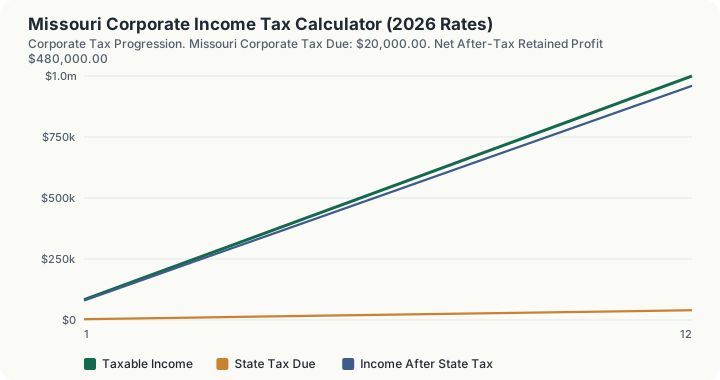
Quick Answer: On $500,000 of pre-apportioned taxable income, Missouri's flat 4.00% corporate income tax rate produces $20,000.00 in state tax due and $480,000.00 in net after-tax profit, before any Kansas City or St. Louis local earnings tax.
Missouri at 4.00% After SB 884
Missouri taxes C-corporation income at a flat 4.00%, one of the lowest positive corporate rates in the country. That rate is recent, and it did not arrive on its own.
Senate Bill 884, enacted in 2018 and effective for tax years beginning on or after January 1, 2020, cut Missouri's corporate rate from 6.25% to 4.00%, a 36% reduction in a single step. But the bill was explicitly a trade, not a giveaway. In exchange for the rate cut it imposed mandatory single sales factor apportionment with market-based sourcing, replacing the menu of apportionment methods Missouri had previously allowed corporations to choose among, and it repealed the corporate deduction for federal income taxes. For a Missouri-heavy manufacturer selling mostly out of state, the apportionment change alone can outweigh the rate cut; for an out-of-state company selling into Missouri, the arithmetic often runs the other way. Anyone benchmarking Missouri on the 4.00% headline without modeling the sales factor is reading half the statute.
SB 884 also loosened consolidated filing: it removed the old requirement that an affiliated group derive 50% or more of its income from Missouri sources before it could file a Missouri consolidated return, and it excluded intercompany transactions from the consolidated computation.
Missouri also stands out for what it doesn't levy. The corporate franchise tax was fully repealed for tax years beginning on or after January 1, 2016, after a multi-year phase-down. Missouri corporations therefore face no net-worth or capital-based state tax at all, unlike Alabama's Business Privilege Tax or the franchise taxes still in force in Texas, Tennessee, and elsewhere.
At the calculator's $500,000 baseline, the flat 4.00% produces $20,000.00. That is well under the $31,000 a Kansas corporation would owe on the identical base (Kansas is graduated: 3.50% on the first $50,000, 6.50% above), a comparison Missouri companies on the Kansas City state line make constantly and often get wrong by quoting Kansas's 6.50% top rate as if it were flat.
How This Is Calculated
Missouri's computation is a single multiplication at the rate step; the analytical work sits upstream, in how much income the single sales factor pulls into Missouri in the first place.
- Read the income field as the taxable base. The single income input is taken as Missouri taxable corporate income exactly as typed. The code applies no modification, allocation or deduction to it before the rate stage; it is the base.
- Apply the single statutory rate. Missouri's 4.00% rate is multiplied against that figure with no bracket lookup, because the schedule has one band running from the first dollar: $500,000 x 4.00% = $20,000.00.
- Subtract credits and floor the result at zero. The credits field is subtracted from the step-2 figure and the difference is clamped at $0.00, so no credit entry can drive the liability negative. With the field at its $0 default the $20,000.00 stands; enter $8,000 of credits and the page returns $12,000.00, a reduction of exactly the credit entered because the subtraction is a straight one.
- Derive the reported rates from those two numbers. The effective rate is the tax divided by the income entered, 4.00% here, and the top statutory bracket is reported separately as 4.00%. Net after-tax retained profit is the income less the tax, $480,000.00. Those four outputs are the whole of what the engine produces.
Worked Example
Take the calculator's baseline: a corporation with $500,000 of taxable income apportioned to Missouri under the post-SB 884 single sales factor.
- Start with apportioned taxable income. $500,000 has been apportioned to Missouri under the mandatory single sales factor, before any state-level tax is applied.
- Apply Missouri's flat statutory rate. Missouri taxes all C-corporation income at 4.00% with no bracket lookup: $500,000 × 4.00% = $20,000.00.
- Missouri corporate tax due: $20,000.00.
- Net retained profit. $500,000 − $20,000.00 = $480,000.00 retained after Missouri tax, before federal liability and before local earnings tax.
For scale: under Missouri's pre-2020 rate of 6.25%, the same $500,000 would have generated $31,250, meaning SB 884 removed $11,250 of state tax from this profile, provided the single sales factor did not increase the apportioned base by more than about 56% in the process. That break-even is the calculation every Missouri-domiciled exporter had to run in 2020.
Filing Mechanics: Form, Deadlines & Estimated Payments
- Return: Missouri Form MO-1120, Corporation Income Tax Return.
- Due date: The 15th day of the fourth month following the close of the tax year. April 15 for calendar-year filers, matching the federal C corporation deadline.
- Extension: Form MO-7004 provides an automatic six-month extension of time to file. It does not extend time to pay; tax owed after the original due date accrues interest and penalty.
- Estimated payments: Required when Missouri estimated tax is expected to be $250 or more, paid on Form MO-1120ES in installments due the 15th day of the 4th, 6th, 9th, and 12th months of the tax year. The $250 trigger is low, it catches corporations with as little as $6,250 of Missouri taxable income.
Single Sales Factor, No Franchise Tax, and What Follows From Both
- Market-Based Sourcing Is the Whole Game. With a mandatory single sales factor, Missouri exposure is determined entirely by where customers receive the benefit. A Missouri-based services firm serving out-of-state clients apportions very little income to Missouri despite all its people and property being there; the reverse is true for a remote seller with a Missouri customer base.
- No Franchise Tax to Plan Around. Because the corporate franchise tax was repealed effective 2016, Missouri holding-company and capitalization structures do not carry the net-worth tax cost they would in a franchise-tax state. Entities can be capitalized for commercial reasons without a state tax penalty.
- Consolidated Filing Follows the Federal Election. Missouri is not a mandatory unitary combined reporting state. A Missouri consolidated return is permitted only where the affiliated group files a federal consolidated return; a group filing separate federal returns files separate Missouri returns. Groups that file a federal consolidated return may still elect separate Missouri returns, in which case each member computes separate federal taxable income on a pro forma basis.
- Local Earnings Tax Exposure. Structuring where work is performed matters in Missouri for a reason unrelated to the state tax, see below.
Local Earnings Taxes: Kansas City and St. Louis
Missouri is one of a small number of states where city-level taxes reach business profits. Both Kansas City and St. Louis levy a 1% earnings tax, and in both cities it applies to the net profits of businesses conducted within the city limits, not merely to individual wages. For a corporation operating inside either city's boundaries, the combined state-plus-local rate on profits earned there is closer to 5% than the 4.00% headline suggests, a 25% increase over the state-only figure.
Both taxes are subject to periodic voter reauthorization under Missouri law, so long-horizon models should treat them as recurring policy events rather than fixed constants. Crucially, the city line matters enormously: a facility a mile outside the Kansas City limits faces no earnings tax at all, which is precisely why site selection in the metro area is unusually granular.
The Statutes Behind These Figures
- Mo. Rev. Stat. Chapter 143: Missouri income tax, including the 4.00% corporate rate and the apportionment provisions rewritten by SB 884.
- Senate Bill 884 (2018): Rate reduction to 4.00%, mandatory single sales factor with market-based sourcing, and the consolidated-return changes, all effective for tax years beginning on or after January 1, 2020.
- Corporate Franchise Tax Repeal: Fully repealed for tax years beginning on or after January 1, 2016.
- Public Law 86-272: Shields out-of-state corporations from Missouri's net income tax where in-state activity is limited to soliciting orders for tangible personal property, protection that is particularly valuable under market-based sourcing, since a protected seller can have substantial Missouri-sourced receipts and no Missouri income tax.
What a Marginal Dollar Costs in Missouri, and What the Credit Field Really Does
The rate is flat, so the twelve-row income sweep is a straight line and the questions worth asking are about slope, about credits, and about the two layers of tax this page does not compute.
The marginal cost of the next unit. Each additional $1,000 of apportioned Missouri income costs $40.00, the lowest positive figure in this batch. The engine returns $20,000.00 at $500,000 and $20,040.00 at $501,000, and $19,600.00 at $490,000. At scale: $4,000.00 at $100,000, $40,000.00 at $1,000,000, $200,000.00 at the $5,000,000 enterprise row. Minnesota charges $98.00 for the same marginal thousand, so a dollar of profit sourced to Missouri rather than Minnesota carries 59% less state tax.
Right method against wrong method, priced. Entering $10,000 of credits against $500,000 of income takes the computed tax from $20,000.00 to $10,000.00, an exact $10,000.00 saving and an effective rate of 2.00% against an unchanged 4.00% marginal rate. Achieving the same through deduction, by reducing income to $490,000, saves $400.00. The credit is worth 25 times the deduction at Missouri's rate, which is the widest multiple in this batch and follows directly from Missouri having the lowest rate: the lower the rate, the less a deduction is worth and the wider the gap.
Where the credit arithmetic stops. The engine computes net tax as the greater of zero and tax less credits. $25,000 of credits against $500,000 of income returns $0.00 and a 0.00% effective rate, with the excess $5,000 discarded. Missouri's own credit programmes differ in carryforward period and transferability, and none of that behaviour is represented here.
The reverse question. A $20,000.00 Missouri bill corresponds to exactly $500,000 of apportioned income, and each further $10,000 of tax to $250,000 of income. A corporation holding $20,000.00 of usable credits pays nothing on $500,000.
Two layers this figure does not include. The single sales factor described above is applied before this calculator begins: the engine performs no apportionment and treats the amount entered as already sourced to Missouri, so the most consequential figure in a multistate Missouri filing is an input rather than a computation. And the Kansas City and St. Louis 1% earnings taxes appear in no output on this page. A corporation earning all $500,000 inside either city faces roughly $5,000 of city tax on top of the $20,000.00 computed here, a 25% increase over the state-only figure, with no field in which to record the city.
What This Does Not Account For
- Federal Taxable Income Starting Point. Net corporate earnings are determined under IRC § 63 before Missouri modifications. This calculator starts one step later: the income box is read as the finished Missouri taxable figure and nothing is derived from a federal return.
- Missouri Additions & Subtractions. Missouri-specific adjustments are applied. Note that the corporate deduction for federal income tax no longer exists post-SB 884. No addback and no subtraction is computed anywhere in this page's code path, so enter an income figure that already reflects them.
- Apportionment Factor Allocation. Income is apportioned to Missouri under the mandatory single sales factor with market-based sourcing, receipts from services and intangibles are sourced to where the benefit is received in Missouri, not to where the work was performed. The engine performs no apportionment of any kind. The word does not appear in the primitive this page binds to; the figure you type is taken as the Missouri figure and multiplied by the rate as it stands.
- Net Operating Loss (NOL) Deductions. Allowable Missouri NOL carryforwards are deducted. No loss deduction is applied by this calculator. If a carryforward is available, subtract it yourself before entering the income.
- Consolidated vs. Separate Determination. A Missouri consolidated return is available only where the group files a federal consolidated return; the state election follows the federal one. No group, election or filing-method test is applied here. The code reads one income figure and one credit figure and nothing else.
- Federal corporate income tax (21% under IRC § 11).
- Kansas City and St. Louis 1% earnings taxes on business net profits earned within those city limits.
- Missouri's separate Financial Institutions Tax, which applies to banks and credit institutions in place of the corporate income tax and is administered under its own schedule.
- Base Erosion and Anti-Abuse Tax (BEAT) or Global Intangible Low-Taxed Income (GILTI) provisions.
- Missouri does not impose a corporate franchise tax, repealed effective 2016, so no net-worth component is modeled.
Common Pitfalls
- Assuming Missouri Mandates Combined Reporting. It does not. Missouri consolidated filing is available only when tied to a federal consolidated return election; there is no mandatory unitary combined reporting regime.
- Quoting Kansas at 6.50% Flat. Kansas is graduated, 3.50% on the first $50,000, 6.50% above, and owes $31,000 on a $500,000 base, not $32,500. Cross-border comparisons on the Kansas City metro line are frequently overstated by this error.
- Ignoring the SB 884 Trade. The 4.00% rate came bundled with mandatory single sales factor apportionment. Modeling the new rate against the old three-factor apportionment produces a number that has never been correct for any tax year.
- Missing the Local Earnings Tax. A corporation with net profits earned inside Kansas City or St. Louis owes 1% to the city on top of the 4.00% state rate. The applicable local tax is Missouri's own, not the NYC-style municipal corporate tax that generic state calculators tend to cite.
- Applying the $250 Estimated Threshold Too Loosely. It is a low bar. Missouri corporations that assume they are below an estimated-payment requirement often are not.
Frequently Asked Questions
What is Missouri's corporate income tax rate?
Does Missouri have a corporate franchise tax?
Does Missouri require combined reporting?
When are Missouri corporate tax returns due?
How is multi-state corporate income apportioned to Missouri?
Sources
Also consulted: Missouri Department of Revenue: Form MO-1120 Instructions; Corporation Income Tax guidance; Form MO-7004; Missouri Senate Bill 884 (2018): Corporate rate reduction, single sales factor, and consolidated-return amendments; City of St. Louis, Office of the Comptroller: U.S. Cities That Levy Earnings Taxes.