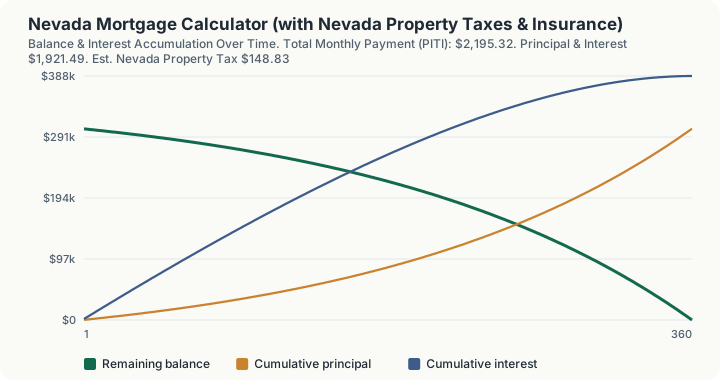
Quick Answer: A $380,000 home in Nevada with 20% down at a 6.5% rate costs about $2,195.32 a month once principal, interest, an estimated 0.47% property tax, and insurance are included.
Overview
Nevada is one of the more forgiving states for a homeowner's monthly bill, and the reason is structural rather than incidental. The state has no personal income tax, and its property tax system runs on assessed value that is capped well below full market value, so the effective rate that actually shows up on a tax bill tends to land near 0.45% to 0.5% of a home's market price in most counties, including Clark County (Las Vegas) and Washoe County (Reno). That is meaningfully lower than the national average of roughly 1%, and it is the single biggest reason a Nevada mortgage payment can look smaller than an identical loan taken out in a high-tax state next door.
The other piece specific to Nevada is NRS 361.4722, the state's property tax abatement law. It limits how fast the taxable portion of a home's assessed value can rise year over year, generally 3% annually for an owner-occupied primary residence and up to 8% for other property, regardless of how much the market value jumps. New buyers should know that a home's first full tax bill after purchase is typically reassessed to reflect the sale price, so the abatement cushion resets and starts protecting the owner from the following year forward. This calculator models a steady 0.47% effective rate; it does not attempt to project how the abatement cap will change your bill five or ten years out.
This tool combines a standard 30-year fixed amortization with Nevada's typical property tax burden and a placed insurance estimate to produce a realistic total monthly housing cost, commonly called PITI (Principal, Interest, Taxes, and Insurance).
How This Is Calculated
The engine runs a standard fixed-rate amortization on the financed balance, then layers on Nevada-specific carrying costs:
- Down payment and loan principal. The down payment percentage is applied to the home price, and the remainder becomes the loan principal.
- Monthly principal and interest. The loan principal, annual rate, and 360-month term feed a standard amortization formula that solves for a level monthly payment, splitting each installment into interest (based on the remaining balance) and principal reduction.
- Nevada property tax estimate. The home price is multiplied by an assumed 0.47% effective annual rate, then divided by 12 to get a monthly tax escrow figure. This reflects a statewide blended average; actual county mill levies and abatement effects will shift the real number up or down.
- Homeowners insurance estimate. A flat $125 monthly placeholder is added to represent a typical Nevada homeowners policy; wildfire, wind, and flood exposure in specific ZIP codes can push actual premiums higher.
- Total monthly payment (PITI). Principal and interest, the property tax estimate, and the insurance estimate are summed into one headline monthly figure, and a full 360-month amortization table tracks the declining balance to zero.
Worked Example
Using the calculator's own baseline inputs: a $380,000 home price, 20% down, and a 6.5% annual interest rate on a 30-year fixed loan.
- Down payment: $380,000 × 20% = $76,000
- Loan principal: $380,000 − $76,000 = $304,000
- Monthly principal and interest: $1,921.49
- Estimated Nevada property tax: $380,000 × 0.47% ÷ 12 = $148.83 per month ($1,786 per year)
- Estimated insurance: $125.00 per month
- Total monthly payment (PITI): $2,195.32
- Total interest paid over 30 years: approximately $387,733
Drop the down payment to 5% instead of 20%, and the financed balance jumps to $361,000, pushing principal and interest alone to roughly $2,282 a month before taxes and insurance are even added, a useful illustration of how much a bigger down payment buys in a state where property tax is already low.
What This Does Not Account For
- Private mortgage insurance (PMI). Any down payment below 20% typically triggers PMI, which is not included in this estimate and can add $100 to $300 or more per month depending on credit score and loan-to-value ratio.
- County-level millage variation. Clark, Washoe, and Nevada's fifteen other counties each set their own combined tax rate; a home in unincorporated Clark County will not carry the same bill as one inside Reno city limits.
- The abatement reset in year one. A newly purchased home is often reassessed at the sale price, meaning the first bill can differ sharply from what the previous owner paid, before the 3% annual cap begins limiting future increases.
- HOA dues. Many newer Nevada subdivisions, especially in the Las Vegas valley, carry homeowners association fees of $50 to $300+ a month that are not part of PITI.
- Closing costs and loan origination fees, which are one-time costs paid at closing rather than part of the recurring monthly payment.
Common Pitfalls
- Assuming the statewide average tax rate applies everywhere. Nevada's 0.47% figure is a blended estimate; special assessment districts and local bonds can raise the real number in specific neighborhoods.
- Forgetting PMI below 20% down. Buyers who run the 5% down scenario often compare it directly to the 20% down payment without adding PMI, understating the true monthly cost.
- Confusing the abatement cap with a tax freeze. The 3% cap slows the rate of increase; it does not stop the bill from rising every year, and it can reset higher after a sale or major renovation.
- Ignoring insurance variability by region. A home near wildfire-prone foothills or in a flood zone can carry a premium well above the $125 monthly placeholder used here.
- Treating the quoted rate as fixed for the life of the loan without checking the loan type. Adjustable-rate products will recalculate payments after the initial fixed period, which this calculator does not model.
Frequently Asked Questions
Why is Nevada's estimated property tax rate so low compared to neighboring states?
Does this calculator include Clark County's specific tax rate?
What happens to my property tax bill in the first year after buying?
Is mortgage insurance required in Nevada if I put down less than 20%?
Can I use this calculator for a refinance instead of a purchase?
Sources
- Nevada Department of Taxation, Property Tax Division statewide rate publications. tax.nv.gov
- Consumer Financial Protection Bureau, Owning a Home resource center (PITI and PMI explainers). consumerfinance.gov
- U.S. Census Bureau, American Community Survey, median property tax and home value estimates by state. census.gov/programs-surveys/acs
Also consulted: Nevada Revised Statutes (NRS) 361.4722, Partial Abatement of Taxes; Clark County Assessor, Property Tax Rates and Abatement guidance.