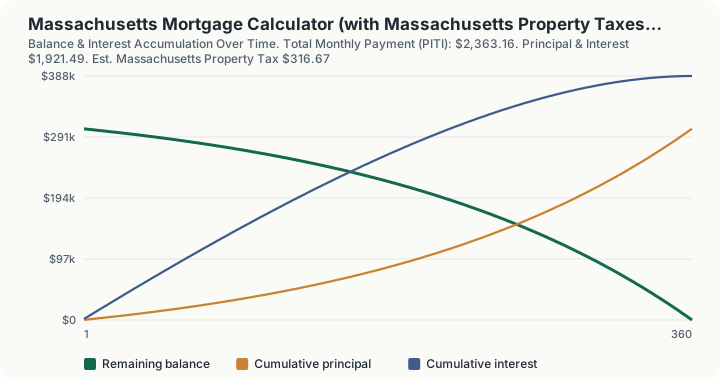
Quick Answer: On a $380,000 home with 20% down and a 6.5% rate, this calculator produces a total monthly payment (PITI) of roughly $2,363, combining $1,921.49 in principal and interest with $316.67 in estimated Massachusetts property tax and a $125 insurance placeholder.
Overview
Massachusetts property tax bills are set locally, not by the state, and they vary enormously from town to town. This calculator uses a 1.00% effective rate, a figure close to the statewide average effective rate reported for owner-occupied homes, to estimate the monthly tax escrow that gets bundled into a typical mortgage payment. Actual bills in Boston, Cambridge, or a Berkshires town can run meaningfully above or below that average depending on the municipality's tax rate and any residential exemption the town offers.
The calculator's job is to take a home price, a down payment percentage, and an interest rate, then produce a full PITI (principal, interest, taxes, insurance) figure using a standard 30-year fixed amortization schedule. Massachusetts also caps how fast a city or town's total property tax levy can grow year over year under Proposition 2½, which limits the annual increase in a municipality's overall tax levy to 2.5% plus new growth, unless voters approve an override. That structural limit is why Massachusetts effective rates tend to be relatively stable compared to states without such a cap, even though home values have risen sharply.
This tool is aimed at prospective buyers comparing towns, testing how a smaller down payment changes monthly cash flow, or estimating what a higher purchase price would do to the total payment. It uses a flat statewide average for both the tax rate and the $125 insurance estimate, so anyone shopping in a specific municipality should still pull that town's actual tax rate from its assessor's office before finalizing a budget.
How This Is Calculated
- Down payment and loan principal. The down payment percentage is applied to the home price, and the remainder becomes the loan principal:
loanPrincipal = homePrice × (1 − downPaymentPercent). - Principal and interest. The loan principal is amortized over 360 months (30 years) at the entered annual rate using the standard fixed-payment formula:
where $P$ is the loan principal, $r$ is the monthly rate (annual rate divided by 12), and $n$ is 360 months.
- Property tax escrow. Monthly property tax is estimated as
homePrice × 1.00% ÷ 12, using Massachusetts's approximate statewide effective tax rate on the full purchase price. - Insurance. A flat $125 monthly homeowners insurance placeholder is added.
- Total PITI. The four components (principal, interest combined as one payment, tax, and insurance) are summed into a single monthly figure.
Worked Example
Using the calculator's default inputs:
- Home price: $380,000.00
- Down payment: 20%
- Interest rate: 6.5%
Down payment and principal: $380,000.00 × 20% = $76,000.00 down; loan principal = $380,000.00 − $76,000.00 = $304,000.00.
Principal and interest: amortizing $304,000.00 over 360 months at 6.5% APR (monthly rate 0.541667%) produces a payment of $1,921.49. Total interest paid over the full 30-year term comes to approximately $387,733.
Property tax: $380,000.00 × 1.00% ÷ 12 = $316.67 per month.
Insurance: $125.00 per month (flat estimate).
Total PITI: $1,921.49 + $316.67 + $125.00 = $2,363.16 per month.
What This Does Not Account For
- Municipal tax rate variation. Massachusetts has over 350 cities and towns, each setting its own tax rate. Some communities run well under 0.8% effective rate while others, particularly in central and western Massachusetts, run closer to 1.5%. The 1.00% figure used here is a statewide approximation, not a town-specific number.
- Residential and other local exemptions. Many Massachusetts municipalities offer a residential exemption that shifts tax burden away from owner-occupied homes toward second homes, rentals, and commercial property; this calculator does not model that shift.
- Private mortgage insurance (PMI). At 20% down, PMI typically is not required, but the calculator does not add PMI for lower down payment scenarios like the built-in 5% down toggle, which would understate the true monthly payment for that scenario.
- Massachusetts deed excise tax and closing costs. The one-time state and county deed stamp tax (commonly $4.56 per $1,000 of sale price in most counties, with a separate rate in Barnstable County), attorney fees, and other closing costs are not part of this recurring monthly calculation.
- Homeowners association dues, flood insurance, or private well and septic costs, all of which are common in parts of Massachusetts and can add materially to monthly housing costs.
Common Pitfalls
- Budgeting off a statewide average tax rate instead of the actual town rate. Because Massachusetts rates vary so widely by municipality, use this calculator for a first pass, then confirm the real number with the target town's assessor before making an offer.
- Forgetting that Proposition 2½ limits levy growth, not individual bills. An individual homeowner's bill can still rise faster than 2.5% in a given year if the home's assessed value increases relative to the rest of the town, even though the town's total levy is capped.
- Assuming the $125 insurance estimate matches coastal or flood-zone premiums. Massachusetts coastal properties, especially on Cape Cod and the Islands, often carry substantially higher homeowners and wind/hail insurance costs than this flat placeholder reflects.
- Comparing 20%-down and 5%-down scenarios without adding PMI. The built-in low-down-payment scenario toggle changes the loan principal but does not layer in private mortgage insurance, so the comparison undersells the true cost difference.
- Ignoring closing costs when budgeting total cash needed. The monthly PITI figure says nothing about the deed excise tax, attorney fees, or points due at closing, all of which require separate cash on hand.
Frequently Asked Questions
What property tax rate does this Massachusetts mortgage calculator use?
Does Proposition 2½ affect what I'll actually pay?
Why is my calculated payment different from what a lender quotes me?
Is mortgage insurance included in this calculation?
How much does a 25% higher home price change my monthly payment?
Sources
- Massachusetts Department of Revenue, Division of Local Services: Municipal Databank, property tax rates by city and town. mass.gov/orgs/massachusetts-department-of-revenue
- Consumer Financial Protection Bureau (CFPB): TILA-RESPA Integrated Disclosure (TRID) rules for mortgage cost disclosure. consumerfinance.gov
- Consumer Financial Protection Bureau, Buying a house. consumerfinance.gov/owning-a-home
Also consulted: Massachusetts General Laws, Chapter 59, Section 21C: Proposition 2½ levy limit statute; Massachusetts Department of Revenue: Deed excise tax guidance, M.G.L. Chapter 64D.