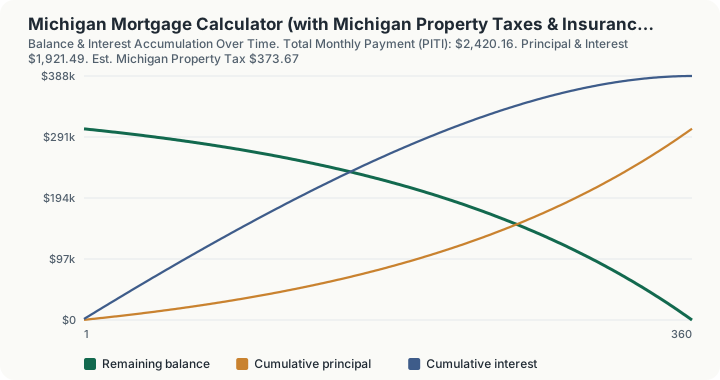
Quick Answer: On a $380,000 home with 20% down and a 6.5% rate, this calculator produces a total monthly payment (PITI) of roughly $2,420, combining $1,921.49 in principal and interest with $373.67 in estimated Michigan property tax and a $125 insurance placeholder.
Overview
Michigan's property tax system is built around a concept that trips up a lot of first-time buyers: the taxable value of a home is not the same as its market value. Under Michigan's Headlee Amendment and Proposal A rules, a property's taxable value can only rise by the rate of inflation or 5%, whichever is lower, each year a home is not sold, even if the market value climbs faster. When a home sells, though, the taxable value resets ("uncaps") to the new state equalized value, which is roughly half of true cash value. That reset is a major reason a buyer's first full-year tax bill on a newly purchased Michigan home is often noticeably higher than what the seller had been paying.
This calculator uses a 1.18% effective property tax rate, applied directly to the purchase price, which approximates Michigan's statewide average effective rate for owner-occupied homes, above the national average of roughly 0.89% but middle of the pack among Midwest states, below Illinois, Nebraska, Iowa, Kansas, Wisconsin, and Ohio. Michigan homeowners who occupy their home as a primary residence can also claim a Principal Residence Exemption (PRE), which removes the local school operating millage (up to 18 mills) from an owner-occupied home's tax bill. This calculator's flat 1.18% figure is meant to approximate an owner-occupied effective rate broadly, but it does not separately model the PRE, so actual bills for homestead-exempt properties may differ from town to town.
The tool combines a 30-year fixed amortization schedule for principal and interest with the estimated property tax escrow and a flat insurance placeholder, giving a single monthly PITI figure that buyers can use to compare home prices, down payment sizes, and interest rate scenarios.
How This Is Calculated
- Down payment and loan principal.
loanPrincipal = homePrice × (1 − downPaymentPercent). - Principal and interest. The principal is amortized over 360 months at the entered annual rate:
where $P$ is the loan principal, $r$ is the monthly interest rate, and $n$ is 360 months.
- Property tax escrow.
monthlyTax = homePrice × 1.18% ÷ 12, applying Michigan's approximate statewide effective rate to the purchase price. - Insurance. A flat $125 monthly placeholder.
- Total PITI. All four components are summed.
Worked Example
Using the calculator's default inputs:
- Home price: $380,000.00
- Down payment: 20%
- Interest rate: 6.5%
Down payment and principal: $380,000.00 × 20% = $76,000.00 down; loan principal = $304,000.00.
Principal and interest: amortizing $304,000.00 over 360 months at 6.5% APR gives a payment of $1,921.49, with total interest over the full term of approximately $387,733.
Property tax: $380,000.00 × 1.18% ÷ 12 = $373.67 per month.
Insurance: $125.00 per month.
Total PITI: $1,921.49 + $373.67 + $125.00 = $2,420.16 per month.
What This Does Not Account For
- Taxable value uncapping at sale. Michigan resets a property's taxable value to its state equalized value (roughly half of true cash value) when ownership transfers, which frequently produces a higher tax bill in the buyer's first year than the prior owner paid. This calculator applies a flat 1.18% to the purchase price and does not model the multi-year cap-then-uncap cycle that follows.
- The Principal Residence Exemption (PRE). Owner-occupants who file a PRE affidavit avoid the local school operating millage, which can meaningfully lower the effective rate versus a non-homestead or rental property. This calculator's 1.18% figure is a statewide blended approximation and does not separately break out the homestead-exempt rate.
- Local millage variation. Michigan property tax rates are set by a combination of county, township or city, school district, and special authority millages that vary block by block; the statewide average used here will not match every municipality.
- Private mortgage insurance (PMI). At 20% down, PMI is typically not required, but the calculator does not add it for the lower-down-payment scenario toggle.
- Michigan transfer taxes and closing costs. The state real estate transfer tax ($3.75 per $500 of value) plus any county transfer tax, title insurance, and attorney or closing agent fees are one-time costs not reflected in this recurring monthly figure.
Common Pitfalls
- Budgeting off the seller's current tax bill instead of the post-sale uncapped value. Because Michigan taxable value resets at sale, a buyer who assumes their tax bill will match the seller's prior bill is often underbudgeting significantly.
- Forgetting to file for the Principal Residence Exemption. New owner-occupants who miss the PRE filing deadline can end up paying the higher non-homestead rate, including the local school operating millage, until the exemption is properly filed.
- Treating the statewide 1.18% average as a specific city's rate. Detroit, Ann Arbor, and rural townships can have very different total millage rates; always confirm the local rate with the county or township assessor before finalizing a budget.
- Ignoring PMI on the 5%-down comparison scenario. The built-in low-down-payment toggle changes the loan principal but does not add mortgage insurance, understating the true monthly cost difference between 20% and 5% down.
- Not budgeting separately for the state real estate transfer tax at closing. This one-time cost at closing is not part of the recurring monthly PITI figure this calculator produces.
Frequently Asked Questions
Why might my Michigan property tax bill jump after I buy a home?
What is the Principal Residence Exemption and does this calculator include it?
Does this calculator include Michigan's real estate transfer tax?
Is mortgage insurance included in the payment shown?
How much of my payment is interest versus principal in the first year?
Sources
- Michigan Department of Treasury: Property Tax, Proposal A, and taxable value uncapping guidance. michigan.gov/treasury
- Consumer Financial Protection Bureau (CFPB): TILA-RESPA Integrated Disclosure (TRID) rules for mortgage cost disclosure. consumerfinance.gov
- Consumer Financial Protection Bureau, Buying a house. consumerfinance.gov/owning-a-home
Also consulted: State of Michigan: Principal Residence Exemption (PRE) guidelines, MCL 211.7cc; Michigan Department of Treasury: State Real Estate Transfer Tax Act, MCL 207.523.