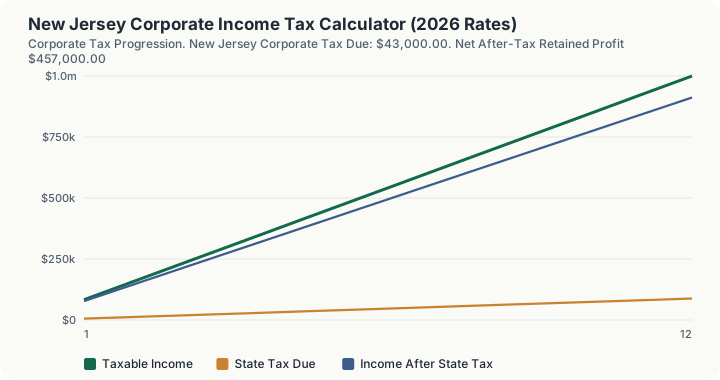
Quick Answer: On $500,000 of pre-apportioned taxable income, New Jersey's graduated corporate income tax brackets (reaching 9.00% at this income level) produce $43,000.00 in state tax due and $457,000.00 in net after-tax profit.
Four Rates, Three Edges
New Jersey is the one state in this family where the sweep genuinely bends. The calculator walks four bands, 6.50% to $50,000, 7.50% to $100,000, 9.00% to $10,000,000 and 11.50% above that, taxing each slice at its own rate rather than applying one rate to the whole base.
That produces the split between the two rate outputs that a flat state never shows. At the $500,000 baseline the marginal rate is 9.00% but the effective rate is 8.60%, because the first $50,000 was taxed at 6.50% and the next $50,000 at 7.50%. The discount is worth $2,000.00 in cash: $43,000.00 of tax rather than the $45,000.00 that a flat 9.00% on $500,000 would produce.
The discount shrinks as the base grows, which the tier schedule shows directly. Row 1 sits at $83,333.33 of income and $5,750.00 of tax, an effective 6.90%. Row 12 sits at $1,000,000 and $88,000.00, an effective 8.80%. Same schedule, same rates, converging on 9.00% from below.
How This Is Calculated
The calculator walks your entered income through the bracket array, sums the tax due in each band, subtracts your entered credits, and floors the result at zero.
where $c_i$ are the bracket ceilings ($50{,}000$, $100{,}000$, $10{,}000{,}000$, then unlimited) and $r_i$ the corresponding rates ($6.50\%$, $7.50\%$, $9.00\%$, $11.50\%$).
- Read the apportioned entire net income you entered. It is treated as already apportioned to New Jersey and already net of state addbacks and post-allocation NOL carryforwards.
- Walk the four bands. For each band the calculator takes the portion of your income that falls inside it and multiplies by that band's rate.
- Record the top band reached as the marginal rate output.
- Sum the four band amounts into the gross tax.
- Subtract the entered credits and floor at zero.
- Divide net tax by income for the effective rate, which sits below the marginal rate whenever more than one band is in play.
- Build the twelve-row tier schedule, re-running the whole walk on your income times the row number over six, so each row's effective rate differs.
Worked Example
Using this calculator's baseline scenario: a corporation with $500,000 in taxable income apportioned to New Jersey.
- Start with apportioned taxable income. $500,000 of entire net income before state tax.
- Fill the first band. The first $50,000 is taxed at 6.50%, which on its own produces $3,250.00 of tax at that income level.
- Fill the second band. Income from $50,000 to $100,000 is taxed at 7.50%, bringing the running total at $100,000 to $7,000.00.
- Fill the third band. The remaining $400,000 up to the $10,000,000 ceiling is taxed at 9.00%.
- Marginal rate reached: 9.00%. Effective rate: 8.60%.
- New Jersey corporate tax due: $43,000.00.
- Net retained profit. $500,000 - $43,000.00 = $457,000.00, before any separate federal liability.
Walking All Three New Jersey Bracket Edges
Each of the three edges is a change in slope, not a cliff, and the calculator prices each one the same way.
The $50,000 edge. At $49,900 of apportioned income the tax is $3,243.50, an effective 6.50%. At $50,100 it is $3,257.50, and the marginal rate output flips from 6.50% to 7.50%. Two hundred dollars of income cost $14.00 across the edge, against the $13.00 the same $200 would have cost entirely inside the first band. The step is worth $1.00.
The $100,000 edge. At $99,900 the tax is $6,992.50, effective 7.00%, marginal 7.50%. At $100,100 it is $7,009.00, and the marginal rate jumps to 9.00%. The same $200 of income now costs $16.50, and the effective rate has not moved off 7.00% because the change applies only to the slice above the line.
The $10,000,000 edge. At $9,999,000 the tax is $897,910.00 at a 9.00% marginal rate. At $10,001,000 it is $898,115.00 and the marginal rate becomes 11.50%. Exactly $10,000,000 produces $898,000.00. Note what the effective rate does across that edge: nothing visible. It reads 8.98% on both sides, because $2,000 of income taxed at a higher rate is invisible against a base of ten million.
Each additional $1,000 of income costs $65.00 in the first band, $75.00 in the second, $90.00 in the third and $115.00 in the fourth. At the $500,000 baseline the applicable figure is $90.00: raising income to $501,000 moves the tax from $43,000.00 to $43,090.00.
The reverse question: how much income can be apportioned to New Jersey before the tax reaches $10,000? At $133,333 the tax is $9,999.97, and at $133,334 it is $10,000.06. That point sits inside the 9.00% band, well past both lower edges.
The credit floor. Credits come off after the bracket walk and are floored at zero. At $42,999 of entered credits the tax is $1.00; at $43,000 it is $0.00; a further dollar of credit is discarded, with no carryforward and no output telling you it was wasted.
What This Does Not Account For
- The minimum tax is not applied. New Jersey floors liability by reference to New Jersey gross receipts rather than income, and this calculator floors at $0.00, so a loss year or a fully credited year shows nothing where a minimum is due.
- The bracket walk is marginal throughout. Every dollar is taxed only at the rate of the band it falls in, including across the $10,000,000 edge, which is why $10,001,000 of income produces $898,115.00 rather than a whole-base recomputation.
- No apportionment is performed. The single sales factor with market-based sourcing and mandatory unitary combined reporting on a water's-edge basis all determine the number you type in.
- No addbacks or NOL usage are computed, including the related-party interest and intangible expense addbacks and the state's percentage limitation on annual NOL usage.
- Credits are taken at face value, with no eligibility test, cap, ordering rule or carryforward.
- Federal corporate income tax (21% under IRC § 11) is separate and not included.
- BEAT and GILTI provisions under the federal international regime are not reflected.
Common Pitfalls
- Applying the 9.00% marginal rate to the whole base. That produces $45,000.00 on $500,000 against the correct $43,000.00, a $2,000.00 overstatement, and the gap is the same in dollars at every income above $100,000.
- Expecting a visible jump at $10,000,000. The effective rate reads 8.98% on both sides of the line, and the marginal rate output is the only thing that moves.
- Entering worldwide income rather than the New Jersey share. At the baseline each $1,000 of over-entry costs $90.00.
- Reading $0.00 as nothing due. New Jersey's receipts-based minimum tax sits outside this model entirely.
Frequently Asked Questions
What are New Jersey's corporate tax brackets?
What does crossing $100,000 of New Jersey income cost?
Why is my effective rate lower than 9.00%?
How much income before New Jersey tax reaches $10,000?
Does this include the New Jersey minimum tax?
Sources
- New Jersey Division of Taxation: Corporation Business Tax Statutes and Guidance (2026). nj.gov/treasury/taxation
- Multistate Tax Commission (MTC): Uniform Apportionment and Allocation Guidelines. mtc.gov