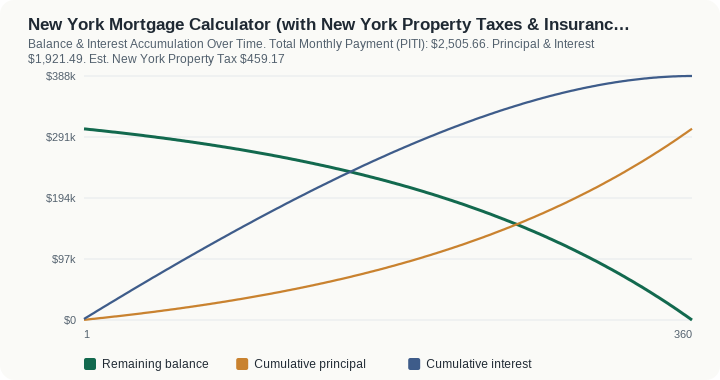
Quick Answer: A $380,000 New York home with 20% down at 6.5% costs about $2,530.74 a month once principal, interest, an estimated 1.45% property tax rate, and $150.08 of average New York homeowners insurance are added together.
What a mortgage payment in New York looks like at the defaults
This New York mortgage calculator starts from a $380,000 purchase, $76,000 down and a 6.5% rate on a 30-year loan. The $304,000 balance costs $1,921.49 a month in principal and interest. On top of that sits $459.17 of property tax and a $150.08 insurance line, for $2,530.74. Tax alone is 18.14% of the bill, close to one dollar in five, while insurance is 5.93%.
Run on those identical inputs in every state, New York lands sixth from the top of 50. Illinois, New Jersey, Connecticut, Texas and Nebraska are the only five that come out higher, and New Hampshire, whose tax line is actually $3.16 heavier than New York's, trails by $38.59 a month because its average premium is far lower. The 1.45% rate is the Census Bureau's 2024 American Community Survey ratio of New York's median real estate taxes paid to its median home value. Compared with 0.89%, which is the unweighted mean of the 50 state ratios rather than a national average, New York's tax line runs $178.03 a month higher at $380,000.
A year of tax at the default price is $380,000 x 1.45% = $5,510. Because the tool holds that figure fixed for all 360 months, the loan's lifetime carries $165,300 of property tax next to $387,732.82 of interest. Detailed assessment rules, STAR and bill schedules sit on the New York property tax calculator.
New York prices, and where tax overtakes insurance
The Census median value for an owner-occupied New York home is $449,800. Financed at 20% down and 6.5%, that price produces $2,274.43 of principal and interest, $543.51 of tax and $2,968.02 in all. Annual tax there works out to $6,522.10.
Some other points on the curve:
- $250,000: $1,264.14 of P&I, $302.08 of tax, $1,716.30 total.
- $600,000: $3,033.93 of P&I, $725 of tax, $3,909.01 total.
- $750,000: $3,792.41 of P&I, $906.25 of tax, $4,848.74 total, with $10,875 of tax a year.
At 1.45%, the monthly tax passes the $150.08 insurance line once the price clears about $124,204. Almost any New York purchase is therefore well past that point, and at $750,000 the tax line is more than six times the insurance figure.
Down payment and rate sensitivity
Holding the $380,000 price and the 6.5% rate:
| Down payment | Loan | Monthly total |
|---|---|---|
| 0% | $380,000 | $3,011.11 |
| 5% | $361,000 | $2,891.02 |
| 10% | $342,000 | $2,770.92 |
| 20% | $304,000 | $2,530.74 |
The tax line stays at $459.17 and insurance at $150.08 in every row because the tool taxes the price, not the loan, and the premium is fixed. A 3% down purchase at $300,000 borrows $291,000 and comes to $2,351.90 a month. No private mortgage insurance is added at any down payment, so every figure under 20% down understates a conventional loan's real cost.
Rate moves hit the P&I line only. At 6% the default total is $2,431.88; at 7% it is $2,631.77. Dropping all the way to 5.5% gives $2,335.33 and trims lifetime interest to $317,387.69. The built-in higher-price case, $475,000 with 20% down, totals $3,125.90, with $6,887.50 of tax a year.
How is this calculated?
Three numbers go in: price, down payment percent and rate. The loan is price minus the down payment. That balance is amortized over 360 months at the annual rate divided by 12. Interest is rounded to the cent each month, so the final installment in the schedule may not match the other 359 exactly. Monthly tax is price x 1.45% / 12. Insurance is $150.08, which is the $1,801 a year that NAIC's homeowners report shows for the average New York HO-3 policy in data year 2023, divided by 12. That statewide mean, 17th highest of the 50 states and $64 above the $1,737 countrywide figure, covers homes of every value, so it is not a quote and it stays the same at any price. The total is the sum of the three. Nothing escalates over time: the tax and insurance lines on month 360 match month 1.
Worked Example
Take a buyer looking at a house priced at the state median, $449,800, with 20% down at 6.5%.
- Down payment: $449,800 x 20% = $89,960.
- Loan: $449,800 minus $89,960 = $359,840.
- Principal and interest from compute(): $2,274.43.
- Annual tax: $449,800 x 1.45% = $6,522.10, so $543.51 a month.
- Insurance: $150.08.
- Total: $2,968.02 a month, with $458,958.85 of interest over the full term.
The mortgage recording tax: a New York closing cost on the loan itself
New York taxes the act of recording a mortgage, separate from the transfer tax on the deed. The Department of Taxation and Finance lists a basic tax of 50 cents per $100 of debt, a special additional tax of 25 cents, and an additional tax of 25 cents, or 30 cents in counties within the Metropolitan Commuter Transportation District. When the property is a one- or two-family home, the first $10,000 of the debt is deducted before the additional tax is computed. New York City, Yonkers and some counties stack a local tax of 25 to 50 cents per $100 on top.
Worked from those statutory rates for the default $304,000 loan in a county outside the commuter district with no local levy: $1,520 basic, $760 special additional and $735 additional on $294,000, or $3,015. In a commuter-district county the additional piece becomes $882, for $3,162 before any city or county tax. Form MT-15 lists the rate in force for each jurisdiction. None of this is in the monthly figure, since it is paid once at closing.
Deed transfer taxes, including the mansion tax, are handled on the New York real estate transfer tax calculator.
Foreclosure, escrow interest and state-backed loans
New York forecloses through the courts. Article 13 of the Real Property Actions and Proceedings Law governs the action to foreclose, and RPAPL 1304 requires a lender to send the borrower notice at least ninety days before starting one on a home loan. Once the case is filed, CPLR 3408 sets a mandatory settlement conference, held within sixty days after proof of service is filed, when the borrower lives in the home. Both sides must negotiate in good faith over options such as a modification or short sale.
Escrow money earns interest here. Banking Law 14-b requires interest on escrow accounts for owner-occupied one-to-six family homes, condominiums included, at a minimum rate the Superintendent of Financial Services sets by regulation. The tax and insurance you prepay each month is not dead money in New York, though the rate is small.
The State of New York Mortgage Agency (SONYMA) runs 30-year fixed programs aimed at first-time buyers: Achieving the Dream for lower-income buyers, the Low Interest Rate program, and a Down Payment Assistance Loan carrying 0% interest that can be added to any SONYMA mortgage. A SONYMA rate can be entered in the rate box to see how it changes the total.
What does this calculator not account for?
- Your town's actual levy. One statewide ratio stands in for every county, town, village and school district.
- Mortgage recording tax and transfer taxes. Both are one-time closing costs.
- PMI. Never added, even at 0% down.
- Co-op maintenance and condo common charges. These can exceed the mortgage itself in New York City and are not modelled.
- Your actual insurance quote. The $150.08 is a statewide NAIC average, so it does not reflect your county, coastal wind exposure on Long Island, construction, deductible, claims history or coverage amount, and it excludes flood cover.
- Changes after closing. Tax and insurance never move in this model.
What mistakes do people make with this?
- Treating $3,015 of recording tax as the whole story. Local city or county mortgage taxes can add up to 50 cents per $100, which is another $1,520 on a $304,000 loan in the highest-rate places.
- Expecting a co-op loan to work like this. Co-op buyers finance shares under a proprietary lease, and their monthly cost includes building maintenance that this tool cannot see.
- Reading sixth place as a fixed verdict. The rank uses identical inputs everywhere; New York's median home value is higher than most states', so actual buyers here often face larger loans as well.
- Ignoring the ninety-day notice if payments slip. A borrower who receives an RPAPL 1304 notice still has time to contact a housing counselor before any case is filed.
- Comparing quotes with different escrow treatment. Some lender estimates include escrow interest or local taxes; this one does not.
Frequently Asked Questions
Why does New York rank sixth when its rate is 1.45%?
Does the mortgage recording tax change my monthly payment?
How much is the recording tax on a $600,000 home with 20% down?
Is a 5% down payment much more expensive per month?
Can I model a SONYMA loan?
Sources
- Census Bureau ACS 2024 for New York: median real estate taxes paid (B25103) over median value (B25077). data.census.gov
- NAIC, Homeowners Insurance Report, data for 2023 (Table 4, HO-3 average premium, New York). content.naic.org/sites/default/files/publication-hmr-zu-homeowners-report.pdf
- New York State Department of Taxation and Finance, Mortgage Recording Taxes. tax.ny.gov/pit/mortgage/mtgidx.htm
- New York State Senate, RPAPL 1304, notice prior to foreclosure. nysenate.gov/legislation/laws/RPA/1304
- New York State Senate, RPAPL 1301, action to foreclose a mortgage. nysenate.gov/legislation/laws/RPA/1301
- New York State Senate, CPLR 3408, mandatory settlement conference. nysenate.gov/legislation/laws/CVP/3408
- New York State Senate, Banking Law 14-b, interest on escrow accounts. nysenate.gov/legislation/laws/BNK/14-B
- New York State Homes and Community Renewal, SONYMA homebuyer programs. hcr.ny.gov/sonyma