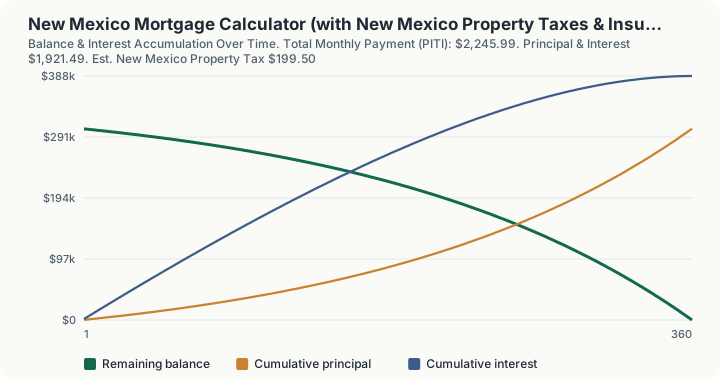
Quick Answer: A $380,000 home in New Mexico with 20% down at 6.5% costs about $2,246 a month, with property tax adding just $199.50 of that thanks to one of the lower effective rates in the country.
Overview
New Mexico's property tax system produces one of the more homeowner-friendly effective rates in the country, landing at about 0.63% of market value statewide, noticeably below the roughly 0.89% national average. Two structural features drive that outcome. First, New Mexico taxes property based on a fraction of full assessed value rather than full market value for the levy calculation, effectively discounting the base against which the mill rate applies. Second, a statutory cap limits how much the taxable value of an owner-occupied residence can increase in a single year, generally capped at 3% annually, which keeps bills from spiking even in a fast-appreciating housing market.
New Mexico also offers direct exemptions that reduce a homeowner's taxable value further: a standard head-of-family exemption available to any qualifying owner-occupied residence, and a larger exemption for qualifying disabled veterans, both of which subtract a fixed dollar amount from assessed value before the tax rate is applied. Neither exemption is built into this calculator's baseline estimate, since eligibility depends on the buyer's specific circumstances rather than the home price alone.
This calculator models a standard 30-year fixed mortgage combined with a statewide blended property tax estimate of 0.63% and a placeholder insurance cost, producing a full monthly PITI (Principal, Interest, Taxes, and Insurance) figure along with a complete amortization table.
How This Is Calculated
- Down payment and loan principal. The chosen down payment percentage applies to the home price; the remainder becomes the financed loan principal.
- Monthly principal and interest. Loan principal, annual rate, and a 360-month term run through a standard fixed-rate amortization formula, producing a level monthly payment split between interest on the remaining balance and principal reduction.
- New Mexico property tax estimate. Home price is multiplied by an assumed 0.63% effective annual rate and divided by 12 for a monthly escrow figure, reflecting a statewide blended average across county mill levies; specific counties, particularly those with higher school district budgets, can run above or below this figure.
- Homeowners insurance estimate. A flat $125 monthly placeholder represents a typical policy; wildfire risk in specific New Mexico counties can push actual premiums higher than this baseline.
- Total monthly payment (PITI). Principal and interest, property tax, and insurance sum into one headline figure, with a full 360-payment amortization schedule tracking the balance to zero.
Worked Example
Using the calculator's baseline inputs: a $380,000 home, 20% down, and a 6.5% rate on a 30-year fixed loan.
- Down payment: $380,000 × 20% = $76,000
- Loan principal: $380,000 − $76,000 = $304,000
- Monthly principal and interest: $1,921.49
- Estimated New Mexico property tax: $380,000 × 0.63% ÷ 12 = $199.50 per month ($2,394 per year)
- Estimated insurance: $125.00 per month
- Total monthly payment (PITI): $2,245.99
- Total interest paid over 30 years: approximately $387,733
Compare that $199.50 monthly tax line to the same $380,000 home priced under New Jersey's 1.89% assumption, where the tax line runs $598.50, three times New Mexico's figure. A qualifying head-of-family or veteran exemption would reduce New Mexico's already modest bill further, an advantage not reflected in the baseline number shown here.
What This Does Not Account For
- County mill levy variation. The 0.63% figure is a statewide blend; Santa Fe, Bernalillo (Albuquerque), and smaller rural counties each set their own combined county, school, and municipal mill levies that can differ from the average.
- The head-of-family and veteran exemptions. These reduce taxable assessed value by a fixed dollar amount for qualifying owner-occupied homes but depend on the buyer's individual eligibility, not the home price, and are not built into this baseline estimate.
- The 3% annual assessed value increase cap's long-term effect. Like similar caps in other states, this can create a gap between a home's taxable value and its market value over time, especially for long-term owners, a dynamic this calculator's flat-rate model does not project forward.
- Private mortgage insurance (PMI). Any down payment under 20% typically triggers PMI on a conventional loan, not included in this baseline estimate.
- Wildfire and flood insurance riders, which can raise actual premiums above the flat $125 monthly placeholder in higher-risk New Mexico counties.
Common Pitfalls
- Assuming the statewide 0.63% average applies to every county. Some New Mexico counties, particularly those with larger school district budgets relative to their tax base, run above the statewide average used here.
- Forgetting to apply for the head-of-family or veteran exemption. These are not automatic; eligible homeowners must file the appropriate paperwork with their county assessor to receive the reduction.
- Confusing the assessed value cap with a tax rate cap. The 3% cap limits how fast taxable value rises, not the tax rate itself, and a bill can still increase from local mill rate changes even when the assessed value cap is in effect.
- Ignoring PMI in the 5% down scenario, which understates the real monthly obligation on a low-down-payment purchase.
- Underestimating wildfire insurance costs in higher-risk counties, where actual premiums can run well above the flat placeholder used in this baseline estimate.
Frequently Asked Questions
Why is New Mexico's effective property tax rate lower than most states?
What is the head-of-family exemption and does this calculator include it?
Do veterans get an additional property tax break in New Mexico?
Does this calculator reflect Bernalillo County's or Santa Fe County's specific rate?
How does a larger down payment affect my New Mexico property tax bill?
Sources
- New Mexico Taxation and Revenue Department, Property Tax Division, statewide rate and exemption publications. tax.newmexico.gov
- Consumer Financial Protection Bureau, Owning a Home resource center. consumerfinance.gov
- U.S. Census Bureau, American Community Survey, median property tax and home value estimates by state. census.gov/programs-surveys/acs
Also consulted: New Mexico Department of Veterans Services, property tax exemption eligibility guidance.