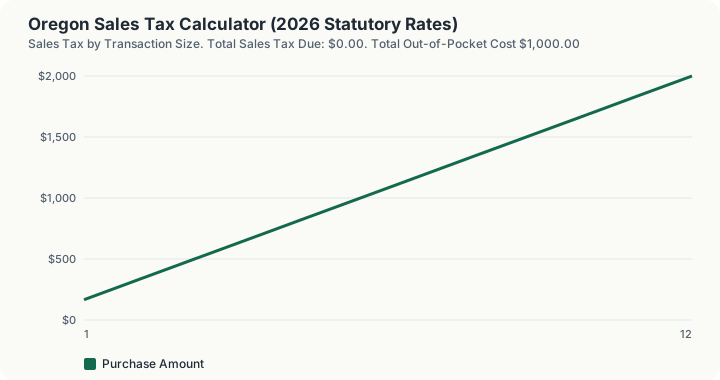
Quick Answer: A $1,000 purchase in Oregon incurs $0.00 in state sales tax and costs $1,000.00 out the door before tax, since Oregon is one of the five NOMAD states and does not levy a statewide general sales tax.
One Of Five States With No Sales Tax
Oregon does not levy a statewide general sales tax, and Oregon cities and counties are likewise barred from imposing their own general sales tax on retail purchases. The 0.00% rate applies uniformly across the entire state.
The absence of a sales tax is one of the more visible features of Oregon's tax code and a frequent draw for shoppers from neighboring Washington, where the combined state and local rate runs well into the high single digits. Oregon still taxes specific categories through narrower mechanisms, such as its transient lodging tax on hotel stays, but general retail purchases of tangible goods pass through tax-free at the register.
Oregon leans instead on a personal income tax to fund state government, a tradeoff that shows up in how the state's overall tax burden compares to sales-tax states rather than in the retail price tag itself. For border-town retailers in cities like Portland, that 0.00% rate is a standing draw for out-of-state shoppers willing to make the trip specifically to avoid sales tax on larger purchases.
How This Is Calculated
Oregon has no general sales tax and no local sales taxes, so a $1,000 purchase costs $1,000 and this calculator returns zero. Oregon does levy a vehicle privilege tax on dealer sales of new vehicles, which functions like a narrow sales tax on one category, and a handful of cities impose taxes on prepared food or marijuana. None of that is a general retail sales tax, and none of it applies to ordinary merchandise, which is why Oregon is a common destination for large purchases made by residents of neighboring Washington.
Both rate terms are zero, so the general form returns zero:
The calculator still walks the sequence:
- Read the purchase price. The full pre-tax amount you enter becomes the taxable base.
- No item-level exemption filtering. There is no general sales tax base in Oregon to filter or exempt from.
- Multiply by the state rate. This produces the state portion of the bill.
- Apply the local surcharge. Oregon localities do not levy general sales taxes, so this term is zero and the local toggle changes nothing.
- Add the pieces together. State tax plus local tax gives the total tax, and adding that to the purchase price gives the amount you actually pay.
Worked Example
For a $1,000 retail purchase in Oregon:
- Starting purchase price. The buyer rings up a $1,000.00 taxable retail purchase in Oregon, the baseline amount before any tax consideration.
- State statutory rate applied. Oregon is one of the five NOMAD states (alongside the other four with no general sales tax), so its state sales tax rate is 0.00%: $1,000.00 × 0.00% = $0.00 in state tax owed.
- No state tax due. Because the statutory rate is zero, the state sales tax line item is $0.00 regardless of the purchase amount, whether it is $10 or $10,000.
- Total out-of-pocket cost. With no state sales tax added, the buyer's total out-of-pocket cost equals the original purchase price: $1,000.00.
This example reflects only the statewide rate. Some localities within Oregon may still impose limited local option or municipal taxes on specific purchases, so a shopper's actual receipt total can differ slightly from the $1,000.00 shown here depending on where the purchase takes place.
Proving The Zero, And Naming What It Leaves Out
Every device on the other forty-five state pages in this family needs a rate to work on. Oregon has none, so the useful walk here is the one that proves the zero and then names precisely what it does not cover.
The sweep returns nothing at every amount. At $1,000.00 the tax is $0.00 and the total out-of-pocket cost is $1,000.00. At $35,000.00, a figure chosen because it is a typical new car, the tax is $0.00 and the total is $35,000.00. The combined rate output reads 0.00% and the state rate output reads 0.00%. The twelve-row sweep, which on any other page in this family separates a state column from a local column, shows $0.00 in both columns on all twelve rows.
The marginal cost of the next unit is $0.00. Each additional $100.00 of taxable spending adds nothing. There is no purchase amount anywhere in this calculator's accepted range, from one cent to ten million dollars, at which the Oregon sales tax becomes a positive number.
The local surcharge toggle is inert. On every other page in this family, switching the average local surcharge off changes the answer. Here it does not: with the toggle on, a $1,000.00 purchase costs $0.00 in tax; with it off, the same purchase costs $0.00. Oregon's table entry carries a state rate of 0 and an average local rate of 0, so both branches of the calculation return the same figure.
The reverse question answers itself. A $1,000.00 out-the-door budget buys $1,000.00 of goods in Oregon. On the neighbouring Washington page the same budget buys materially less, which is why the Oregon border is one of the most heavily shopped retail corridors in the country. This page cannot compute the other side of that border, and it will not tell a Washington resident that their home state expects use tax on goods carried back.
Right method against wrong method. The error Oregon invites is treating $0.00 as the whole story on a large purchase. Oregon levies a vehicle privilege tax on the retail sale of new vehicles and a corresponding vehicle use tax on vehicles bought outside the state, a bicycle excise tax on new adult bicycles, and local transient lodging taxes on accommodation. None of those appear in any figure above. A $35,000.00 new car shows $0.00 here and carries a real Oregon privilege tax liability that this calculator does not compute.
What the zero also hides. Oregon funds itself through the income tax instead, and the Corporate Activity Tax reaches commercial activity above a statutory threshold at the business level, with the cost frequently passed into shelf prices that no line on this page separates out. The $0.00 is an accurate statement about Oregon's general retail sales tax and about nothing else.
What This Does Not Account For
- Statutory exemptions on unprepared groceries, prescription medications, or manufacturing equipment.
- Special industry excise taxes (lodging hotel taxes, vehicle rental fees, alcohol/tobacco excise).
- Use tax compliance on out-of-state untaxed online purchases.
- B2B resale certificate exemptions or direct pay permit programs.
Common Pitfalls
- Confusing State and Combined Rates: Quoting the state base rate without factoring in local city and county add-on taxes.
- Overlooking Consumer Use Tax: Failing to self-report and remit use tax on untaxed out-of-state purchases on your state income tax return.
- Missing Annual Sales Tax Holidays: Many states offer annual tax-free weekends for back-to-school items, severe weather supplies, or energy-efficient appliances.
- Failing to Collect Resale Certificates: Selling wholesale without collecting valid exemption certificates exposes sellers to full sales tax liability upon audit.
Frequently Asked Questions
What is the sales tax rate in Oregon?
Are groceries taxed in Oregon?
How does use tax differ from sales tax?
Are digital goods and SaaS taxable in Oregon?
Sources
- Oregon Department of Revenue: 2026 Sales and Use Tax Rate Schedules. oregon.gov/dor
- Streamlined Sales Tax Governing Board (SSTGB): State Taxability Matrix. streamlinedsalestax.org/for-businesses/taxability-matrix