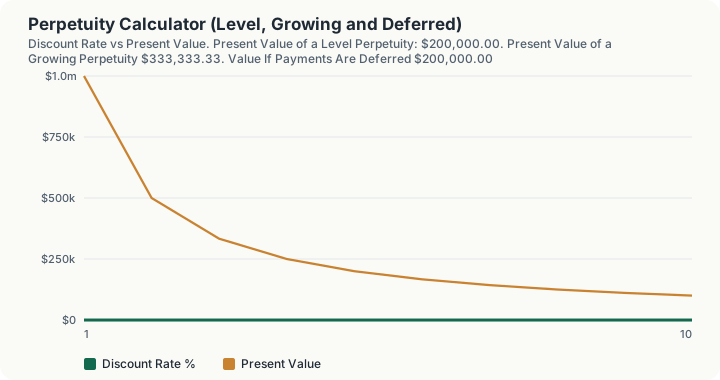
Quick Answer: A perpetuity paying $10,000 a year discounted at 5% is worth $200,000.00 today: exactly twenty times the payment, because the value of a level perpetuity is always the payment divided by the rate. If the payment grows 2% a year the value rises to $333,333.33. Notably, only 23.1% of that value comes from beyond year thirty.
What does this calculator do?
A perpetuity is a cash flow that continues forever. Despite the infinite stream, its present value is finite and remarkably simple:
PV = PMT/i
The value is always the payment divided by the discount rate, so at 5% a perpetuity is worth exactly twenty times its annual payment, and at 4% exactly twenty-five times.
Two consequences follow, and both matter more than the formula.
Perpetuities are brutally rate-sensitive. Halving the discount rate exactly doubles the value. This is why long-duration assets valued as perpetuities (infrastructure, ground rents, terminal values in a DCF) swing so violently when rates move.
Almost all the value is near-term. At 5%, less than a quarter of a perpetuity's value comes from beyond year thirty. The infinite tail contributes far less than intuition suggests.
How is this calculated?
Level perpetuity:
PV = PMT/i
Growing perpetuity, where each payment is g larger than the last:
PV = PMT₁/(i − g)
This requires i > g. If growth equals or exceeds the discount rate the series diverges and the value is genuinely infinite; the calculator reports that rather than returning a misleading number.
Deferred perpetuity, starting n years from now, is the ordinary value discounted back:
PV = PMT/i × 1/((1 + i)ⁿ)
Worked Example
An endowment promises $10,000 a year forever, and the trustee's required return is 5%.
Step 1: The level perpetuity. $10,000 / 0.05 = $200,000.00
Step 2: As a multiple of the payment. $200,000.00 / $10,000 = 20.0x, which is simply 1/0.05
Step 3: The same stream growing 2% a year. $10,000 / (0.05 - 0.02) = $10,000 / 0.03 = $333,333.33
Two points of growth adds 67% to the value, because the denominator fell by 40%. Everything on this page is a division by a small number, and small numbers are where valuations go wrong.
Now the question that surprises people: how much of that $200,000 is the distant future?
Step 4: A thirty-year annuity of the same payment. $153,724.51
Step 5: The value of everything after year thirty. $200,000.00 - $153,724.51 = $46,275.49
Step 6: That tail as a share of the whole. $46,275.49 / $200,000.00 = 23.1%
Three quarters of an infinite stream's value arrives in the first thirty years. Payments from year 100 onward are worth almost nothing at 5%, which is why a perpetuity is a reasonable approximation for a long-lived asset rather than a mathematical curiosity.
The discount rate is the dominant variable:
Step 7: Halve the rate to 2.5%. $10,000 / 0.025 = $400,000.00, exactly double, at 40.0x the payment
Step 8: What that does to the tail. The thirty-year annuity rises only to $209,302.93, so the post-year-thirty tail is now $190,697.07, or 47.7% of the value
Halving the rate does not just double the answer; it moves half the value beyond the point most forecasts even attempt.
The growing case is more fragile still:
Step 9: Raise growth to 4.5% against the 5% discount rate. $10,000 / (0.05 - 0.045) = $10,000 / 0.005 = $2,000,000.00
Step 10: Compare that to the level case. $2,000,000.00 / $200,000.00 = 10 times the value, from a growth assumption half a percentage point below the discount rate
Step 11: The boundary. At g equal to or above i the denominator reaches zero or turns negative, and the calculator reports divergence rather than a number, because the value is genuinely infinite
Step 10 is the terminal-value problem in every DCF, stated plainly. Analysts argue over the growth rate to a tenth of a point precisely because the last tenth is worth more than everything before it.
Finally, deferral, which works in the opposite direction:
Step 12: The same perpetuity starting in twenty years. $200,000.00 / 1.05^20 = $75,377.90
Waiting two decades costs 62% of the value of an otherwise identical infinite stream.
What does this calculator not account for?
- Whether anything truly lasts forever. Perpetuity is a modelling convenience. Real ground rents get enfranchised, real companies fail, and real infrastructure concessions expire.
- Credit risk. The formula assumes payments arrive with certainty. A risky perpetuity needs a higher discount rate, and the value falls proportionately.
- Inflation. Use either a nominal payment with a nominal rate, or a real payment with a real rate. Mixing them is a common and serious error.
- Tax on the income stream.
- Variable growth. Real cash flows rarely grow at a single constant rate forever. Multi-stage models exist for that.
- Payment frequency. This assumes annual payments in arrears. Quarterly or monthly streams need the rate converting to match.
- Callability. Many real perpetual instruments, such as perpetual bonds, can be redeemed by the issuer, which caps the upside.
What mistakes do people make with this?
- Setting growth close to the discount rate. As g approaches i the denominator approaches zero and the value approaches infinity. A terminal growth rate of 4.5% against a 5% discount rate produces a $2 million valuation from a $10,000 payment, which is arithmetic rather than analysis.
- Assuming the far future matters most. It does not. At 5%, more than three quarters of the value arrives within thirty years.
- Mixing real and nominal. A payment stated in today's money discounted at a nominal rate will understate the value substantially.
- Using a perpetuity where a finite annuity is correct. A thirty-year lease is not a perpetuity, and treating it as one overstates its value by about 30% at a 5% discount rate.
- Forgetting the first payment timing. The standard formula assumes the first payment arrives one period from now. A payment today makes it a perpetuity due, worth one payment more.
- Ignoring the rate sensitivity when rates move. A move from 5% to 4% raises the value by 25%, not by 1%.
Frequently Asked Questions
How can something infinite have a finite value?
Why is a perpetuity worth twenty times its payment?
What happens if growth exceeds the discount rate?
How much of the value is in the distant future?
Where are perpetuities actually used?
What is a perpetuity due?
Sources
- U.S. Securities and Exchange Commission, Investor.gov, the official authority for the investing this calculator relates to. investor.gov
Also consulted: Standard present value mathematics. The level perpetuity, growing perpetuity and deferred perpetuity formulas shown above are closed-form results with no jurisdictional content; The growing perpetuity formula is the Gordon growth model, which requires the discount rate to exceed the growth rate for convergence.