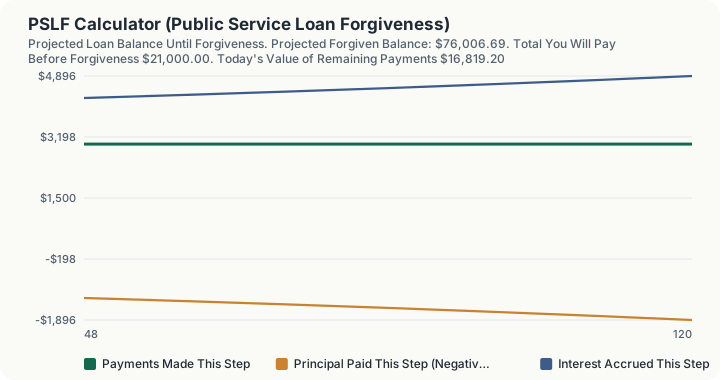
Quick Answer: With a $65,000 balance, $250 monthly IDR payments, and 36 qualifying payments already made, your projected forgiven balance at month 120 is $76,006.69, and yes, the balance is expected to grow before it's forgiven.
Overview
Public Service Loan Forgiveness (PSLF) forgives the remaining balance on eligible federal Direct Loans after a borrower makes 120 qualifying monthly payments, roughly ten years, while working full-time for a qualifying government or nonprofit employer, typically under an income-driven repayment (IDR) plan. The forgiven amount is not taxed as income at the federal level, which sets it apart from most other forms of loan forgiveness.
The part that confuses a lot of borrowers is that their loan balance often doesn't shrink much, and sometimes grows, during those ten years. That's because IDR payments are calculated based on income, not based on what it would actually take to pay off the loan. If the monthly payment is smaller than the interest accruing each month, the balance grows even as qualifying payments are being made correctly. This is completely normal under PSLF and does not disqualify anyone from forgiveness. In fact, it is exactly the situation PSLF is designed for: the eventual forgiveness is often worth more than what would have been paid off through standard repayment.
This calculator tracks where you are in the 120-payment countdown, projects what your balance is likely to look like when you hit that count, and shows the size of the balance that would ultimately be forgiven.
How This Is Calculated
The number of qualifying payments still needed is straightforward:
`
Months Remaining = 120 − Qualifying Payments Already Made
`
Projecting the loan balance forward requires accounting for two things happening at once every month: interest accrues on the current balance, and a payment is applied. This calculator uses the standard time-value-of-money future value relationship for a balance receiving a fixed periodic payment:
`
Projected Balance = Balance × (1 + i)^n − Payment × [(1 + i)^n − 1] / i
`
where i is the monthly interest rate (annual rate divided by 12) and n is the number of months remaining. If the fixed monthly payment is smaller than the interest accruing on the balance each month, this formula produces a balance larger than the starting balance, capturing exactly the negative-amortization pattern many IDR borrowers experience. If the payment is large enough to be paying the loan down faster than interest accrues, the formula correctly shows the balance shrinking instead.
The calculator also computes the present value of the remaining required payments, discounted at the loan's own interest rate, using the standard ordinary annuity present value formula. This is not the forgiven amount; it's a separate figure showing what those remaining monthly payments are worth today, which is useful context when weighing PSLF against other repayment strategies.
Worked Example
Take a borrower with a $65,000 federal loan balance, a $250 monthly IDR payment, 36 qualifying payments already made, and a 6.53% weighted average interest rate:
- Months remaining: 120 − 36 = 84 payments, or 7 more years
- Total scheduled payments before forgiveness: $250 × 84 = $21,000.00
- Monthly interest rate: 6.53% ÷ 12 = 0.005442
- First month's interest alone: $65,000 × 0.005442 ≈ $353.71, already more than the $250 payment
- Projected balance at month 120: using the future value formula on the remaining 84 months, the balance grows to approximately $76,006.69
- Amount forgiven: the full projected balance, $76,006.69, forgiven tax-free at the federal level
Over those 84 months, the borrower pays $21,000.00 out of pocket. In exchange, a balance of roughly $76,006.69, more than three and a half times what they paid, is wiped out. That gap is the entire value proposition of PSLF for someone whose income-based payment doesn't keep pace with their loan's interest.
What This Does Not Account For
- Payment count resets and non-qualifying periods. Any month you're not working full-time for a qualifying employer, not in an eligible repayment plan, or your loan is in deferment or forbearance (with limited exceptions) generally doesn't count toward the 120. This calculator assumes every future month counts; verify your actual qualifying payment count through the PSLF Help Tool or your loan servicer.
- Changes to your IDR payment amount. Income-driven payments are recalculated annually based on income and family size. This calculator holds your monthly payment constant for the full projection; a raise, a new job, or a change in household size would change your actual payment and therefore your actual forgiven balance.
- Interest rate changes across multiple loans with different rates. If you have several federal loans at different rates, use your weighted average rate for a reasonable approximation; this calculator doesn't model each loan separately.
- Full payoff before month 120. If your payment is large enough to pay off the loan entirely before reaching 120 qualifying payments, there's nothing left to forgive, and continuing to pursue PSLF may not make sense at that point. This calculator projects the balance assuming payments continue at the fixed level for the full remaining count; it does not stop early if the balance would hit zero first.
- State tax treatment. PSLF forgiveness is tax-free federally, but check your state's specific rules, since state tax treatment of forgiven student debt has varied.
Common Pitfalls
- Panicking when the balance goes up instead of down. A growing balance under an IDR plan is often expected, not a sign something is wrong. What matters for PSLF is qualifying payment count, not balance trajectory.
- Assuming any repayment plan qualifies. Only certain plans, generally IDR plans and, for a period, the standard 10-year plan, count toward PSLF. Paying under a plan that doesn't qualify means payments may not count even if the employer and loan type are otherwise eligible.
- Not certifying employment regularly. Qualifying payment counts are verified through employer certification. Borrowers who don't submit certification forms periodically can lose track of, or dispute, their actual payment count.
- Refinancing federal loans into a private loan. Private refinancing permanently disqualifies a loan from PSLF, since the program only applies to federal Direct Loans. This is one of the most consequential and hardest-to-reverse mistakes a borrower pursuing PSLF can make.
- Switching employers without checking qualification first. Not every government or nonprofit job qualifies, and not every nonprofit qualifies regardless of mission. Confirm employer eligibility before assuming a new job keeps your PSLF clock running.
Frequently Asked Questions
Why is my loan balance growing instead of shrinking under PSLF?
Is the forgiven amount taxed?
Does refinancing my federal loans disqualify me from PSLF?
Do all 120 payments need to be consecutive?
What counts as a qualifying employer?
Sources
- U.S. Department of Education, Federal Student Aid: Public Service Loan Forgiveness Program rules, qualifying payment requirements, and PSLF Help Tool, studentaid.gov. studentaid.gov
- Internal Revenue Code § 108(f): Federal tax exclusion for student loan forgiveness under PSLF. law.cornell.edu/uscode/text/26/108
Also consulted: U.S. Department of Education: Income-Driven Repayment Plan guidance and payment recalculation rules.