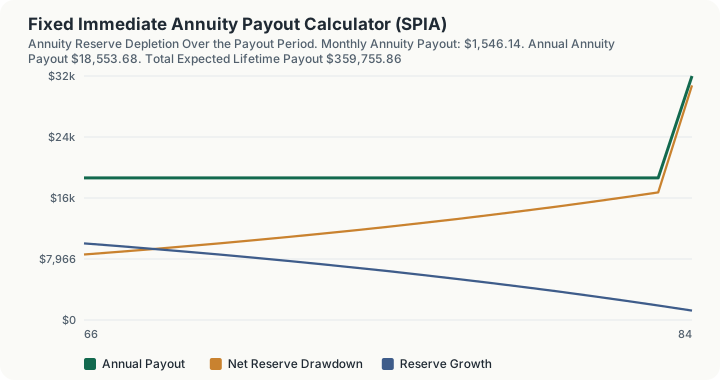
Quick Answer: A single premium immediate annuity (SPIA) converts a lump sum into a guaranteed monthly income stream sized to your age-based life expectancy and the insurer's assumed interest rate, and this calculator estimates that monthly payout.
Overview
A single premium immediate annuity is an insurance contract, not an investment account. You hand an insurer a lump sum (the premium), and in exchange the insurer promises to pay you a fixed monthly income starting almost immediately, typically within 30 days to a year, for as long as you live (a life annuity) or for a fixed period (a period-certain annuity). The core appeal is longevity protection: an insurer pools mortality risk across many annuitants, so it can promise payments that continue even if you live decades past your statistical life expectancy, something an individual managing their own withdrawals cannot guarantee themselves.
The size of the monthly payment an insurer can offer depends on two things pulling in opposite directions: how long the insurer expects to pay you (driven by your age, sex, and health at purchase, since these determine the mortality-adjusted payout period), and what return the insurer expects to earn by investing your premium in the meantime (the assumed interest rate baked into the pricing). A younger annuitant with a longer expected payout period gets a smaller monthly check per dollar of premium than an older annuitant with a shorter expected payout period, all else equal, because the insurer expects to make more total payments to the younger buyer.
This calculator models a life-only SPIA using the same math the industry uses internally: it amortizes your premium, treated as a present value, into a level monthly payment over your mortality-adjusted payout period at the insurer's assumed interest rate.
How This Is Calculated
The calculation runs in two steps.
Step 1: Determine the payout period. The calculator looks up your remaining life expectancy in years for your current age using Social Security Administration period life table data, which serves as the mortality-adjusted basis insurers use (in practice, insurers use their own proprietary mortality tables, which typically assume longer lifespans than the general population because people who buy annuities tend to be healthier than average, a phenomenon actuaries call anti-selection; this calculator's estimate is therefore a reasonable approximation, not an insurer's exact pricing).
Step 2: Solve for the level monthly payment. With the payout period converted to months, the calculator solves the standard time-value-of-money annuity equation for the payment that fully amortizes the premium to zero over that period at the assumed monthly rate:
`
Premium = Monthly Payment × [1 − (1 + i)⁻ⁿ] / i
`
where i is the monthly assumed interest rate and n is the number of months in the payout period. Solving this for the payment is exactly the same math used to compute a loan payment, run in reverse: instead of a bank amortizing a loan you owe, an insurer is amortizing a premium it owes you. The calculator then reconciles the answer by discounting the computed payment back over the same period at the same rate and confirming it reproduces the original premium, the same reconciliation discipline this platform applies to every amortization-style calculation.
Worked Example
Consider a 65-year-old purchasing a SPIA with a $250,000 premium, using the platform's unisex life expectancy basis and a 4.0% assumed interest rate.
- Mortality-adjusted payout period: 19.39 years (232.68 months)
- Monthly annuity payout: $250,000 × 0.003333 / [1 − 1.003333⁻²³²·⁶⁸] = $1,546.14
- Annual payout: $1,546.14 × 12 = $18,553.68
- Annual payout rate: $18,553.68 ÷ $250,000 = 7.42%
- Total expected lifetime payout: $1,546.14 × 232.68 ≈ $359,755.86
Notice the total expected payout ($359,755.86) is well above the original premium ($250,000). That gap is not free money: it represents the interest the insurer expects to earn on the unpaid balance of your premium while it is gradually being paid back to you, exactly like the total interest paid over a mortgage exceeds the loan principal.
Following the Insurer's Reserve
The schedule under this calculator is not a payment guarantee. It is the insurer's reserve for the contract, amortising at the assumed 4.0% rate over the mortality-adjusted expectancy, and it shows where the money to pay you is coming from year by year.
Step 1 -- Age 66, the first full year. Reserve growth of $10,000.00 against a $18,553.68 annual payout leaves a reserve of $241,446.32
Step 2 -- Age 67. Growth of $9,657.85 against the same payout leaves $232,550.49
Step 3 -- Payouts received after two years. $18,553.68 + $18,553.68 = $37,107.36
Step 4 -- Age 75, ten years in. Payouts total $185,536.80, cumulative reserve growth is $82,840.40, and the reserve stands at $147,303.60
Ten years of payments have returned $185,536.80 against a $250,000 premium, and $82,840.40 of that came from interest the insurer credited to the reserve rather than from your own capital. Read the later rows for what they are: the reserve is projected to run to zero around the expectancy age, which is a modelling horizon, not a stopping date. A life-only contract keeps paying past it, and an annuitant who dies early stops well short of it. The reserve schedule is how the insurer prices that bet, not a promise about your own longevity.
What This Does Not Account For
- Insurer pricing load and profit margin. Real SPIA quotes include the insurer's expenses, profit margin, and reserve requirements, which typically reduce the payout below what a pure time-value calculation would produce. This calculator shows the underlying actuarial math, not a specific carrier's quote.
- Insurer-specific mortality tables. Annuity buyers as a population live longer than the general population. This calculator's SSA-based life expectancy figure is a reasonable general approximation, not a specific insurer's pricing table.
- Optional riders, such as a cash refund feature, a period-certain guarantee, cost-of-living adjustments, or joint-and-survivor coverage for a spouse, all of which change the payout math and are not modeled here.
- Health-based underwriting. Some "enhanced" or "impaired risk" annuities pay more to buyers with shorter-than-average life expectancy due to documented health conditions.
- Insurer credit risk and state guaranty association coverage limits. A SPIA is only as reliable as the issuing insurer's claims-paying ability, backstopped up to state-specific limits by guaranty associations, not by FDIC-style federal insurance.
- Tax treatment of the payout, which depends on whether the premium came from qualified (pre-tax) or non-qualified (after-tax) money, and which is not calculated here.
Common Pitfalls
- Comparing the payout rate to an investment return. The 7.42% annual payout rate in the example above is not a 7.42% investment yield. Part of every payment is a return of your own principal, not investment earnings, the same way a mortgage payment blends principal and interest.
- Assuming the payout is guaranteed to beat self-managed withdrawals. A SPIA trades flexibility and legacy value for longevity insurance. If you die shortly after purchase (with a life-only annuity and no refund rider), the insurer keeps the remaining premium.
- Ignoring irrevocability. Once purchased, a life-only SPIA typically cannot be surrendered for its cash value. The premium is gone in exchange for the income stream, which is a meaningful liquidity tradeoff.
- Shopping only one insurer. Payout rates for economically identical SPIAs can vary meaningfully across carriers depending on their mortality assumptions, investment strategy, and profit targets.
- Forgetting inflation. A level, non-inflation-adjusted monthly payment loses purchasing power every year. Some insurers offer inflation-adjusted riders at a lower starting payout.
Frequently Asked Questions
Is a SPIA the same as a deferred annuity?
Why does my age affect the payout so much?
What happens to my money if I die right after buying a life-only SPIA?
Can I get my premium back if I change my mind?
How does the assumed interest rate affect my payout?
Sources
- Social Security Administration Period Life Table, used as the life expectancy data source in this calculator. ssa.gov
- National Association of Insurance Commissioners (NAIC): A Shopper's Guide to Annuities. content.naic.org
- Internal Revenue Service Publication 939, General Rule for Pensions and Annuities, for the tax treatment of annuity payments. irs.gov/publications/p939