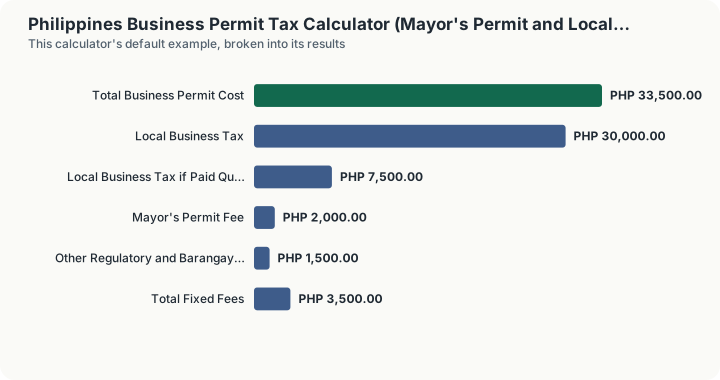
Quick Answer: A business with PHP 2,000,000 of prior-year gross receipts, assessed at a 1.5% local business tax rate with a PHP 2,000 mayor's permit fee and PHP 1,500 of other regulatory fees, pays PHP 33,500.00 in total. That is 1.675% of gross receipts. The 1.5% rate is a placeholder you must replace: there is no national business permit tax rate in the Philippines, and every local government sets its own.
What does this calculator do?
Renewing a Philippine business permit in January is not one payment but a bundle. The largest component is normally the local business tax, assessed as a percentage of last year's gross sales or receipts. Around it sit a set of fixed regulatory fees: the mayor's permit fee itself, sanitary and garbage fees, a fire safety inspection fee, signage fees, occupational permits and a barangay clearance.
The governing statute is Republic Act No. 7160, the Local Government Code of 1991. What that statute does, crucially, is delegate. Section 143 empowers municipalities to impose a tax on business, Section 147 lets local governments charge fees for permits and licences commensurate with the cost of regulation, and Section 151 lets cities levy at rates above the municipal maxima. But the actual rate that applies to your business is fixed by your own local government's revenue ordinance, not by national law.
That has a direct consequence for this calculator, and it is the most important thing on this page. The rate is a user input. There is no national figure to default to, and this tool does not pretend otherwise. The 1.5% default is a placeholder chosen to make the arithmetic legible, not a legal rate. The correct rate for you appears in your city or municipality's revenue code, and depends on your line of business: retailers, wholesalers, manufacturers, contractors, banks and exporters are all rated differently, and many ordinances use graduated tables keyed to gross receipts brackets rather than a single percentage.
Note also that the assessment is on the preceding calendar year's gross receipts. A business renewing in January 2027 is assessed on its 2026 receipts. A newly registered business is normally assessed a fixed initial amount instead, which this calculator does not model.
How is this calculated?
The local business tax is the rate applied to prior-year gross receipts:
Local Business Tax = Prior-Year Gross Receipts × LGU Rate
The fixed fees are simply summed:
Total Fixed Fees = Mayor’s Permit Fee + Other Regulatory Fees + Barangay Clearance
And the total is the two together:
Total Permit Cost = Local Business Tax + Total Fixed Fees
The effective rate expresses that total back against receipts, which is a more useful number for a small business than the bare tax rate:
Effective Rate = (Total Permit Cost)/(Prior-Year Gross Receipts)
The calculator also divides the business tax by four, because RA 7160 permits payment in quarterly instalments rather than a single January payment:
Quarterly Instalment = (Local Business Tax)/4
No statutory maximum rate is applied anywhere in this calculation. That is deliberate rather than an oversight, and the reason is set out under the limitations below.
Worked Example
A trading business in a city recorded PHP 2,000,000 of gross receipts last year. Its city revenue ordinance rates its line of business at 1.5%. The mayor's permit fee is PHP 2,000, and sanitary, garbage and fire fees come to PHP 1,500 combined.
Step 1: Apply the LGU rate to prior-year gross receipts.
2,000,000 × 1.5% = 30,000
Local business tax: PHP 30,000.00
Step 2: Sum the fixed regulatory fees.
2,000 + 1,500 = 3,500
Total fixed fees: PHP 3,500.00
Step 3: Add the two components.
30,000 + 3,500 = 33,500
Total permit cost: PHP 33,500.00
Step 4: Express the total as a percentage of receipts.
33,500 ÷ 2,000,000 = 1.675%
Effective rate on receipts: 1.675%
Step 5: Split the business tax into quarterly instalments.
30,000 ÷ 4 = 7,500
Quarterly instalment: PHP 7,500.00
Now compare a micro business in the same city with PHP 300,000 of receipts and the same fixed fees.
Step 6: Apply the same rate to the smaller receipts figure.
300,000 × 1.5% = 4,500
Local business tax: PHP 4,500.00
Step 7: Add the same fixed fees and re-express as an effective rate.
4,500 + 3,500 = 8,000; 8,000 ÷ 300,000 = 2.6667%
Effective rate on receipts: 2.6667%
The fixed fees do not scale, so the smaller business pays a materially higher effective rate on the same nominal schedule. That regressivity is the practical reality of local business taxation for micro enterprises, and it is why the calculator surfaces the effective rate rather than only the tax.
What does this calculator not account for?
- The rate itself, which is entirely your input. No national business permit tax rate exists. Look it up in your LGU's revenue code or ask the Business Permits and Licensing Office. The default is a placeholder.
- Any statutory ceiling on the rate. RA 7160 does set maximum rates that municipalities may impose, with cities permitted to exceed them by a stated margin under Section 151. For a business not covered by the specific schedules in Section 143(a) to (g) and subject to VAT or percentage tax, Section 143(h) caps the municipal rate at 2% of the preceding year's gross sales or receipts; Section 144 lets Metro Manila municipalities go up to 50% above the Section 143 maximums, and Section 151 lets cities do the same. This calculator does not enforce any of these ceilings, because which one applies depends on your line of business and LGU. Check the rate you enter against your LGU's revenue code.
- Graduated rate tables. Many LGU ordinances rate business tax through a bracketed schedule of gross receipts, with fixed peso amounts at low turnover and a percentage only above a threshold. This calculator applies a single flat percentage.
- Different rates by line of business. Retailers, wholesalers, manufacturers, contractors, banks, exporters and essential commodity dealers are rated differently in the same ordinance. Enter the rate for your own classification.
- Newly started businesses. A business in its first year has no prior-year receipts and is normally assessed a fixed initial amount rather than a percentage. That is not modelled.
- Businesses operating in multiple LGUs. RA 7160 has rules for allocating gross receipts between the location of the principal office and the location of factories or branches. This calculator assumes a single location.
- Real property tax. A business occupying property it owns also pays real property tax, which is a separate annual assessment and not part of the business permit bundle.
- Penalties and surcharges. Late renewal attracts surcharges and interest under the LGU ordinance, which are not computed.
What mistakes do people make with this?
- Looking for a national rate. There is not one. Any source quoting "the Philippine business permit tax rate" as a single national figure is wrong.
- Using the current year's receipts. The assessment is on the preceding calendar year. Using this year's figures produces the wrong tax.
- Forgetting the barangay clearance. Most LGUs will not act on a permit application without it, and it is charged separately by the barangay.
- Assuming the rate for one line of business applies to another. Ordinances rate manufacturers, wholesalers, retailers and contractors quite differently, and misclassification is a common source of assessment disputes.
- Missing the January deadline. Business permit renewal is generally due in the first month of the year, with penalties for late filing. Quarterly payment of the business tax is an option, but it does not extend the renewal deadline.
- Assuming the fixed fees are trivial. For a micro business they can exceed the business tax itself, as the worked example shows.
Frequently Asked Questions
How much is a business permit in the Philippines?
What is local business tax based on?
Is there a national rate for the mayor's permit?
Can I pay the local business tax in instalments?
What other fees come with a business permit?
Why is my effective rate higher than the tax rate?
Sources
- Bureau of Internal Revenue (Philippines), the official authority for the national tax authority this calculator relates to. bir.gov.ph
Also consulted: Republic Act No. 7160, Local Government Code of 1991. Section 143 empowers municipalities to impose a tax on business; Section 147 permits reasonable fees and charges for permits and licences commensurate with the cost of issuance and regulation; Section 151 authorises cities to levy at rates above the municipal maxima. Rates and fee amounts are fixed by each local government's own revenue ordinance, not by national law. (read 31 August 2026; the retrieved text of Section 143(h) was truncated, which is why no rate ceiling is asserted or enforced by this calculator); Your own local government unit's revenue code, obtainable from the Business Permits and Licensing Office. This is the only authoritative source for the rate and fees that apply to your business.