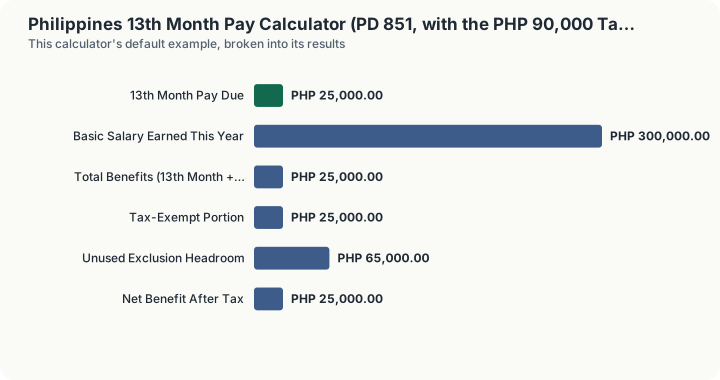
Quick Answer: An employee earning PHP 25,000 in monthly basic salary who worked all twelve months of the calendar year with no unpaid absences is entitled to PHP 25,000.00 in 13th month pay. That is one twelfth of the PHP 300,000 in basic salary earned during the year. It is entirely tax free, and leaves PHP 65,000 of headroom under the PHP 90,000 benefits exclusion ceiling.
What does this calculator do?
13th month pay in the Philippines is a statutory entitlement, not a discretionary bonus. Presidential Decree No. 851, issued in 1975, requires every covered employer to pay it, and Memorandum Order No. 28 of 1986 removed the original salary ceiling so that all rank and file employees are covered regardless of how much they earn. The benefit must be paid not later than 24 December each year, though an employer may pay half before the school year opens and the balance by December.
The amount is fixed by the decree at one twelfth of the basic salary an employee earned within the calendar year. Two things follow from that wording. It is based on basic salary only, so cost of living allowances, overtime pay, holiday and night differential premiums, and profit sharing are excluded unless your employer has integrated them into basic pay. And it is based on salary actually earned, so an employee who joined in June, or who took unpaid leave, receives a proportionate amount rather than a full month's pay.
The second half of the calculation is tax. Section 32(B)(7)(e) of the Tax Code, as amended by the TRAIN Law, excludes 13th month pay and other benefits from gross income up to PHP 90,000 for the year. That is a single ceiling covering the whole benefit pot, not a separate allowance for each bonus. Anything above it becomes ordinary taxable income taxed at your marginal rate, which is why this calculator asks for your other taxable income for the year.
How is this calculated?
The benefit itself is a two step calculation. First the basic salary actually earned:
Basic Salary Earned = Monthly Basic Salary × Months Worked − Unpaid Absences
Then one twelfth of it:
13th Month Pay = (Basic Salary Earned)/12
The tax treatment then measures the whole benefit pot against the statutory ceiling:
Total Benefits = 13th Month Pay + Other Bonuses
Exempt Portion = min(Total Benefits, 90,000)
Taxable Excess = max(Total Benefits − 90,000, 0)
Any taxable excess is ordinary income, so it is taxed at whatever marginal rate it reaches when stacked on top of the rest of your year's taxable income. The calculator prices it by computing the graduated income tax twice and taking the difference:
Tax on Excess = Tax (Other Income + Taxable Excess) − Tax (Other Income)
That difference approach matters because a large excess can straddle a bracket boundary, in which case a single flat marginal rate would give the wrong answer.
Worked Example
An employee earns PHP 120,000 a month in basic salary, worked the full year, and has PHP 1,200,000 of other taxable income for the year after mandatory contributions.
Step 1: Compute the basic salary earned during the calendar year.
120,000 × 12 = 1,440,000
Basic salary earned: PHP 1,440,000.00
Step 2: Take one twelfth of it.
1,440,000 ÷ 12 = 120,000
13th month pay: PHP 120,000.00
Step 3: Measure the benefit pot against the PHP 90,000 ceiling.
There are no other bonuses, so the pot is PHP 120,000, which exceeds the ceiling.
Exempt portion: PHP 90,000.00
Step 4: Compute the taxable excess.
120,000 − 90,000 = 30,000
Taxable excess: PHP 30,000.00
Step 5: Compute the income tax without the excess.
PHP 1,200,000 sits in the band "Over PHP 800,000 but not over PHP 2,000,000", carrying PHP 102,500 plus 25% of the excess over PHP 800,000.
102,500 + (400,000 × 25%) = 102,500 + 100,000 = 202,500
Tax without the excess: PHP 202,500.00
Step 6: Compute the income tax with the excess stacked on top.
102,500 + (430,000 × 25%) = 102,500 + 107,500 = 210,000
Tax with the excess: PHP 210,000.00
Step 7: Take the difference.
210,000 − 202,500 = 7,500
Income tax on the taxable portion: PHP 7,500.00
Step 8: Compute the net benefit.
120,000 − 7,500 = 112,500
Net benefit after tax: PHP 112,500.00
Carrying the Accrual Through the Year
The 13th month pay is not a December event; it accrues at one twelfth of each month's basic salary. The same employee, month by month:
Step 9: Month one. Basic salary earned PHP 120,000.00, accrued 13th month pay PHP 10,000.00, still to accrue by December PHP 110,000.00
Step 10: Month two. Basic salary earned PHP 240,000.00, accrued PHP 20,000.00, still to accrue PHP 100,000.00
Step 11: Month nine, where the accrual reaches the exemption ceiling. Basic salary earned PHP 1,080,000.00, accrued PHP 90,000.00. Every peso of the benefit accrued so far is inside the PHP 90,000 exclusion; every peso accrued from month ten onward is not.
Step 12: Month twelve. Basic salary earned PHP 1,440,000.00, accrued PHP 120,000.00, of which PHP 30,000.00 is the taxable excess.
An employee who resigns in September walks away with the full PHP 90,000 tax-free and no taxable excess at all. Working the last quarter adds PHP 30,000 of benefit and PHP 7,500 of tax on it. Note also what resets: the PHP 90,000 ceiling is an annual figure that starts again on 1 January, and it is shared with every other 13th month and other-benefit peso in the same calendar year, not with the accrual alone.
What does this calculator not account for?
- Whether you are a covered employee. PD 851 exempts several categories, including government employees, employers already paying an equivalent benefit, household helpers, and employees paid purely on commission or task basis other than piece rate workers. The calculator computes the benefit for anyone; it does not test coverage.
- What your employer counts as basic salary. The decree excludes allowances and monetary benefits not integrated into basic pay, but the treatment of specific allowances varies by company policy and by collective bargaining agreement. Enter the figure your payslip labels basic salary.
- Maternity leave and other paid leave with statutory benefits. How periods on SSS maternity benefit are treated in the 13th month computation is a question of Department of Labor and Employment guidance and employer practice, and this calculator makes no assumption about it beyond whatever you enter as unpaid absences.
- Separate 14th month pay or performance bonuses. These are contractual, not statutory. They should be entered in the other benefits field so the shared PHP 90,000 ceiling is measured correctly, but the calculator does not compute their amount.
- The accrual table's treatment of unpaid absences. The month by month accrual table is computed on basic salary alone. Any unpaid absence figure you enter is applied to the headline result, not spread across the twelve rows.
- Withholding timing. Where a benefit is taxable, employers typically withhold the tax in the pay period the benefit is released, and the final position is settled at year end annualization. This calculator gives the annual tax effect, not the timing.
What mistakes do people make with this?
- Using gross pay instead of basic salary. Including overtime, allowances and premiums inflates the benefit. The statutory base is basic salary alone.
- Dividing by the months worked instead of by twelve. The divisor is always twelve. An employee who worked seven months divides seven months of salary by twelve, not by seven, which is why a partial year produces a proportionately smaller benefit rather than a full one.
- Treating the PHP 90,000 ceiling as a per bonus allowance. It is one ceiling for all 13th month pay and other benefits combined for the year.
- Assuming a taxable excess is taxed at a flat rate. It is ordinary income and takes your marginal rate, which can be anywhere from 15% to 35% depending on the rest of your income.
- Expecting the benefit to be prorated by days rather than by earnings. The decree ties the benefit to basic salary actually earned, so unpaid absences reduce it through the earnings figure rather than through a separate day count.
Frequently Asked Questions
How is 13th month pay computed in the Philippines?
Is 13th month pay taxable?
Do I get 13th month pay if I resigned mid year?
When must 13th month pay be released?
Does a Christmas bonus count against the PHP 90,000 ceiling?
Are managers entitled to 13th month pay?
Sources
- Republic Act No. 10963 (TRAIN), amending Section 32(B)(7)(e) of the National Internal Revenue Code to set the exclusion for 13th month pay and other benefits at PHP 90,000, and Section 24(A)(2)(a) for the graduated rates used to price any taxable excess. (read 31 August 2026) lawphil.net/statutes/repacts/ra2017/ra_10963_2017.html
- Bureau of Internal Revenue (Philippines), the official authority for the national tax authority this calculator relates to. bir.gov.ph
Also consulted: Presidential Decree No. 851 (1975), requiring 13th month pay equal to one twelfth of basic salary earned within a calendar year, payable not later than 24 December. (read 31 August 2026); Memorandum Order No. 28 (13 August 1986), removing the PHP 1,000 monthly salary ceiling in PD 851 and extending the benefit to all rank and file employees regardless of basic salary.