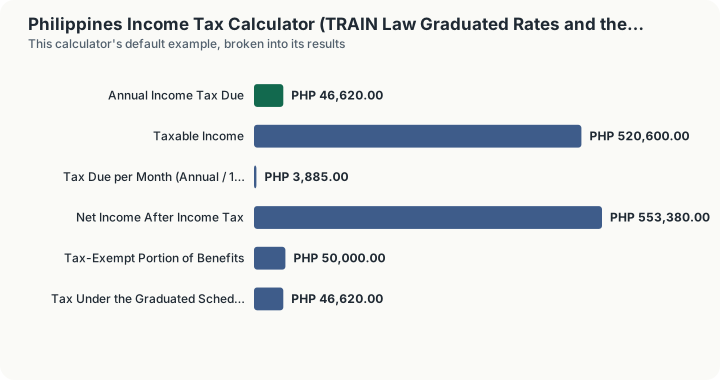
Quick Answer: A Philippine employee earning PHP 600,000 a year, with PHP 29,400 of SSS, PhilHealth and Pag-IBIG contributions and PHP 50,000 of 13th month pay and bonuses, has PHP 520,600 of taxable income and owes PHP 46,620.00 in annual income tax. That is about PHP 3,885 a month, or 7.77% of gross income. All figures are in Philippine pesos.
What does this calculator do?
This calculator applies the graduated individual income tax schedule of the National Internal Revenue Code, as rewritten by Republic Act No. 10963: the Tax Reform for Acceleration and Inclusion Act, universally called the TRAIN Law. It handles both of the regimes an individual taxpayer can end up under: the graduated brackets that run from 0% to 35% and apply to everyone by default, and the flat 8% option that a self-employed individual or professional may elect instead.
The schedule this page uses is the one headed "Effective January 1, 2023 and onwards" in Section 24(A)(2)(a). That is important, because the TRAIN Law legislated two different tables: a first one for 2018 through 2022, and a second, lower one from 2023 forward. Many older Philippine tax pages still quote the 2018 table. The 2023 table is the one in force now, and it is the one used here.
Three features of Philippine individual income tax dominate the arithmetic and are worth understanding before reading the result. First, the initial PHP 250,000 of taxable income is taxed at zero, which is why a great many Filipino workers owe no income tax at all. Second, mandatory contributions to SSS, PhilHealth and Pag-IBIG come out of gross income before the brackets are applied, so they reduce tax as well as take-home pay. Third, 13th month pay and other benefits are excluded from taxable income up to a combined ceiling of PHP 90,000, and only the amount above that ceiling is taxed.
The calculator shows the tax under both regimes side by side, whichever one you select, so a freelancer can see immediately whether electing the 8% option would help or hurt.
How is this calculated?
Under the graduated regime, taxable income is built by subtraction:
Taxable Income = Gross Income − Contributions − Exempt Benefits − Other Deductions
where the exempt benefits term is the smaller of your total 13th month pay plus other benefits, and the statutory ceiling:
Exempt Benefits = min(13th Month Pay + Other Benefits, 90,000)
The tax is then read off the statutory schedule. Each band carries a fixed peso base and a marginal rate on the excess over the band floor:
Tax Due = Base Tax + (Taxable Income − Band Floor) × Marginal Rate
The six bands under Section 24(A)(2)(a) for 2023 onwards are: nil on the first PHP 250,000; 15% of the excess over PHP 250,000 up to PHP 400,000; PHP 22,500 plus 20% of the excess over PHP 400,000 up to PHP 800,000; PHP 102,500 plus 25% of the excess over PHP 800,000 up to PHP 2,000,000; PHP 402,500 plus 30% of the excess over PHP 2,000,000 up to PHP 8,000,000; and PHP 2,202,500 plus 35% of the excess over PHP 8,000,000.
Under the 8% option in Section 24(A)(2)(b), the arithmetic is different and much shorter:
Tax Due = (Gross Receipts − 250,000) × 8%
No deduction of any kind is taken under this option. Contributions, business expenses and the benefits exclusion are all ignored, which is exactly why the calculator still shows you the graduated figure for comparison.
Worked Example
A salaried employee in Metro Manila earns PHP 600,000 in basic pay for the year, deducts PHP 29,400 in employee-side SSS, PhilHealth and Pag-IBIG contributions, and receives PHP 50,000 in 13th month pay and Christmas bonus.
Step 1: Test the benefits against the PHP 90,000 exclusion ceiling.
PHP 50,000 is below PHP 90,000, so the whole amount is excluded.
Exempt benefits: PHP 50,000.00
Step 2: Subtract the mandatory contributions from gross income.
600,000 − 29,400 = 570,600
Running figure: PHP 570,600.00
Step 3: Subtract the exempt benefits.
570,600 − 50,000 = 520,600
Taxable income: PHP 520,600.00
Step 4: Identify the statutory band.
PHP 520,600 falls in "Over PHP 400,000 but not over PHP 800,000", which carries a base tax of PHP 22,500 and a 20% marginal rate.
Marginal rate: 20%
Step 5: Compute the excess over the band floor.
520,600 − 400,000 = 120,600
Excess over the floor: PHP 120,600.00
Step 6: Apply the marginal rate to that excess.
120,600 × 20% = 24,120
Tax on the excess: PHP 24,120.00
Step 7: Add the band's base tax.
22,500 + 24,120 = 46,620
Annual income tax due: PHP 46,620.00
Step 8: Express it monthly and as an effective rate on gross income.
46,620 ÷ 12 = 3,885; 46,620 ÷ 600,000 = 7.77%
Monthly tax: PHP 3,885.00. Effective rate on gross: 7.77%
Note how far the effective rate sits below the 20% marginal rate. That gap is the combined effect of the PHP 250,000 zero band, the contributions deduction and the benefits exclusion, and it is the single most misunderstood thing about Philippine income tax.
What does this calculator not account for?
- Withholding versus final liability. This computes annual tax on the figures you enter. Your employer withholds monthly using a separate BIR table and then performs a year-end annualization; the two can differ, producing a refund or a small balance due.
- Whether you actually qualify for the 8% option. The option is available only to self-employed individuals and professionals whose gross sales or receipts do not exceed the PHP 3,000,000 VAT threshold, who are not VAT-registered, and who elect it on time in the first quarter return. The calculator will compute an 8% figure for any income you enter; it does not test your eligibility.
- The percentage tax. A non-VAT taxpayer under the graduated regime also owes percentage tax on gross receipts. That is a separate tax and is not computed here. It is one of the reasons the 8% option can be attractive, since electing it replaces the percentage tax as well as the income tax.
- Mixed income earners. Someone with both compensation income and business income is taxed under rules that split the two streams differently from the single-stream calculation here.
- Non-resident and alien taxpayers. Different rates and rules apply to non-resident aliens, and to income sourced outside the Philippines for non-residents.
- Passive income taxed at final rates. Interest, dividends, royalties and capital gains on shares and real property are subject to separate final taxes and are not part of the graduated schedule.
- The Optional Standard Deduction rate. If you claim the OSD, it is 40% of gross sales or receipts for an individual, but you must compute and enter that amount yourself in the deductions field. The calculator does not derive it.
What mistakes do people make with this?
- Using the 2018 to 2022 bracket table. The TRAIN Law wrote two schedules into the statute. The current one, effective 2023 onwards, is materially lighter. Check that any figure you compare against uses the correct table.
- Assuming the whole PHP 90,000 benefits ceiling applies only to 13th month pay. It is a single combined ceiling. A large Christmas bonus can push part of your 13th month pay into taxable income even when the 13th month pay by itself is far below PHP 90,000.
- Deducting contributions under the 8% option. They are not deductible there. Taxpayers who assume the 8% is applied to income net of contributions understate their liability.
- Confusing the marginal rate with the effective rate. Reaching the 20% band does not mean you pay 20% of your income. In the worked example the effective rate is 7.77%.
- Forgetting that the 8% option must be elected. It is not automatic. A taxpayer who fails to signify the election in the first quarter return is taxed under the graduated rates for the whole year, regardless of what would have been cheaper.
Frequently Asked Questions
What are the current income tax rates in the Philippines?
How much salary is tax free in the Philippines?
Is 13th month pay taxable in the Philippines?
Should I choose the 8% option or the graduated rates?
Are SSS, PhilHealth and Pag-IBIG contributions tax deductible?
Does this calculator use the 2026 tax rates?
Sources
- Republic Act No. 10963, Tax Reform for Acceleration and Inclusion (TRAIN), amending the National Internal Revenue Code. Sections 24(A)(2)(a) graduated schedule effective 1 January 2023 and onwards, 24(A)(2)(b) the 8% option, 32(B)(7)(e) the PHP 90,000 exclusion for 13th month pay and other benefits, and 109(BB) the PHP 3,000,000 VAT threshold. (read 31 August 2026) lawphil.net/statutes/repacts/ra2017/ra_10963_2017.html
- Bureau of Internal Revenue, Revenue Regulations No. 11-2018, Annex "E", Revised Withholding Tax Table effective 1 January 2023 and onwards. bir-cdn.bir.gov.ph/local/pdf/Annex%20E%20RR%2011-2018.pdf (read 31 August 2026)