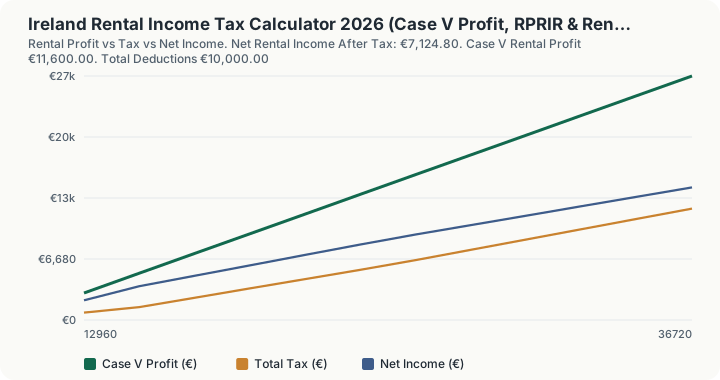
Quick Answer: €21,600 of annual rent, less €3,000 of expenses, €6,000 of RTB-registered mortgage interest and a €1,000 wear-and-tear allowance, leaves a Case V profit of €11,600 and €7,124.80 of net rental income after tax. On top of €55,000 of other income the profit attracts €4,640.00 of income tax at 40%, €348.00 of USC and €487.20 of PRSI, less €1,000.00 of Residential Premises Rental Income Relief.
What does this calculator do?
Irish rental income is taxed as Case V income. The profit is rent received less allowable deductions, and it is then stacked on top of your other income, so the rate it attracts is decided by what sits underneath it rather than by anything about the property. A landlord with €55,000 of salary pays 40% on the rent; one with €25,000 of salary would pay 20% on much of it.
Three features drive most of the outcome.
Mortgage interest is deductible in full, but only if the tenancy is RTB-registered. The old 75%/80%/85% restriction was fully unwound and there is no percentage limit now. But registration with the Residential Tenancies Board is a condition of the deduction, so failing to register does not cost a penalty so much as the entire interest deduction.
Rent-a-room relief is a cliff. Gross room rent in your own home up to €14,000 is exempt. At €14,001 the whole amount becomes taxable, not just the excess.
RPRIR is small and capped. Residential Premises Rental Income Relief is the lower of the annual cap and 20% of the rental profit. The cap is €1,000 for 2026, up from €800 in 2025 and €600 in 2024, and only one claim is allowed per year regardless of how many properties you hold.
How is this calculated?
Profit = R − E − I_RTB − 0.125F; Tax = ΔIT + ΔUSC + p⋅ Profit − RPRIR
Step 1: Check rent-a-room status. If the letting is rent-a-room and the gross rent is at or below €14,000, the whole amount is exempt: no profit, no deductions, no tax. Above the limit the exemption is lost entirely and the letting is computed normally.
Step 2: Take the allowable expenses. Insurance, repairs, RTB registration, agent and accountancy fees, local authority rates, ground rents, service charges you bear and mortgage protection premiums.
Step 3: Decide whether mortgage interest is deductible. If the tenancy is RTB-registered, the whole of the qualifying interest is deducted. If not, none of it is, and the calculator reports the disallowed amount separately.
Step 4: Compute the wear-and-tear allowance. The original cost of furniture and fittings multiplied by 12.5%, which is the annual rate for a maximum of eight years.
Step 5: Total the deductions. Expenses plus deductible interest plus the capital allowance.
Step 6: Compute the Case V profit. Rent received less total deductions, floored at zero.
Step 7: Compute the tax on your other income alone. A full Irish income tax and USC computation on the other income, with no rent.
Step 8: Compute the tax on other income plus the rental profit. The same computation with the profit stacked on top.
Step 9: Take the differences. The increase in income tax and the increase in USC are the amounts genuinely caused by the rent. Because both are progressive, this differencing is the only accurate way to attribute them.
Step 10: Compute PRSI on the profit. The profit multiplied by the PRSI rate you supply. No rate is hard-coded, because the class that applies depends on your own PRSI position.
Step 11: Compute RPRIR. The lower of €1,000 and 20% of the Case V profit, if claimed and the letting is not rent-a-room exempt.
Step 12: Total the tax. Incremental income tax plus incremental USC plus PRSI, less the RPRIR relief, floored at zero.
Step 13: Net rental income. Case V profit less that total.
Step 14: Measure the marginal rate. The calculator recomputes income tax and USC on €100 more of profit, adds the PRSI on that €100, and reports the result as a percentage.
Worked Example
A landlord with a €55,000 salary, single assessment, letting a property for €1,800 a month.
Step 1: Annual rent received. €1,800 x 12 = €21,600.00
Step 2: Allowable expenses. €3,000.00
Step 3: Mortgage interest deducted. The tenancy is RTB-registered, so the full €6,000.00 is allowed, and €0.00 is disallowed
Step 4: Wear-and-tear allowance. €8,000 x 12.5% = €1,000.00
Step 5: Total deductions. €3,000.00 + €6,000.00 + €1,000.00 = €10,000.00
Step 6: Case V profit. €21,600.00 - €10,000.00 = €11,600.00
Step 7: Income tax on €55,000 alone. €9,200.00
Step 8: Income tax on €66,600. €13,840.00
Step 9: Incremental income tax caused by the rent. €13,840.00 - €9,200.00 = €4,640.00, which is 40% of the profit, because the salary already fills the standard rate band
Step 10: Incremental USC. €348.00, which is 3% of the profit
Step 11: PRSI at 4.2%. €11,600.00 x 4.2% = €487.20
Step 12: RPRIR relief. min(€1,000, €11,600 x 20% = €2,320) = €1,000.00
Step 13: Total tax on the rental profit. €4,640.00 + €348.00 + €487.20 - €1,000.00 = €4,475.20
Step 14: Net rental income. €11,600.00 - €4,475.20 = €7,124.80
Step 15: Effective rate on the profit. €4,475.20 / €11,600.00 = 38.58%
Step 16: Marginal rate on the next €100 of rent. 40% income tax + 3% USC + 4.2% PRSI = 47.20%
Now the counterfactual that matters most. Fail to register the tenancy with the RTB and the €6,000 interest deduction disappears, lifting the Case V profit from €11,600 to €17,600 and adding roughly €2,832 of tax at this landlord's 47.2% marginal rate. It is the single most expensive compliance failure available to an Irish landlord.
What does this calculator not account for?
- The PRSI rate is a user input, not a computed figure. The class that applies to rental profit depends on the landlord's own PRSI position, and no single rate is correct for everyone. Check the Department of Social Protection's SW14 "PRSI Contribution Rates and User Guide" and set the field accordingly. The 4.2% default is a starting point, not a verified rate for your circumstances.
- Pre-letting expenditure on vacant premises is not modelled. It is capped and carries its own conditions.
- Retrofitting relief is not modelled.
- Capital allowances already part-used in earlier years are not tracked. The calculator applies a full 12.5% of the original cost every year it is run. Wear and tear runs for a maximum of eight years, after which the allowance ceases, and this page has no notion of which year you are in.
- Rental losses carried forward are not modelled. A loss in a prior year that could shelter this year's profit is not applied.
- Non-resident landlord withholding is not modelled. Where the landlord is outside Ireland, a withholding obligation can fall on the tenant or agent.
- RPRIR's four-year retention condition is not tested. The relief can be clawed back if the property is disposed of within the retention period, and the calculator does not model that.
- Only one property is modelled. RPRIR's second and third limbs, 20% of the qualifying premises' profit and 20% of the profit of all the landlord's Irish rental properties, collapse to the same figure for a single-property landlord. A multi-property landlord's relief could be lower than this page shows, and only one claim is allowed per year in any case.
- Tax credits are handled inside the underlying Irish income tax computation. The differencing approach means credits are applied consistently in both the baseline and the with-rent computation, but no rent-specific credit is applied.
What mistakes do people make with this?
- Not registering the tenancy with the RTB. Interest is deductible in full for residential lettings, but registration is a condition. Losing a €6,000 deduction at a 47.2% marginal rate costs roughly €2,832 a year.
- Deducting mortgage capital repayments. Only the interest is deductible. The capital element is not an expense at all.
- Going one euro over the rent-a-room limit. €14,000 of room rent is exempt; €14,001 is taxable in full. Revenue's own wording is that if the income exceeds the limit "then you are taxed on the total amount". A €1 overage can cost thousands.
- Expecting the old interest restriction. The 75%/80%/85% percentage restriction was fully unwound. Any guidance still applying it understates the deduction.
- Treating RPRIR as 20% of your rent. It is the lower of 20% of the Case V profit and the annual cap, which is €1,000 for 2026. On the worked example the 20% limb is €2,320, so the cap is what you actually get.
- Deducting capital improvements as expenses. Improvements are capital and are not deductible against rental income, though they may reduce a future CGT gain. Repairs are deductible; improvements are not.
- Assuming a flat 52% on rental income. The rate depends entirely on what other income the profit stacks on and on your PRSI class. This landlord faces 47.2% at the margin, not 52%.
- Running the wear-and-tear allowance forever. It lasts eight years from the expenditure. This calculator does not know which year you are in and will keep giving it.
Frequently Asked Questions
Is mortgage interest fully deductible against Irish rental income?
How much is rent-a-room relief and what happens if I go over?
What is RPRIR and how much can I claim?
How is wear and tear calculated on furniture?
What rate will my rental profit be taxed at?
Does PRSI apply to rental income?
Sources
- Revenue (revenue.ie), revenue.ie/en/property/rental-income/irish-rental-income/what-expenses-are-allowed.aspx, read 2026-08-30: the list of deductible expenses; interest on money borrowed to purchase, improve or repair the property being deductible where the tenancy is RTB-registered, with no percentage restriction; and wear and tear at "12.5% annually for a maximum of 8 years".
- Revenue (revenue.ie), revenue.ie/en/personal-tax-credits-reliefs-and-exemptions/land-and-property/rent-a-room-relief/index.aspx, read 2026-08-30: "The income you receive must not exceed the exemption limit of EUR 14,000. If it does, then you are taxed on the total amount."
- Revenue (revenue.ie), revenue.ie/en/personal-tax-credits-reliefs-and-exemptions/land-and-property/rprir/how-much-can-you-claim.aspx, read 2026-08-30: RPRIR as the lowest of the annual cap, 20% of the qualifying premises' rental profit and 20% of the profit of all the landlord's Irish rental properties, with caps of €600 (2024), €800 (2025), €1,000 (2026) and €1,000 (2027), and one claim per year.
Also consulted: Department of Social Protection, SW14 "PRSI Contribution Rates and User Guide", the source you should check for the PRSI rate to enter. No rate is hard-coded in the engine; Income tax, USC and the standard rate band come from engine/primitives/ireland-tax.ts, which carries its own Revenue citations.