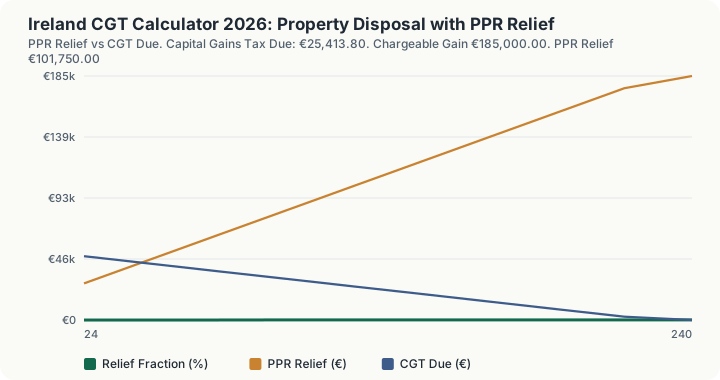
Quick Answer: A €500,000 sale of a property bought for €300,000 with €15,000 of allowable costs, owned 240 months and lived in for 120, produces €25,413.80 of Capital Gains Tax if sold on or after 7 October 2026. Principal Private Residence relief covers 55% of the €185,000 chargeable gain (132 qualifying months of 240, the final 12 counting automatically), leaving €83,250; the €1,270 annual exemption reduces that to €81,980 taxable at 31%. The same sale completed before 7 October 2026 was taxed at the former 33%: €27,053.40.
What does this calculator do?
Irish Capital Gains Tax is a flat 31% for disposals made on or after 7 October 2026, cut from 33% in Budget 2027 (disposals from 1 January to 6 October 2026 stay at 33%), with a small personal exemption of €1,270 a year that is not transferable between spouses. That much is simple. What decides most Irish CGT bills on a house is not the rate but Principal Private Residence relief under section 604 TCA 1997, and PPR relief is a time apportionment:
PPR Relief = Chargeable Gain × (Period of Occupation)/(Total Ownership Period)
Revenue treats the last 12 months of ownership as occupation whether or not you were living there, which is why a property you never lived in still gets a sliver of relief and why the fraction is almost never a clean one.
Two clarifications before the arithmetic. This is not the Capital Acquisitions Tax calculator: CGT is charged on the person disposing of an asset, on the growth in its value, while CAT is charged on the person receiving a gift or inheritance, on the whole value received. Until 7 October 2026 both sat at 33%, a coincidence of rate rather than a shared mechanism, and Budget 2027 cut only the CGT rate. And this page is specifically about the PPR question on a property disposal, not a general share or asset disposal.
How is this calculated?
Step 1: Compute the chargeable gain. Sale price, less purchase price, less allowable costs, floored at zero. Allowable costs are stamp duty and legal fees on purchase, agent and legal fees on sale, and enhancement expenditure still reflected in the property. Not repairs or maintenance.
Step 2: Add up actual and deemed occupation. Months lived in as your main home, plus deemed-occupation months, capped at the ownership period.
Step 3: Add the automatic final 12 months. Add twelve to the Step 2 figure, then cap the total at the ownership period. The calculator reports how many of those twelve were not already counted, so you can see what the rule actually contributed.
Step 4: Form the relief fraction. Qualifying months divided by total months owned.
Step 5: Apply the fraction to the gain. That product is the PPR relief.
Step 6: Subtract the relief from the gain. Floored at zero. This is the gain that remains chargeable.
Step 7: Apply capital losses. Losses are applied after PPR relief and before the annual exemption, floored at zero.
Step 8: Apply the annual exemption. Up to €1,270, but never more than the remaining gain, so it cannot create or increase a loss.
Step 9: Charge the flat rate on what is left. 31% for a disposal on or after 7 October 2026, 33% for one from 1 January to 6 October 2026, chosen by the Date of Disposal input. That is the CGT due.
Step 10: Compute the counterfactual. The calculator reruns the same steps with no PPR relief at all, so the value of the relief can be stated as a tax figure rather than as a fraction.
Worked Example
A house sold for €500,000, bought twenty years earlier for €300,000, with €15,000 of allowable costs. It was the owner's main home for ten of those twenty years and let for the rest.
Step 1: Chargeable gain. €500,000 - €300,000 - €15,000 = €185,000.00
Step 2: Occupation before the final-12 rule. 120 months lived in + 0 deemed = 120 months
Step 3: Add the automatic final 12 months. 120 + 12 = 132 qualifying months, of which 12 came from the final-12 rule
Step 4: Relief fraction. 132 / 240 = 55.00%
Step 5: PPR relief. €185,000 x 55.00% = €101,750.00
Step 6: Gain after PPR relief. €185,000.00 - €101,750.00 = €83,250.00
Step 7: Gain after losses. €83,250.00 - €0 = €83,250.00
Step 8: Annual exemption used. min(€83,250.00, €1,270) = €1,270.00
Step 9: Taxable gain. €83,250.00 - €1,270.00 = €81,980.00
Step 10: CGT at 31% (a sale on or after 7 October 2026). €81,980.00 x 31% = €25,413.80
Had the sale completed before 7 October 2026, the same €81,980.00 would have been charged at 33%: €27,053.40.
Step 11: Net gain after tax. €185,000.00 - €25,413.80 = €159,586.20
Now the counterfactual, to size the relief:
Step 12: Gain with no PPR relief, after the exemption. €185,000.00 - €1,270.00 = €183,730.00
Step 13: CGT with no PPR relief. €183,730.00 x 31% = €56,956.30
Step 14: Value of PPR relief. €56,956.30 - €25,413.80 = €31,542.50
Note how the ten years of letting cost this owner €25,413.80. Had they occupied the property throughout, the fraction would be 100% and no CGT would arise at all. Had they never occupied it, only the final 12 months would qualify, a relief fraction of 1/20th.
What does this calculator not account for?
- Deemed occupation is taken as an input, not inferred. Whether a particular absence qualifies is a question of fact. Revenue's list covers employment where all duties are performed outside Ireland, up to four years of employer-required relocation elsewhere, and time in hospital or a nursing home. The calculator does not test any of those conditions; it counts whatever months you enter.
- Floor-area apportionment is not applied. Where part of a property was used exclusively for business, or let as a separate unit, Revenue can apportion by area as well as by time. This calculator apportions by time only.
- Development land restrictions are not modelled. PPR relief is restricted where the disposal value reflects development potential rather than residential use. Gains on development land are also charged at 33% under section 649A TCA 1997, which Budget 2027 left unchanged; this calculator applies only the standard rate.
- Section 604A seven-year relief is not modelled. The relief for land and buildings acquired in the 2011 to 2014 window is a separate provision entirely.
- Indexation relief is not applied. It is available only for assets acquired before 2003 and is out of scope here, so gains on very long-held properties will be overstated.
- Only one annual exemption is applied. The €1,270 is per person per year and is not transferable between spouses. A jointly owned property disposed of by a couple would have two exemptions against their respective shares, which this single-taxpayer calculation does not model.
- The payment deadline is not surfaced on this page. Irish CGT has two windows: disposals from 1 January to 30 November are payable by 15 December of the same year, and December disposals by 31 January of the following year. This calculator computes the liability, not the deadline.
- Losses are taken as a single figure. No distinction is drawn between current-year and carried-forward losses, and no restriction on the use of losses against particular gains is applied.
- The rate change is taken from the Budget, ahead of the Finance Act. The 31% rate applies to disposals from 7 October 2026 as announced in Budget 2027 and already applied by Revenue; the Finance Bill that writes it into section 28(3) TCA 1997 had not been enacted when this page was updated. If the enacted rate or start date differs, the calculator will be updated.
- This is not Capital Acquisitions Tax. If you received the property as a gift or inheritance rather than disposing of it, this is the wrong tax entirely.
What mistakes do people make with this?
- Entering the final 12 months in the occupation field. The calculator adds them automatically. Including them yourself will double-count and overstate the relief. The help text on the input says so, and the "Months Added by the Final-12 Rule" output shows what was actually contributed.
- Assuming a former home is fully exempt. PPR relief is proportional to occupation, not a switch. Ten years of letting on a twenty-year ownership costs 45% of the relief, which on this gain is over €25,000 of tax.
- Expecting the €1,270 to matter. It is a small fixed exemption, worth at most €393.70 of tax at 31% (€419.10 at the former 33%), and it does not transfer between spouses. It is not a planning tool on a property disposal.
- Applying losses before PPR relief. The order is PPR relief, then losses, then the exemption. Applying losses first wastes them against a gain that would have been relieved anyway.
- Confusing CGT with CAT. CAT is still 33% and CGT was too until 7 October 2026, but CGT is on the disposer's gain and CAT is on the recipient's whole acquisition, with entirely different thresholds and reliefs.
- Counting repairs as allowable costs. Only enhancement expenditure still reflected in the state of the property qualifies, along with the incidental costs of acquisition and disposal. Ordinary maintenance and repairs do not.
- Forgetting deemed occupation entirely. Someone posted abroad by their employer for four years may be able to treat those 48 months as occupation, which on the worked example would lift the relief fraction from 55% to 75%.
Frequently Asked Questions
How is PPR relief calculated in Ireland?
Do the last 12 months really count even if I moved out?
What counts as deemed occupation?
Is the €1,270 exemption transferable between spouses?
What is the difference between CGT and CAT in Ireland?
When do I have to pay Irish CGT?
Sources
- Revenue (revenue.ie), "How to calculate CGT" (published 07 October 2026): the 31% rate for most gains from 7 October 2026, the historic 33% rate for disposals from 6 December 2021 to 6 October 2026, the 33% development land rate and the €1,270 annual personal exemption. Read 2026-10-08. revenue.ie/en/gains-gifts-and-inheritance/transfering-an-asset/how-to-calculate-cgt.aspx
- Department of Finance, Budget 2027: Tax Policy Changes, section 4.1, the standard rate in section 28(3) TCA 1997 reduced from 33% to 31% for disposals made on or after 7 October 2026, with no change to the 33% development land rate in section 649A. assets.gov.ie/static/documents/c6792805/Budget_2027_Tax_Policy_Changes_v2.pdf
- Revenue (revenue.ie), revenue.ie/en/gains-gifts-and-inheritance/cgt-reliefs/principal-private-residence-ppr-relief.aspx: section 604 TCA 1997 PPR relief as a time apportionment, "PPR Relief = Chargeable Gain x (Period of Occupation / Total Ownership Period)", the statement that "The last 12 months of ownership of a PPR is considered to be included in your period of occupation", and the list of deemed-occupation absences. Read 2026-08-30.
Full citation block, and the explicit list of what the PPR function does not do, is in engine/primitives/ireland-capital-gains.ts.
Also consulted: Citizens Information (citizensinformation.ie), Capital Gains Tax, corroboration of the rate, exemption and the two payment windows split at 30 November.