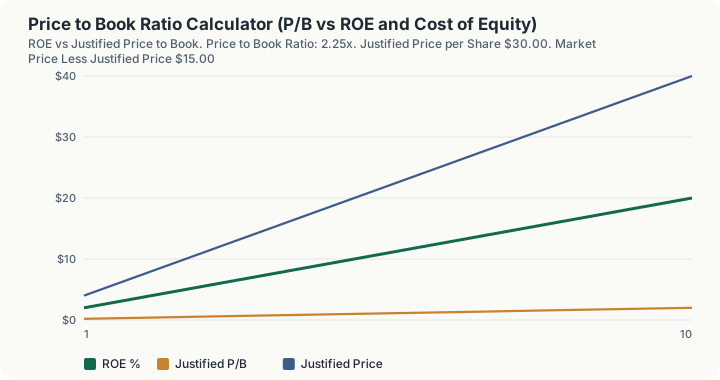
Quick Answer: A $45.00 share price against $20.00 of book value per share is a price to book ratio of 2.25x. Earnings of $3.00 per share on that book is a 15.00% return on equity, and against a 10.00% cost of equity the fundamentals justify only 1.50x, or $30.00 a share. The market is paying a 50.00% premium to the multiple the returns support.
What does this calculator do?
Price to book is the ratio most often quoted without the one number that makes it meaningful. A 2.25x multiple is neither cheap nor expensive on its own. It is expensive if the company earns 8% on its equity and cheap if it earns 25%, because what a share of book value is worth depends entirely on what that book value earns relative to what shareholders demand.
The identity that settles it comes straight out of the dividend discount model:
P/B = (ROE − g)/(r − g)
Set ROE equal to the cost of equity and the whole expression collapses to exactly 1.00, for every growth rate. A company earning precisely its cost of equity is worth its book value and not a cent more, no matter how fast it grows, because growth at the hurdle rate creates nothing. That single fact is what this calculator is built around.
So the page reports two multiples: the one you are being asked to pay, and the one the fundamentals justify. The gap between them is the argument.
How is this calculated?
Step 1: Compute the multiple actually being paid. $45.00 / $20.00 = 2.25x
Step 2: Compute return on equity from the per-share figures. Earnings per share divided by book value per share is the same ratio as net income over shareholders' equity. $3.00 / $20.00 = 0.15 = 15.00%
Step 3: Measure the excess return. This is the entire test in one number. 15.00% - 10.00% = +5.00 percentage points
Positive, so a premium to book is deserved. The question is how large a premium.
Step 4: Compute the justified multiple from the Gordon relation. With growth at the default of zero: (15.00% - 0%) / (10.00% - 0%) = 0.15 / 0.10 = 1.50x
Step 5: Convert the justified multiple into a price. 1.50 x $20.00 = $30.00 per share
Step 6: Take the valuation gap. $45.00 - $30.00 = $15.00 per share
Step 7: Express that as a premium. ($45.00 / $30.00) - 1 = 0.50 = 50.00%
The cost of equity is required to exceed the growth rate. If it does not, the denominator is zero or negative and the multiple is not finite; the engine rejects that case rather than printing a number.
The table on the page sweeps return on equity from 2% to 20% at the same cost of equity, and the justified multiple crosses 1.00x at exactly 10%, which is the identity in Step 4 made visible.
Worked Example
A bank trades at $45.00. Its last reported book value per share was $20.00 and it earned $3.00 per share. You think shareholders in this business require 10%.
Step 1: The multiple you would be paying. $45.00 / $20.00 = 2.25x
Step 2: What the equity earns. $3.00 / $20.00 = 15.00%
Step 3: Is a premium deserved at all? 15.00% against a 10.00% hurdle is +5.00 points of excess return. Yes. Every dollar of book equity in this business generates 15 cents where shareholders would accept 10 cents, so a dollar of book is worth more than a dollar.
Step 4: How much more? 0.15 / 0.10 = 1.50x. A dollar of book is worth exactly a dollar and fifty cents, which is 15 cents of perpetual excess earnings capitalised at the 10% hurdle.
Step 5: Translate to a price. 1.50 x $20.00 = $30.00
Step 6: The conclusion. The share costs $45.00 and the returns support $30.00. You are paying $15.00 a share, a 50.00% premium, for something the current profitability does not justify. To defend the price you have to believe return on equity rises, or that growth is coming, or that book value understates the assets.
Step 7: Test the boundary. Drop earnings per share to $2.00. Return on equity becomes exactly 10.00%, the justified multiple collapses to exactly 1.00x, and the justified price is exactly book, $20.00. Drop it to $1.20 and the 6.00% return justifies 0.60x: the discount to book is deserved rather than a bargain.
What does this calculator not account for?
- What book value actually contains. Accounting equity is a historical-cost residual. It reflects buybacks executed above book, decades of accumulated write-downs, goodwill from acquisitions, and any revaluation the standards happen to permit. This calculator takes the figure you type as given and tests nothing about its quality.
- Intangible-heavy businesses. Companies whose value sits in brands, software or research spend it through the income statement, so it never enters book value. Price to book on a software firm is close to meaningless, and no adjustment is made here.
- Where the cost of equity comes from. The 10.00% default is illustrative. No capital asset pricing model, beta, or equity risk premium is estimated anywhere on this page.
- Whether the growth rate is sustainable. The field accepts any value below the cost of equity. Retention ratio times return on equity is the disciplined estimate, and nothing enforces it.
- Earnings quality and one-off items. A single year's earnings per share drives the return on equity here. A large impairment or a gain on sale distorts it completely.
- Preferred stock and minority interests. Book value per share should exclude preferred equity. The calculator does not perform that subtraction.
- Leverage. Return on equity rises mechanically with debt. Two companies with identical operating returns and different balance sheets produce different justified multiples here, and the page does not flag the difference.
What mistakes do people make with this?
- Calling a low multiple cheap. A company at 0.6x book earning 6% against a 10% cost of equity is priced correctly, not cheaply. The discount is the market charging for value destruction. The justified multiple line exists to catch exactly this.
- Calling a high multiple expensive. By the same arithmetic, a company earning 25% against a 10% hurdle justifies 2.50x. Paying 2.25x for it would be a discount.
- Using a stale book value. Book value moves every quarter through retained earnings, buybacks and dividends. Pairing last year's book with today's price shifts the multiple.
- Including goodwill without thinking about it. Goodwill is the premium paid on past acquisitions. Whether it belongs in the denominator depends on whether those acquisitions earned their cost, which the ratio cannot tell you.
- Adding growth to rescue a weak business. Growth raises the justified multiple only when return on equity already exceeds the cost of equity. When it does not, growth makes the multiple worse, because the firm is expanding at a loss to shareholders. Try it: set earnings per share to $1.20 and then add growth.
- Comparing the ratio across industries. Banks and insurers carry mark-to-market balance sheets and are the natural home of this ratio. Asset-light businesses are not, and cross-sector screening on price to book produces noise.
- Using the wrong denominator in the return on equity. Earnings per share divided by book value per share is the per-share form. Using an average equity balance instead of the beginning or ending figure will shift the answer and should at least be consistent.
Frequently Asked Questions
What is a good price to book ratio?
Why does the justified multiple equal exactly 1.00 when ROE equals the cost of equity?
Should I use tangible book value instead?
Why does adding growth sometimes lower the justified multiple?
Can I use this for a company with negative book value?
How does this relate to the residual income model?
Sources
- U.S. Securities and Exchange Commission, Investor.gov, the official authority for the investing this calculator relates to. investor.gov
Also consulted: Gordon, M.J., "Dividends, Earnings and Stock Prices," Review of Economics and Statistics, 1959. The dividend discount relation from which P/B = (ROE - g)/(r - g) is derived; Williams, J.B., "The Theory of Investment Value," 1938; The engine computes the multiple as market price over book value per share, derives return on equity as earnings per share over book value per share, and applies the justified-multiple formula with a guard requiring the cost of equity to exceed the growth rate.