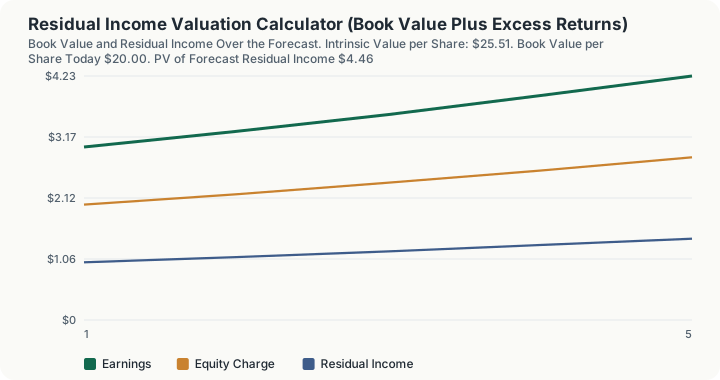
Quick Answer: $20.00 of book value per share earning a 15% return against a 10% cost of equity is worth $25.51 per share. Of that, $20.00 is book value already on the balance sheet, $4.46 is the present value of five years of residual income at a 40% payout ratio, and $1.05 is the continuing value decaying at a 0.6 persistence factor. Book value supplies 78.40% of the answer, which is why this model is more stable than a dividend discount model.
What does this calculator do?
Accounting earnings subtract every cost of doing business except one: the cost of the shareholders' own capital. A company can report a profit every year and still be destroying value, if the return it earns on equity is below what equity holders require. Residual income is the number that fixes the omission. It is earnings less an explicit charge for the equity employed.
Once that charge is imposed, valuation becomes an addition rather than a projection. A share is worth the book value it already has, plus the present value of whatever earnings exceed the equity charge from here on. When return on equity equals the cost of equity exactly, residual income is zero in every year and the model returns book value and nothing else.
The practical advantage is where the value sits. In a dividend discount model, a company paying no dividend has nothing to discount, and most of the value is pushed into a terminal figure that dominates the answer. Here, 78.40% of the value at the defaults comes from a figure the company already reported. That makes the result far less sensitive to the assumptions at the far end of the forecast.
How is this calculated?
V₀ = B₀ + ∑(t = 1 to N) RIₜ/((1 + r)ᵗ) + (RI_N × w/(1 + r − w))/((1 + r)^N)
where RIₜ = EPSₜ − r × B_(t − 1), earnings are ROE × B_(t − 1), and book value rolls forward by retained earnings, Bₜ = B_(t − 1) + EPSₜ(1 − payout).
Step 1: Compute year one earnings from beginning book value. $20.00 x 15% = $3.00
Step 2: Compute the equity charge on that same beginning book value. $20.00 x 10% = $2.00
This is the line accounting never draws. Two dollars of the three simply pay for the capital.
Step 3: Take the difference. That is residual income. $3.00 - $2.00 = $1.00
Step 4: Discount it one year. $1.00 / 1.10 = $0.91
Step 5: Roll book value forward by retained earnings. With a 40% payout, 60% is retained. $20.00 + ($3.00 x 0.60) = $21.80
Step 6: Repeat for year two on the larger book. Earnings: $21.80 x 15% = $3.27 Charge: $21.80 x 10% = $2.18 Residual income: $1.09 Discounted: $1.09 / 1.10² = $0.90 Ending book: $21.80 + ($3.27 x 0.60) = $23.76
Step 7: Continue through year five and sum the discounted residual income. $4.46
Note that residual income grows in dollars each year while its present value falls slightly. Book value is compounding at 9% a year through retention, so the excess return applies to a larger base, but discounting compounds faster.
Step 8: Value the residual income beyond the forecast. After year five, residual income is assumed to decay by the persistence factor each year. The sum of that decaying geometric series is exact, not an approximation:
∑_(k ≥ 1) (w/(1 + r))ᵏ = w/(1 + r − w)
With year five residual income of $1.41, a persistence factor of 0.6 and a 10% cost of equity: $1.41 x 0.6 / (1 + 0.10 - 0.6) = $0.847 / 0.50 = $1.69 at year five, discounted back five years at 1.10⁵ = $1.05
Step 9: Add the three components. $20.00 + $4.46 + $1.05 = $25.51
Step 10: Compute the implied multiple of book. $25.51 / $20.00 = 1.28x
Step 11: Compare against the market price. $30.00 - $25.51 = $4.49 paid above book plus discounted excess returns.
The components are rounded to the cent before they are added, so the reported total always equals the sum of the reported parts exactly.
Worked Example
A company reports $20.00 of book value per share. You forecast a 15% return on equity for five years, you require 10%, the company pays out 40% of earnings, and you think competition erodes the excess return steadily after the forecast window rather than instantly.
Step 1: What the balance sheet already gives you. $20.00
That is the floor, and unusually for a valuation model it is a reported number rather than a projection.
Step 2: What next year's earnings are worth above the hurdle. $3.00 earned, $2.00 of it consumed by the equity charge, $1.00 left over.
Step 3: What five years of that is worth today. $4.46
Step 4: What survives after the forecast. $1.05, on a persistence factor of 0.6. This is the assumption doing the least work on this page, and that is deliberate: it accounts for 4.1% of the total value. In a dividend discount model the equivalent terminal figure routinely carries more than half.
Step 5: The total. $20.00 + $4.46 + $1.05 = $25.51, an implied 1.28x book.
Step 6: Against a $30.00 market price. The market is paying $4.49 more than the model. To defend that you need a higher return on equity, a longer competitive advantage period, a lower cost of equity, or a persistence factor closer to one.
Step 7: Check the identity that anchors the model. Set the forecast return on equity to 10%, exactly the cost of equity. Residual income is zero in every year, the continuing value is zero, and the intrinsic value collapses to exactly $20.00, an implied 1.00x book. A company earning precisely its cost of equity is worth its book value. Every dollar above or below book is a statement about the spread between those two rates and nothing else.
Step 8: Note what the payout ratio does not do. Set the payout to zero. The model still values the company, because it never needed a dividend. Book value simply compounds faster and residual income grows on a larger base. A dividend discount model has nothing to discount here at all.
Carrying the Forecast Into Year Two and Beyond
Step 9: Year one, restated with the book value it leaves behind. Earnings $3.00, equity charge $2.00, residual income $1.00, ending book value $21.80, present value of that year's residual income $0.91.
Step 10: Year two. Earnings $3.27, equity charge $2.18, residual income $1.09, ending book value $23.76, present value $0.90. Residual income grew 9%; its present value fell by a cent.
Step 11: Year five. Earnings $4.23, equity charge $2.82, residual income $1.41, ending book value $30.77, present value $0.88.
Step 12: The five present values summed. $0.91 + $0.90 + $0.89 + $0.88 + $0.88 = $4.46, the forecast-window component of the $25.51 valuation.
The residual income stream grows 41% across the forecast and contributes almost exactly the same present value every year, because 9% growth and a 10% discount rate very nearly cancel. That near-cancellation is why the model is so insensitive to the length of the forecast window and so sensitive to the spread between return on equity and cost of equity, which is the only thing on this page that can change the shape of the stream rather than its length.
What does this calculator not account for?
- Clean surplus violations. The model assumes book value changes only through earnings and dividends. In practice, foreign currency translation, pension remeasurements, available-for-sale marks and other items bypass the income statement and land directly in equity. Every one of those breaks the roll-forward used here, and none of them is modelled.
- A constant return on equity. A single figure is applied to every forecast year. Real returns on equity move with the cycle, with mix, and with the leverage that changes underneath them.
- Share issuance and buybacks. The share count is fixed. Equity raised below or above book value shifts book value per share, and dilution from stock compensation is invisible.
- Accounting quality. Beginning book value is taken as reported. Aggressive capitalisation, understated provisions or acquisition goodwill all flow straight into the answer.
- Where the cost of equity comes from. The 10% default is illustrative. No capital asset pricing model, beta or risk premium is estimated anywhere.
- Any basis for the persistence factor. The 0.6 default is a convention, not a measurement. Empirical work on residual income persistence is thin and industry specific.
- Negative book value. A company with negative equity cannot be valued by this model, and no adjustment is made for that case.
What mistakes do people make with this?
- Forgetting that the equity charge uses beginning book value. Year one charges $2.00 on the $20.00 opening balance, not on the year-end $21.80. Using the closing figure overstates the charge and understates the value.
- Double counting growth. Book value grows here through retained earnings only. Adding a separate growth rate on top of the return on equity double counts the same reinvestment.
- Setting the persistence factor to one without meaning it. A factor of 1.00 says excess returns last forever with no decay. That is a strong claim about competition, and it inflates the continuing value substantially.
- Comparing the result to a dividend discount model and expecting a match. They agree in theory under clean surplus, but they distribute the value differently, and small assumption differences show up in wildly different places.
- Treating the $20.00 floor as safe. Book value is only a floor if the assets are worth what the balance sheet says. For an intangible-heavy business they usually are not, in either direction.
- Ignoring what happens when return on equity is below the cost of equity. Residual income goes negative and the model values the company below its own book. That is the correct answer, not a bug, and it is the case where residual income is most useful.
Frequently Asked Questions
Why does this model work for companies that pay no dividend?
What does the persistence factor actually represent?
Why is so much of the value already on the balance sheet?
What happens when return on equity is below the cost of equity?
Is the continuing value formula an approximation?
How does this relate to price to book?
Sources
- U.S. Securities and Exchange Commission, Investor.gov, the official authority for the investing this calculator relates to. investor.gov
Also consulted: Ohlson, J.A., "Earnings, Book Values, and Dividends in Equity Valuation," Contemporary Accounting Research, 1995. The modern formulation of the residual income model and of the persistence parameter used here; Preinreich, G., "Annual Survey of Economic Theory: The Theory of Depreciation," Econometrica, 1938. The early statement of the residual income identity; Edwards, E., and Bell, P., "The Theory and Measurement of Business Income," 1961; The engine implements the model directly: earnings as return on equity times beginning book value, an equity charge as the cost of equity times the same base, book value rolled forward by retained earnings, and an exact closed-form continuing value for decaying residual income.