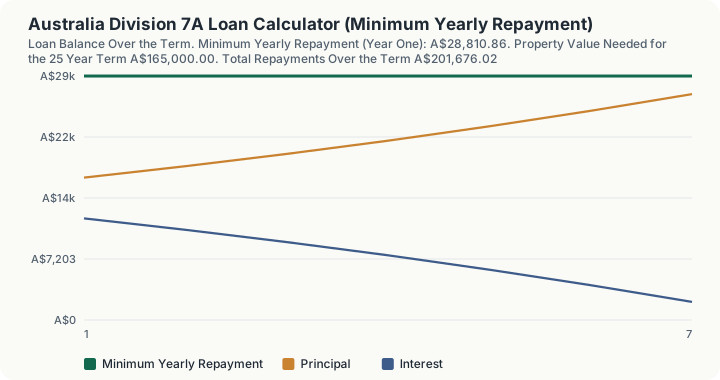
Quick Answer: A A$150,000 unsecured Division 7A loan at an 8% benchmark rate over the maximum 7 year term requires a minimum yearly repayment of A$28,810.86 in year one. The 8% is a placeholder: the benchmark rate is an RBA statistical publication, not a legislated figure, and you must enter the rate published for your income year.
What does this calculator do?
Division 7A of the Income Tax Assessment Act 1936 exists to stop a private company distributing profits to its shareholders as loans rather than as dividends. Section 109D deems the company to have paid a dividend where it lends to a shareholder or associate and the loan is not repaid by the lodgment day for that year of income. The critical feature is that the deemed dividend is unfranked. It carries no franking credit, so the shareholder pays tax on the full amount with nothing to offset against it, even though the company has already paid tax on the same profits. That is what makes non-compliance expensive rather than merely inconvenient.
Section 109N takes the loan back out of that deeming if three conditions are met: s 109N(1)(a), the agreement is in writing; s 109N(1)(b), the interest rate for years after the year the loan is made equals or exceeds the benchmark interest rate for the year; and s 109N(1)(c), the term does not exceed the s 109N(3) maximum. Section 109E then deems a dividend for any year in which the borrower fails to make the minimum yearly repayment.
The one figure here that cannot be verified is the benchmark rate. Section 109N(2) defines it as "the Indicator Lending Rates: Bank variable housing loans interest rate last published by the Reserve Bank of Australia before the start of the year of income". That is an RBA statistical release, not a figure in any Act or legislative instrument. It changes every year and appears nowhere on the Federal Register of Legislation. The 8% loaded by default is a placeholder, exposed as an input precisely so it is never mistaken for law. Everything else on this page, the s 109E(6) formula, the 7 and 25 year maximum terms, the 110% property value test, is verified statute, read in Compilation No. 192 of ITAA 1936, compilation date 1 July 2026.
How is this calculated?
Section 109E(6) states the minimum yearly repayment as the amount of the loan not repaid by the end of the previous year of income, multiplied by the current year's benchmark rate, divided by one minus the reciprocal of one plus that rate raised to the remaining term. That is the ordinary annuity payment formula. Using the defaults: A$150,000, 8%, 7 year term, year one.
- Step 1: Determine the maximum term under s 109N(3). The loan is not secured by a registered mortgage over real property, so s 109N(3)(b) applies. maximum term = 7 years
- Step 2: Establish the remaining term for year one. 7 - 1 + 1 = 7 years
- Step 3: Compound one plus the benchmark rate over the remaining term. 1.08^7 = 1.71382426877952
- Step 4: Take the reciprocal. 1 / 1.71382426877952 = 0.58349039526213
- Step 5: Form the statutory denominator. 1 - 0.58349039526213 = 0.41650960473787
- Step 6: Multiply the opening balance by the benchmark rate. A$150,000 x 8% = A$12,000.00
- Step 7: Divide to obtain the minimum yearly repayment. A$12,000.00 / 0.41650960473787 = A$28,810.86
- Step 8: Split year one between interest and principal. interest A$150,000 x 8% = A$12,000.00; principal A$28,810.86 - A$12,000.00 = A$16,810.86
- Step 9: Carry the closing balance forward. A$150,000.00 + A$12,000.00 - A$28,810.86 = A$133,189.14
The engine recomputes step 3 onwards each year on the actual opening balance and the reducing remaining term, which is what s 109E(6) requires. It is not a fixed annuity payment locked in at the start, although with a constant benchmark rate and full repayments the two coincide, and the balance amortises to nil by the end of the term.
Worked Example
The term is worth more than the rate. Section 109N(3)(a) allows a 25 year term, but only where 100% of the loan is secured by a mortgage registered under a State or Territory law and, when the loan is first made, the market value of that property less prior-ranking secured liabilities is at least 110% of the loan amount.
On a A$150,000 loan, 110% means the property must be worth at least A$165,000. Meet that with, say, a A$400,000 property and the same loan at the same 8% rate over 25 years needs only:
1.08^25 = 6.848475196; reciprocal 0.14601790; denominator 0.85398210; A$12,000.00 / 0.85398210 = A$14,051.82 a year. Roughly half the 7 year figure, on identical loan terms.
Failing the 110% test costs you the whole benefit. A property worth A$155,000 is only 103% of a A$150,000 loan. Section 109N(3)(a)(ii) is not satisfied, so the term drops straight back to 7 years under s 109N(3)(b) and the minimum returns to A$28,810.86. There is no partial credit and no proportional term. The security is either good enough or it is not.
Underpaying. Repay only A$20,000 in year one against the A$28,810.86 minimum and s 109E deems a dividend of the A$8,810.86 shortfall. At a 47% marginal rate that is roughly A$4,141 of tax, and because the deemed dividend is unfranked there is no franking credit to reduce it.
What Seven Years of Minimum Repayments Actually Costs
The minimum yearly repayment is the compliance test, but the interest inside it is the real price of having taken the money out as a loan rather than a dividend.
Step 1: Year 1 split. Of the A$28,810.86 repayment, A$12,000.00 is interest and A$16,810.86 is principal, closing at A$133,189.14
Step 2: Year 2 split. A$10,655.13 interest, A$18,155.73 principal, closing at A$115,033.41
Step 3: Interest paid after two years. A$12,000.00 + A$10,655.13 = A$22,655.13
Step 4: Repayments made after two years. A$28,810.86 x 2 = A$57,621.72, against a A$150,000 loan
Step 5: The full seven-year term. Total repayments A$201,676.02, of which A$51,676.02 is interest, closing balance A$0.00
Two years in, the shareholder has paid A$57,621.72 and reduced the debt by only A$34,966.59. Over the full term the loan costs A$51,676.02 in interest, roughly a third of the original amount, and every dollar of it is assessable income to the private company while giving the shareholder no deduction unless the borrowing was genuinely income-producing. That is the standing cost of keeping a Division 7A loan complying rather than repaying it early.
What does this calculator not account for?
- The benchmark interest rate is unverified. The 8% default is a placeholder. Section 109N(2) points to an RBA statistical publication that changes annually and is not on the Federal Register of Legislation. Enter the rate published before the start of your income year.
- Section 109N(2) also allows the benchmark rate to be worked out under the regulations where they so provide. The calculator simply takes whatever rate you enter.
- The lodgment day itself. The calculator assumes a complying loan agreement is in place and models the repayments; it does not model the s 109D outcome where no agreement exists at all and the entire loan balance is deemed a dividend.
- The distributable surplus limit, which can cap the deemed dividend a company is treated as paying.
- A benchmark rate that changes partway through the term. The schedule applies the single rate you enter to every year.
- Whether the written agreement satisfies s 109N(1)(a). That is a legal question the calculator cannot assess.
What mistakes do people make with this?
- Treating the 25 year term as available because a mortgage exists. It requires both a registered mortgage over 100% of the loan value and property worth at least 110% of the loan when the loan is first made.
- Assuming a franking credit comes with the deemed dividend. It does not. That is the entire sting of Division 7A.
- Using last year's benchmark rate. The rate is the one last published by the RBA before the start of the income year, and it moves.
- Paying interest only. The minimum yearly repayment is a full amortising payment. Paying only the A$12,000 of interest leaves a A$16,810.86 shortfall deemed as an unfranked dividend.
- Entering a term longer than the maximum. The engine caps the term at the s 109N(3) maximum, because a longer term would take the loan outside s 109N entirely.
Frequently Asked Questions
Why is the benchmark rate a user input rather than a built-in figure?
What makes a deemed dividend so costly?
How much does the 25 year term save?
What exactly is the 110% test?
What happens if I repay less than the minimum?
Sources
- Income Tax Assessment Act 1936, No. 27, 1936, series C1936A00027, Part III Division 7A, read in Volume 2 of 7 of Compilation C2026C00333, Compilation No. 192, compilation date 1 July 2026: <legislation.gov.au/C1936A00027/latest/text>
Also consulted: s 109D, the deemed dividend on an unrepaid private company loan; s 109E(6), the minimum yearly repayment formula; s 109N(1), the three conditions for a complying loan; s 109N(2), the benchmark interest rate; s 109N(3), the 7 year and 25 year maximum terms; The benchmark interest rate itself is the Reserve Bank of Australia's "Indicator Lending Rates, Bank variable housing loans" series. It is an RBA statistical publication and appears on no legislative register; Verification for this collection was carried out against legislation.gov.au.