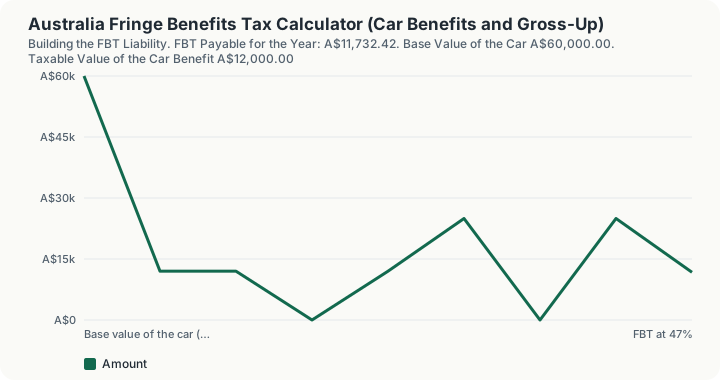
Quick Answer: A A$60,000 petrol car available to an employee for the full FBT year, with no employee contribution, produces a taxable value of A$12,000.00 and A$11,732.42 of FBT payable for the year.
What does this calculator do?
A$11,732.42 of tax on A$12,000 of taxable value is 97.77 cents of FBT for every dollar of benefit. Providing a fringe benefit does not add a percentage to its cost; for a type 1 benefit it very nearly doubles it.
The rate lands so close to one dollar because the gross-up and the 47% tax rate compose. Section 5B(1B) grosses the type 1 aggregate amount up to what an employee would have had to earn, pre-tax and GST-inclusive, to buy the benefit themselves; s 6 of the Fringe Benefits Tax Act 1986 then taxes that grossed-up figure at 47%. Composing the two gives a single multiplier:
FBT = taxable value × (FBT rate + GST rate)/((1 − FBT rate)(1 + GST rate)) = taxable value × 0.57/0.583
The gross-up rates themselves are also not statutory numbers. The figures 2.0802 and 1.8868 are quoted everywhere as though they were constants in the Act, and they appear nowhere in it. Sections 5B(1B) and 5B(1C) state formulas whose only terms are the FBT rate and the GST rate, both defined in s 136(1). This engine derives both rates from 47% and 10% rather than hardcoding the rounded decimals, so they cannot go stale independently of the rates that produce them.
How is this calculated?
The defaults: a A$60,000 GST-inclusive cost price, 365 days available, no employee contribution, a petrol car, and an employer entitled to a GST credit.
- Step 1: Establish the base value (s 9(2)). The car has not passed its fourth anniversary. A$60,000 x 1 = A$60,000.00
- Step 2: Apply the 20% statutory fraction (s 9(1)). A$60,000.00 x 0.2 = A$12,000.00
- Step 3: Apply the availability fraction (s 9(1)). A$12,000.00 x 365 / 365 = A$12,000.00
- Step 4: Subtract the recipient's payment (s 9(1)). A$12,000.00 - A$0 = A$12,000.00 taxable value
- Step 5: Test the s 8A exemption. Not a battery electric or hydrogen fuel cell vehicle, so no exemption applies. A$12,000.00
- Step 6: Route it to the type 1 aggregate. The employer was entitled to a GST credit on the car. type 1 = A$12,000.00, type 2 = A$0.00
- Step 7: Derive the s 5B(1B) gross-up rate from the FBT and GST rates. (0.47 + 0.10) / (0.53 x 1.10 x 0.47) = 2.0802
- Step 8: Gross up the type 1 amount (s 5B(1B)). A$12,000.00 x 2.08021605... = A$24,962.59
- Step 9: Add the grossed-up type 2 amount to get the fringe benefits taxable amount. A$24,962.59 + A$0.00 = A$24,962.59
- Step 10: Apply the s 6 rate of 47%. A$24,962.59 x 47% = A$11,732.42
- Step 11: Express the result per dollar of taxable value. A$11,732.42 / A$12,000.00 = 0.9777, or 97.77% of the taxable value
Worked Example
Take the same A$60,000 car and change one input at a time.
As a battery electric vehicle. Section 8A exempts a car benefit where the car is a zero or low emissions vehicle and no luxury car tax has become payable on it. The taxable value falls to nil, the FBT falls to nil, and the exemption saving line reports the full A$11,732.42.
As a plug-in hybrid. The FBT stays at A$11,732.42. Section 8A(2) covers only (a) battery electric vehicles and (b) hydrogen fuel cell electric vehicles. Plug-in hybrids were removed by Schedule 2 items 1 to 4 of the Treasury Laws Amendment (Electric Car Discount) Act 2022 for benefits provided on or after 1 April 2025. Item 5(2) grandfathers arrangements where a binding commitment to the car's availability existed before that date, and setting the grandfathering flag restores the exemption. Without it, a PHEV is taxed exactly like the petrol car.
As an electric car attracting luxury car tax. At a A$150,000 cost price, s 8A(1) is not satisfied. The taxable value is A$30,000 and the FBT is A$29,331.05. The exemption is lost entirely, not scaled back.
With a A$4,000 employee contribution. Section 9(1) subtracts the recipient's payment dollar for dollar: A$12,000 becomes A$8,000, and the FBT falls to A$7,821.61.
Held more than four years. Section 9(2) reduces the base value to two-thirds, so A$60,000 becomes A$40,000 and the taxable value A$8,000.
Remove the GST credit entitlement. The same A$12,000 becomes a type 2 amount, grossed up at 1/0.53 = 1.8868, and the FBT is A$10,641.51. Type 2 benefits are cheaper because the gross-up does not have to restore GST the employer never recovered.
What does this calculator not account for?
- The operating cost method. Only the s 9 statutory formula method is modelled. Section 10 allows an election to use operating costs with a logbook business-use percentage, which can produce a much lower taxable value.
- Base value adjustments other than the four-year reduction. Non-business accessories, dealer delivery and leased cars are not separately modelled; the cost price is taken as entered.
- Benefit types other than car benefits. Other type 1 and type 2 amounts can be entered directly, but the calculator does not compute loan, expense payment, housing, board, entertainment or residual benefit taxable values.
- Reductions and concessions. No otherwise-deductible rule, no minor benefits exemption, no s 58X work related items, no rebatable or FBT-exempt employer capping, and no reportable fringe benefits amount.
- Upcoming changes deliberately not applied. Schedule 4 Part 2 of the Treasury Laws Amendment (Tax Reform No. 1) Act 2026 inserts s 24(1A), stopping the otherwise-deductible rule from applying to salary packaged expense payment benefits of the kind now covered by the ITAA 1997 s 25-130 standard deduction, and replaces s 58X(2) to (5) so that an eligible work related item must not be provided under a salary packaging arrangement, with the former one-item-per-year limit removed. Item 20 applies those amendments only to FBT years starting on or after 1 April 2027.
- Instalments and lodgment. The calculator produces an annual liability, not a payment schedule.
Every figure used is drawn from the two Acts. There are no estimated values in this calculator.
What mistakes do people make with this?
- Comparing a benefit with salary at the 47% headline rate. The effective cost of a type 1 benefit is 97.77% of its taxable value.
- Assuming a plug-in hybrid is still exempt. It is not, for benefits provided on or after 1 April 2025, unless the item 5(2) grandfathering applies.
- Treating luxury car tax as a partial restriction on the exemption. Section 8A(1) is a condition, not a cap. Once luxury car tax has become payable, the exemption is gone.
- Counting only the days the car was driven. A car garaged at an employee's home is generally available for private use whether or not it moves.
- Quoting 2.0802 as a figure from the Act. It is the value of a formula, correct only while the FBT rate is 47% and the GST rate is 10%.
Frequently Asked Questions
Why derive the gross-up rates instead of using 2.0802?
What makes a benefit type 1 rather than type 2?
Does an employee contribution always save FBT?
Are the 2027 changes to salary packaging reflected in the result?
Sources
- Fringe Benefits Tax Act 1986 (No. 40, 1986), Compilation No. 9, compilation date 19 June 2018: s 6, the 47% rate. legislation.gov.au/C2004A03281/latest/text
- Fringe Benefits Tax Assessment Act 1986 (No. 39, 1986), Compilation No. 97, compilation date 1 July 2026: ss 5B(1B), 5B(1C), 8A, 9(1), 9(2), 24(1A), 58X, 136(1). legislation.gov.au/C2004A03280/latest/text
- Treasury Laws Amendment (Electric Car Discount) Act 2022, Schedule 2 items 1 to 4 and item 5(2). legislation.gov.au/C2022A00086/latest/text
- Treasury Laws Amendment (Tax Reform No. 1) Act 2026 (No. 49, 2026), Schedule 4 Part 2, items 18 to 20. legislation.gov.au/C2026A00049/latest/text
Verification was against the Federal Register of Legislation.