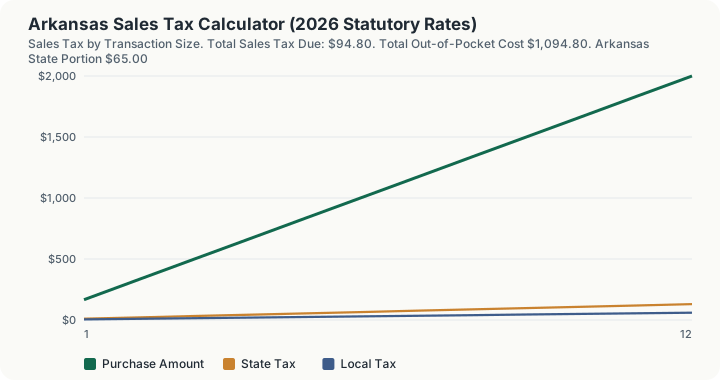
Quick Answer: A $1,000 taxable purchase in Arkansas costs $94.80 in combined state and local sales tax, for a total of $1,094.80 out the door.
Sixty-Five Dollars to Little Rock, Thirty to the City
Arkansas pairs a high state rate with a substantial local layer: 6.50% at the state level and a statewide average 2.98% from cities and counties, for a combined 9.48%. On the $1,000.00 default the engine returns $94.80 of tax, split $65.00 state and $29.80 local. Unlike Alabama or Colorado, the state takes the larger share here, by $35.20 per $1,000.00 of taxable spending.
The proportions hold at every size computed. At $50,000.00 the tax is $4,740.00, of which $3,250.00 is state and $1,490.00 local. At $100.00 it is $9.48, of which $6.50 is state and $2.98 local. That 2.98% is one statewide average, and this calculator has no city, county or ZIP input, so it cannot produce the rate for any particular Arkansas address.
How This Is Calculated
Arkansas runs a high state rate with heavy local layering: 6.50% at the state level and an average 2.98% from cities and counties, for a combined 9.48% and $94.80 on a $1,000 purchase. The most distinctive feature is the split grocery base. Food for home consumption is taxed at a sharply reduced state rate rather than the full 6.50%, while local rates continue to apply to it in full, so the grocery total on an Arkansas receipt is not simply the general rate applied to food. None of that split is modelled here.
This calculator works on the general base, where state and local rates share the same taxable amount:
The order of operations is:
- Read the purchase price. The full pre-tax amount you enter becomes the taxable base; a negative entry is clamped to zero.
- No item-level exemption filtering. The reduced grocery rate and the prescription drug exemption are not modeled. The combined general rate is applied to the full amount you enter.
- Multiply by the state rate and round to the cent. This produces the state portion as its own rounded figure.
- Multiply by the local surcharge and round to the cent separately. The 2.98% average reflects city and county rates across Arkansas, several of which run above 3% on their own. If the local toggle is off, this term is zero.
- Add the two rounded pieces together. State tax plus local tax gives the total tax, and adding that to the purchase price gives the amount you actually pay.
Worked Example
For a $1,000 taxable purchase in Arkansas:
- Starting purchase price. The buyer rings up a $1,000.00 taxable retail purchase in Arkansas, the baseline amount before any tax is applied.
- State portion. Arkansas's statutory state sales tax rate of 6.50% applies to the full purchase amount: $1,000.00 × 6.50% = $65.00 owed to the state.
- Local portion. Local municipal, county, and special-district surcharges add an average of 2.98% on top of that: $1,000.00 × 2.98% = $29.80 more.
- Combined tax due. Summing the two pieces, $65.00 in state tax plus $29.80 in local surcharge comes to $94.80 in total sales tax owed on the transaction.
- Total out-of-pocket cost. Adding that $94.80 in tax to the $1,000.00 purchase price brings the buyer's total out-of-pocket cost to $1,094.80.
This example uses Arkansas's statewide average local rate of 2.98%; actual combined rates vary by city and county, so a real receipt could show a combined rate above or below the 9.48% average used here.
What the Tier Schedule Shows, and What It Cannot
The twelve tiers on this page are a straight line, and there is no threshold in them because the rate is flat. The computed values run $15.80 of tax at $166.67, $47.40 at $500.00, $94.80 at $1,000.00, $142.20 at $1,500.00 and $189.60 at $2,000.00. Carried further, the same line gives $474.00 at $5,000.00, $2,370.00 at $25,000.00 and $4,740.00 at $50,000.00.
There is no purchase size at which the rate changes. At $100.00 the tax is $9.48 and at $50,000.00 it is $4,740.00, both exactly 9.48% of the base, so no advice about staying under a figure has anything to attach to. Each additional $100 of purchase price costs $9.48: $1,000.00 returns $94.80 and $1,100.00 returns $104.28. One extra dollar costs ten cents, taking $94.80 to $94.90 at $1,001.00. A $1.00 purchase rounds to $0.10 of tax.
Pricing the Local Layer On and Off
The local surcharge switch is the only step change this calculator has. At $1,000.00, turning it off drops the tax from $94.80 to $65.00 and the total cost from $1,094.80 to $1,065.00. At $50,000.00 it drops from $4,740.00 to $3,250.00, a $1,490.00 difference on a single transaction.
That is a modelling switch, not a statutory one. With local tax on, the engine applies a statewide blend charged at no specific address; with it off, it reports the bare 6.50% state rate, which understates almost every real Arkansas purchase. Several Arkansas cities and counties exceed 3% on their own, so the true combined figure at a given address can sit well above 9.48%, and the calculator has no way to say so.
Recovering the Pre-Tax Price From a Receipt Total
The engine runs in one direction. It takes a pre-tax amount and adds tax, and it has no tax-extraction mode: there is no input for a tax-inclusive figure. So the question "my receipt says $1,000.00 including tax, what was the shelf price" cannot be asked directly, only searched for by running the forward calculation.
For Arkansas the answer is a pre-tax price of $913.41, which the engine prices at $59.37 of state tax and $27.22 of local tax, or $86.59 total, giving an out-the-door cost of exactly $1,000.00. A cent lower, $913.40, totals $999.99.
The wrong method against the right one, priced. The usual mistake is to multiply the $1,000.00 tax-inclusive total by 9.48%. Entered as a pre-tax amount, $1,000.00 returns $94.80 of tax, but a $1,000.00 receipt actually contains $86.59. The overstatement is $8.21 per $1,000.00 of gross, about $821 across $100,000 of gross taxable receipts. The correct operation is the tax fraction, r divided by (1 + r), rather than the rate itself. Measured against a tax-inclusive total, Arkansas's 9.48% combined rate works out to roughly 8.66%. Those are different numbers, and a bookkeeping export that uses the headline rate to strip tax out of gross figures will never reconcile against the tax actually collected.
What This Does Not Account For
- Any specific jurisdiction. The 2.98% local figure is a statewide average. There is no ZIP, city or county input, and Arkansas local rates spread widely around it.
- The split grocery base. Arkansas taxes food for home consumption at a sharply reduced state rate while local rates apply in full. The engine applies the single 9.48% combined rate to whatever amount you enter, so a grocery total entered here is materially overstated.
- What else you bought. No product taxability classification exists. Prescription drugs, clothing and services are taxed at the same combined rate as general merchandise.
- Exemption and resale certificates, direct pay permits, and sales tax holidays. None are modelled; no input could express them.
- Use tax, marketplace facilitator collection, and economic nexus thresholds for sellers. The engine prices a single transaction and computes no filing or registration obligation.
- Special industry excise taxes such as lodging, rental vehicle, alcohol and tobacco levies, which stack on top of the general rate.
- Cent-level agreement with a register applying one combined rate. The state and local components are each rounded to the cent before being summed. At $999.11 the engine returns $94.71 of tax; applying 9.48% once to the same base and rounding gives a figure one cent higher.
Common Pitfalls
- Quoting 6.50% as the Arkansas rate. On $1,000.00 that understates the bill by $29.80, and on $50,000.00 by $1,490.00.
- Running a grocery total through this page. The engine has no reduced-rate path, so it returns the full $94.80 on $1,000.00 of food that Arkansas would tax far more lightly at the state level.
- Stripping tax from a gross total at 9.48%. A $1,000.00 tax-inclusive receipt contains $86.59 of tax, not $94.80.
- Expecting a threshold. The sweep is linear from $0.10 of tax on $1.00 to $4,740.00 on $50,000.00, with no rate change anywhere in between.
Frequently Asked Questions
What is the sales tax rate in Arkansas?
How much of an Arkansas sales tax bill is local?
How much tax is inside a $1,000 Arkansas receipt?
Are groceries taxed in Arkansas?
How does use tax differ from sales tax?
Sources
- Arkansas Department of Finance and Administration: 2026 Sales and Use Tax Rate Schedules. dfa.arkansas.gov
- Streamlined Sales Tax Governing Board (SSTGB): State Taxability Matrix. streamlinedsalestax.org/for-businesses/taxability-matrix