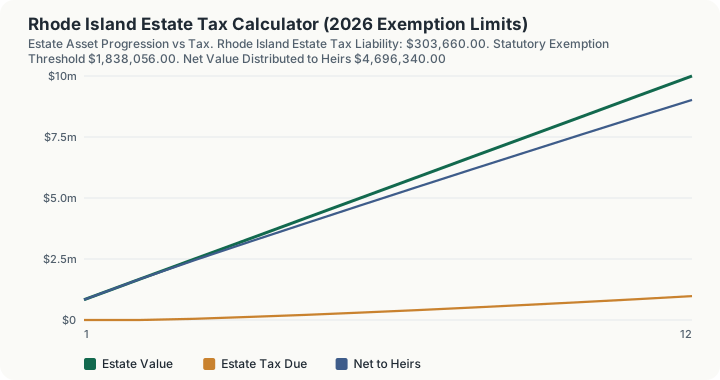
Quick Answer: A $5,000,000 estate in Rhode Island owes $303,660 in state estate tax. Rhode Island does not tax the $3,161,944 above the exemption at a flat rate; it applies the pre-2001 federal credit-table schedule to the entire estate and then subtracts a flat 2026 credit of $87,940 (the amount that zeroes out an estate exactly at the $1,838,056 exemption).
Why Rhode Island's Exemption Is Not a Round Number
Rhode Island's estate tax exemption, $1,838,056, is one of the more specific, non-round thresholds among the twelve states with a separate estate tax, the kind of figure that results from an exemption originally set at a round number and adjusted for inflation since.
The number is odd because it is not a legislated exemption at all: Rhode Island applies the pre-2001 federal credit table to the whole estate and subtracts a flat $87,940 credit, and $1,838,056 is simply the estate value at which those two figures cancel. The credit is reset annually, so the threshold moves with it.
As the smallest state by land area, Rhode Island has an unusually high share of residents living within a short drive of a state border, which makes cross-border estate and residency planning a more routine consideration here than in most other states with an estate tax.
There's no additional inheritance tax in Rhode Island, so the estate-level figure above is the complete state tax picture. Because the exemption adjusts periodically, Rhode Island residents with estates near the threshold should confirm the current-year figure rather than relying on a number from a prior tax year.
How This Is Calculated
The calculator starts from two numbers you enter: the gross estate at fair market value, and the marital, charitable, and administrative deductions the estate can claim. It subtracts the second from the first to get the net estate, then applies Rhode Island's own schedule to that figure. Nothing else feeds the result.
Rhode Island uses the same shape as Massachusetts, with different numbers. Under R.I. Gen. Laws section 44-22-1.1 the state applies the frozen pre-2001 federal state-death-tax credit table to the whole estate, less a $60,000 adjustment, then subtracts a flat 2026 credit of $87,940. The much-quoted $1,838,056 threshold is not a subtraction at all: it is simply the estate value at which the table output equals the credit, so the tax comes out to zero.
- Value the gross estate. Fair market value at the date of death of all real property, business interests, securities, cash, and life insurance proceeds the decedent owned.
- Subtract allowable deductions. Debts, administrative expenses, qualifying charitable bequests, and the unlimited marital deduction come off the gross figure.
- Subtract $60,000 to reach the adjusted taxable estate.
- Run the credit table, whose graduated steps climb from 0.8% just above $40,000 to 16% above $10,040,000.
- Subtract the $87,940 credit, flooring the result at zero.
- Subtract the tax from the net estate to get what beneficiaries receive.
The threshold is republished each year as the credit is adjusted, which is why it is an odd number rather than a round one. A $3,000,000 Rhode Island estate owes $94,060, an effective rate of 3.14%.
That is the entire computation. The calculator does not carry over a deceased spouse's unused exemption, add back lifetime taxable gifts, apply the generation-skipping transfer tax, discount closely held interests, or figure the separate federal return. Those sit under "What This Does Not Account For" below, not in the math above.
Worked Example
- Start with the gross estate. This example uses a $5,000,000 gross estate: the fair market value of all property, business interests, equities, cash, and life insurance the decedent owned at death, before deductions.
- Apply the credit-table schedule to the whole estate, not just the excess. Rhode Island runs the pre-2001 federal state-death-tax-credit table against an adjusted taxable estate of $5,000,000 − $60,000 = $4,940,000, landing in the $4,040,000-$5,040,000 bracket: $290,800 + 11.2% × ($4,940,000 − $4,040,000) = $391,600.
- Subtract the flat 2026 credit of $87,940. The credit is set so the $1,838,056 exemption threshold produces exactly $0 tax. $391,600 − $87,940 = $303,660.
- Net estate distributed to heirs. $303,660 in tax leaves $4,696,340 ($5,000,000 minus $303,660) to beneficiaries.
- Why this isn't "excess × 16%." A flat 16% on the $3,161,944 above the exemption would suggest roughly $505,911; the real table-and-credit mechanism produces $303,660 instead, since the credit table is graduated and applied to the whole estate before the flat credit is subtracted.
- What this leaves out. This is Rhode Island's state-level computation only; federal estate tax is assessed separately under IRC § 2010.
Walking the $1,838,056 Cliff, Dollar by Dollar
Rhode Island's exemption behaves as a genuine on/off point, and the calculator lets you stand on either side of it. Sweeping grossEstateValue in $2 steps with deductions at zero:
At a net estate of $1,838,054. The credit table produces less than the $87,940 flat credit, the subtraction floors at zero, and the tax due is $0.00.
At $1,838,056, two dollars later. The table output has just overtaken the credit and the tax due is $0.03. That is the entire meaning of the published exemption: it is the crossover point of two figures, not a deduction, and the engine reports it as exemptionThreshold because the JSON stores it, not because any subtraction uses it.
At $1,838,058. The tax is $0.18, then $0.32 at $1,838,060. There is no jump-to-a-large-number cliff here of the New York kind; what makes the boundary sharp is how fast the liability climbs immediately after it.
At $1,839,000, roughly a thousand dollars past the line. The tax is $68.00. At $1,840,000 it is $140.00, at $1,850,000 $860.00, and at $1,900,000 $4,460.00.
The cost of the next $100,000 above the line
From $1,838,056 to $1,938,056 the tax moves from $0.03 to $7,200.03. That is $7,200 per $100,000, a 7.2% marginal rate on the first slice of estate above the threshold, and it holds flat to $2,038,056, where the tax is $14,400.03. The marginal rate is not the 0.8% figure at the bottom of the credit table, because the table is applied to the whole estate and the flat credit has already absorbed everything below the crossover; the first taxable dollar arrives already sitting in the table's 7.2% band.
Higher up the schedule the step widens. Between $4,900,000 and $5,000,000 the tax rises from $292,460 to $303,660, a marginal $11,200 per $100,000 (11.2%). From $11,000,000 onward each additional $500,000 of estate costs a flat $80,000, the credit table's 16% top band, reached once the adjusted taxable estate passes $10,040,000.
The reverse question: how much passes untouched?
Run it backwards and the answer is precise. A Rhode Island net estate of $1,838,054 owes nothing. Every dollar of estate below that passes to heirs without a state estate tax reduction of any size, and the calculator returns an effective rate of 0.00% across that whole range.
Deductions move the line rather than the tax. The schedule tiers off the net estate, gross minus estateDeductions, so a $5,000,000 gross estate carrying $3,161,944 of marital and charitable deductions computes on $1,838,056 and owes $0.03 instead of $303,660. That is the single largest lever the calculator actually models: $3,161,944 of deductions removes $303,659.97 of tax, an effective 9.6 cents of tax saved per deduction dollar at that estate size.
Right method against wrong method, priced
The common error is to treat $1,838,056 as an exemption in the ordinary sense and apply the 16% top rate to the excess. That is how a generic state-estate-tax engine behaves, and it is how this engine's own fallback branch computes states that publish a rate but no table. Rhode Island does not take that branch, because its table entry carries a flatCredit, which routes it to the credit-table calculation instead.
Priced across the sweep, the excess-times-16% shortcut overstates the bill every time:
- $2,000,000 estate. Shortcut: $25,911.04. Engine: $11,660.00. Overstated by $14,251.04, more than double the real figure.
- $3,000,000 estate. Shortcut: $185,911.04. Engine: $94,060.00. Overstated by $91,851.04.
- $5,000,000 estate. Shortcut: $505,911.04. Engine: $303,660.00. Overstated by $202,251.04.
- $15,000,000 estate. Shortcut: $2,105,911.04. Engine: $1,778,860.00. Overstated by $327,051.04.
The gap narrows in percentage terms as the estate grows, because more of the estate sits in the table's own 16% band, but it never closes: the first $10,040,000 of adjusted taxable estate is always taxed below 16%, so the shortcut is wrong at every size the calculator accepts. An executor reserving cash on the shortcut figure at $5,000,000 would set aside two thirds more than the estate owes.
What This Does Not Account For
- Portability of a deceased spouse's unused exemption. Most states with an estate tax, including this one, do not allow it at the state level, and the calculator does not apply it in either direction.
- Lifetime taxable gifts added back into the taxable estate, and any QTIP election, credit shelter trust, or state QTIP decoupling that would change what the taxable estate actually is.
- Valuation discounts for minority or non-marketable interests in closely held entities. Enter the discounted value yourself if the appraisal supports one.
- Federal generation-skipping transfer (GST) tax under IRC Chapter 13.
- Ancillary probate requirements for real property situated in other jurisdictions.
- Complex liquidity discounts for minority non-voting family business entities.
- State-specific inheritance taxes levied directly on beneficiaries (e.g. PA, NJ, MD, KY, NE). Rhode Island levies none, and this calculator never reads
state-inheritance-tax.jsonin any case: its config imports only the money and state-tax primitives. - Federal estate tax. The engine models no part of it.
estateTaxDueis a Rhode Island figure only, and the $87,940 credit here is the state's flat credit, not the federal unified credit.
Common Pitfalls
- Assuming State Exemption Matches Federal: Forgetting that states like Oregon ($1.0M) and Massachusetts ($2.0M) tax estates far below the federal threshold.
- The "Cliff" Effect in Specific States: Failing to recognize that states like New York eliminate the exemption entirely if the estate exceeds 105% of the threshold.
- Out-of-State Real Property Exposure: Holding real estate in states with active estate taxes exposes non-resident estates to proportional state estate taxes.
- Failing to Fund Revocable Living Trusts: Assets held outside trust structures are subjected to public probate proceedings and statutory executor fees.
Frequently Asked Questions
Does Rhode Island have a state estate tax?
Does Rhode Island have an inheritance tax?
When is state estate tax due?
What assets are included in the taxable estate?
Sources
- Rhode Island Division of Taxation: Estate Tax Guidance (2026). tax.ri.gov