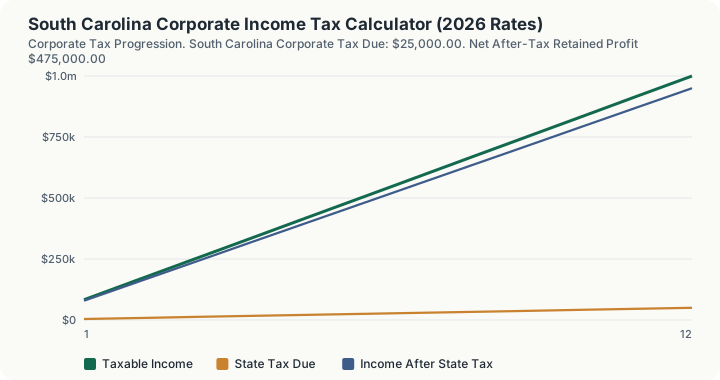
Quick Answer: On $500,000 of pre-apportioned taxable income, South Carolina's flat 5.00% corporate income tax rate produces $25,000.00 in state tax due and $475,000.00 in net after-tax profit.
How This Is Calculated
Two inputs drive this page: apportioned South Carolina taxable income and state tax credits. The engine multiplies the first by one flat rate, subtracts the second from the resulting tax, floors the answer at zero, and reports an effective rate alongside the statutory one. It does not build the income figure for you. No federal reconciliation, no state addbacks, no apportionment formula and no NOL limitation is computed anywhere in the code path.
- Apportioned income is accepted as entered. The input asks for net apportioned taxable income in South Carolina and is used verbatim. Enter a pre-apportionment figure and every output below is overstated in the same proportion, silently.
- A single bracket covers the whole range. South Carolina's entry in the rate table is one band from $0 upward at 5.00%. The sweep confirms it: $500.00 of tax at $10,000 of income, $1,000.00 at $20,000, $2,500.00 at $50,000, $5,000.00 at $100,000. The step is $500.00 per $10,000 at every point tested, with no inflection anywhere.
- Credits offset the tax, not the base. The credit input is subtracted after the rate has been applied, so each credit dollar is worth a full dollar rather than five cents.
- Negative results are clipped to zero. Credits beyond the liability simply vanish. Nothing carries forward, nothing is refunded, nothing is banked.
- The two rate outputs answer different questions. With $10,000 of credits on the default income the engine returns $15,000.00 of tax, an effective rate of 3.00%, and a marginal rate that still reads 5.00%. The effective figure is net of credits; the marginal figure is the statutory rate that prices the next dollar.
- The 12-row table scales income. Row i is the entered income times i over 6, so row 6 reproduces your input and row 12 doubles it: $1,000,000 of income and $50,000.00 of tax on the default. These are income scenarios, not periods.
Worked Example
Using this calculator's baseline scenario: a corporation with $500,000 in taxable income apportioned to South Carolina.
- Start with apportioned taxable income. $500,000 has already been apportioned to South Carolina before any state-level tax is applied.
- Apply the flat statutory rate. $500,000 × 5.00% = $25,000.00.
- Subtract credits. With the default $0 of credits the liability stands at $25,000.00.
- Net retained profit. $500,000 − $25,000.00 = $475,000.00, before any separate federal liability.
Because the rate is flat, marginal and effective rates coincide at 5.00% for every income the engine accepts, from $0 through the $1,000,000,000 input ceiling, whenever credits are zero. They part company as soon as credits are not.
Where the 5.00% Rate Stops Being the Rate You Pay
There is no bracket edge in South Carolina, so the only boundary this calculator contains sits on the credit input. It is a hard one.
At $24,999 of credits. Against $25,000.00 of computed tax, South Carolina tax due is $1.00.
At $25,000 of credits. South Carolina tax due is $0.00. That last dollar of credit bought a full dollar of relief.
At $25,001 of credits. Still $0.00. That dollar bought nothing.
Stepping in larger increments makes the shape plain. At $24,000 of credits the tax is $1,000.00; at $24,500 it is $500.00, a fall of exactly $500.00; at $25,000 it is $0.00, another fall of exactly $500.00. From there the delta is $0.00 forever: $25,500 and $26,000 of credits both return $0.00. Every credit dollar past the 25,000th is dead weight in this model.
This is the engine's max(0, tax - credits) clamp, and it is a genuine limitation rather than a description of state law. A credit that would carry to a later year in practice is worth precisely zero here.
The Reverse Calculation: Income Sheltered by a Fixed Credit
Fix credits at $25,000 and sweep income instead, and the same boundary answers a different question. The engine returns $0.00 of tax at $400,000, at $450,000 and at $500,000 of apportioned income. At $500,200 it returns $10.00, and at $500,400 it returns $20.00, a step of $10.00 per $200 of income, which is the 5.00% rate resuming once the credit is spent.
Widen the steps and the curve is linear beyond the boundary: $2,500.00 of tax at $550,000 of income, $5,000.00 at $600,000. The effective rate creeps from 0.00% to 0.45% to 0.83% across those points while the marginal rate output holds at 5.00% throughout. A $25,000 credit shelters exactly $500,000 of South Carolina income and not one dollar more.
The Marginal Cost of the Next Thousand Dollars
Each additional $1,000 of apportioned South Carolina income costs $50.00. Four consecutive sweep steps from the default show no drift at all: $25,000.00 at $500,000, $25,050.00 at $501,000, $25,100.00 at $502,000, $25,150.00 at $503,000, $25,200.00 at $504,000.
Two Ways to Apply a Credit, One of Them Expensive
The mistake worth pricing here is netting credits against income rather than against tax.
Correct, as this engine computes it. $500,000 of income with $10,000 of credits: 5.00% of $500,000 is $25,000.00, less $10,000, leaves $15,000.00 of South Carolina tax.
Incorrect, credits deducted from income first. $500,000 less $10,000 is $490,000, and the engine returns $24,500.00 of tax on that income.
The error costs $9,500.00. Deducting a credit from the base recovers only 5 cents per credit dollar; applying it against the tax recovers 100 cents. Nothing about the arithmetic changes with income size, because the rate never changes.
What This Does Not Account For
- South Carolina's corporate license fee on capital stock and paid-in surplus. It is computed on capital rather than income and carries its own minimum. This engine computes an income tax only, and returns nothing for the license fee at any input.
- Credit carryforward or refundability. Excess credits are discarded at the zero floor, as the sweep above shows.
- Any statutory minimum tax. The flat branch of the engine is income times rate with no floor other than zero, so an entity with $0 of income returns $0.00.
- Federal corporate income tax (21% under IRC § 11).
- Specialized gross receipts taxes (e.g. Ohio CAT, Washington B&O, Texas Franchise Tax) where applicable.
- Base Erosion and Anti-Abuse Tax (BEAT) or Global Intangible Low-Taxed Income (GILTI) provisions.
- Local municipal corporate earnings taxes (e.g. NYC General Corporation Tax).
Common Pitfalls
- Treating the Output as the Whole South Carolina Bill: The license fee on capital is assessed on the same return and is absent from every figure this page produces.
- Mistaking the Flat Rate for the Final Bill: The 5.00% applies to apportioned taxable income after additions, subtractions and NOL adjustments, none of which this calculator performs on your behalf.
- Confusing the Effective and Marginal Outputs: At $500,000 with $10,000 of credits, the effective rate reads 3.00% and the marginal rate reads 5.00%. Only the second one prices additional income.
- Claiming Credits Past the Zero Point: $25,000, $25,500 and $26,000 of credits all return $0.00 on the default income. The extra claim is invisible in the result.
Frequently Asked Questions
Does South Carolina have a corporate income tax?
What does an extra $1,000 of South Carolina income cost?
How much income does a $25,000 credit shelter?
When are South Carolina corporate tax returns due?
Does South Carolina tax S-corporations and LLCs?
Sources
- South Carolina Department of Revenue: Corporate Tax Statutes and Guidance (2026). dor.sc.gov
- Multistate Tax Commission (MTC): Uniform Apportionment and Allocation Guidelines. mtc.gov