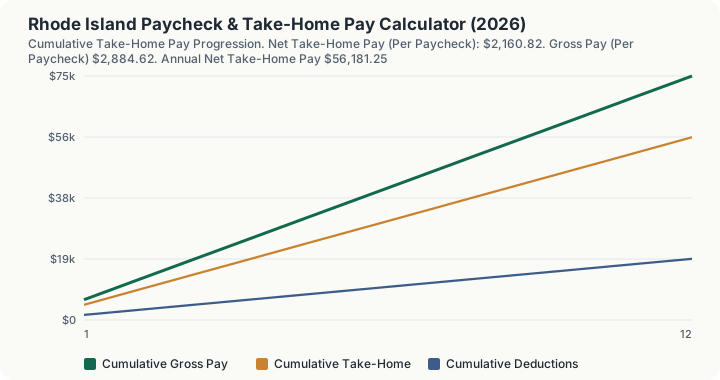
Quick Answer: A $75,000 annual salary in Rhode Island, paid bi-weekly and filing single, takes home about $2,160.82 per paycheck ($56,181.25 per year) after federal tax, FICA, and Rhode Island state withholding.
What This Calculator Answers For Rhode Island Workers
This calculator exists to answer a specific question for Rhode Island workers: given a salary, a pay frequency, and a filing status, what actually clears into the bank account after every required deduction. That means computing federal income tax withholding, FICA payroll taxes, and Rhode Island's own state income tax under verified 2026 statutory rates. Rhode Island runs a graduated tax schedule with three brackets, topping out at a 5.99% marginal rate, so the state's share depends on where taxable wages fall rather than one flat number. The tool covers bi-weekly, semi-monthly, monthly, and weekly pay schedules, because the same annual salary produces different per-paycheck totals depending on how often an employer runs payroll. It also factors in pre-tax elections, since a 401(k) or HSA contribution lowers the wages used to calculate federal and state tax while FICA still applies to the full gross amount. Salaried employees comparing job offers, hourly workers estimating a raise, and payroll staff setting up a new employee's withholding all need the same calculation, just applied to their own numbers rather than a generic estimate.
How This Is Calculated
Rhode Island's three-bracket schedule tops out at 5.99%, modest for the region, but Rhode Island is one of a small handful of states that funds temporary disability insurance out of employee payroll deductions, so a Rhode Island stub carries a TDI line that most states' stubs do not. That contribution is separate from income tax. The income tax calculation:
Four steps produce the per-paycheck figure:
- FICA Payroll Tax Computation: - Social Security (OASDI): 6.20% withheld on wages up to the 2026 statutory wage base ($184,500). - Medicare (HI): 1.45% withheld on all gross earnings (no wage cap), plus 0.90% Additional Medicare Tax on earnings exceeding $200,000 (single) or $250,000 (married filing jointly).
- Federal Income Tax Withholding: Evaluated using 2026 progressive federal tax brackets (10%, 12%, 22%, 24%, 32%, 35%, 37%) after applying standard deduction thresholds ($16,100 single / $32,200 married joint).
- Rhode Island State Income Tax Withholding: Run against the 2026 Rhode Island schedule (3.75%, 4.75% above $82,050, 5.99% above $186,450). No Rhode Island standard deduction and no personal exemption are subtracted before the schedule is walked.
- Pay Period Proration: Annual net compensation is divided across the designated pay frequency (26 bi-weekly, 24 semi-monthly, 12 monthly, or 52 weekly pay periods).
Worked Example
Consider an employee in Rhode Island earning $75,000 annually, paid bi-weekly (26 paychecks per year), filing single, with $3,500 in annual pre-tax 401(k) contributions.
- Gross pay per paycheck. $75,000 ÷ 26 pay periods = $2,884.62 before any withholding.
- Pre-tax deduction. The $3,500 annual 401(k) contribution reduces each paycheck by $134.62 and also shrinks the wages used to calculate federal and state income tax; FICA is still assessed on the full gross amount.
- FICA payroll taxes. Social Security withholds 6.2% of gross pay ($178.85) and Medicare withholds 1.45% ($41.83), for $220.67 per paycheck.
- Federal income tax withholding. Applying the 2026 IRS withholding tables to the reduced taxable wage withholds $265.38 per paycheck.
- Rhode Island state tax withholding. Rhode Island's withholding tables apply to the reduced taxable wage, withholding $103.13 per paycheck.
- Net take-home pay. $2,884.62 gross, minus $134.62 pre-tax, minus $220.67 FICA, minus $265.38 federal tax, minus $103.13 state tax leaves $2,160.82 per paycheck, or $56,181.25 per year, an effective total tax rate of 20.43%.
Carrying The Year Forward
Rhode Island's 4.75% bracket does not begin until $82,050, and the pre-tax 401(k) contribution pulls this employee's state base to $71,500 -- well under it, so the entire year accrues at the 3.75% entry rate.
Step 7 -- Two months of cumulative pay. The schedule's first row shows $6,250.00 of cumulative gross against $4,681.77 of cumulative take-home. Row two doubles both: $12,500.00 gross, $9,363.54 take-home, with $3,136.46 accumulated on the deduction side.
Step 8 -- The full year. By month twelve the schedule reaches $75,000.00 of cumulative gross and $56,181.25 of cumulative take-home, adding $4,681.77 every month without variation.
Step 9 -- What the year actually withheld. The cumulative deduction column closes at $18,818.75. That column carries the $3,500 pre-tax 401(k) contribution alongside the tax, so tax alone is $18,818.75 - $3,500 = $15,318.75, an effective total tax rate of 20.43% on $75,000.00 of gross pay.
Step 10 -- Why the monthly increment never changes. The cumulative columns advance by a constant amount each month. That is by construction: the engine caps Social Security at the $184,500 annual wage base and charges the extra 0.9% Medicare above $200,000 for a single filer, then divides the resulting annual total by twelve. The step-change a real ledger shows when Social Security stops mid-year is therefore invisible in this schedule. On $75,000 of gross the question does not arise -- neither threshold is within reach.
$56,181.25 clears over twelve months. Because the $3,500 deferral keeps the state base at $71,500, below $82,050, every state dollar inside $15,318.75 was charged at 3.75% and none at 4.75%.
Where The Rhode Island Bracket Actually Bites
The engine walks the Rhode Island schedule on gross salary minus pre-tax deductions, with no state standard deduction and no personal exemption removed first. That places the statutory $82,050 bracket edge at a salary of $85,550 once the default $3,500 deferral is subtracted, and sweeping grossSalaryAnnual in $100 steps confirms it lands exactly there.
At $85,550 of salary. Net take-home is $2,431.06 per bi-weekly check, of which Rhode Island withholds $118.34. Federal withholding is $354.65 and FICA is $251.71. Each preceding $100 of salary had been adding $2.56 to the net check.
At $85,650, one hundred dollars later. Net take-home is $2,433.58 and Rhode Island withholds $118.52. The increment has fallen to $2.52 and stays there. The 4.75% band costs one extra cent of state tax per dollar of salary, which on a per-check basis is four cents out of every additional $100 -- small, but it is a real step and it is where it is only because the engine gives this filer no state deduction.
How much salary is left before the crossing. At the $75,000 default the state base is $71,500, so this filer has $10,550 of additional salary before the 4.75% band starts. Raising the 401(k) election moves that line: every extra dollar deferred buys another dollar of headroom, because the deferral and the salary hit the same base.
What the next $1,000 of salary costs. Going from $75,000 to $76,000 lifts annual take-home from $56,181.25 to $56,847.25. Of the extra $1,000, $666.00 reaches the bank and $334.00 is withheld. Per check that is $2,160.82 rising to $2,186.43, a gain of $25.61. Rhode Island's share of that $334.00 is $1.44 per check, or $37.44 for the year.
The mistake that costs the most here, priced. A saver raising a 401(k) election usually assumes the deferral shrinks every tax on the stub. It does not shrink FICA. calculateW2PayrollFICA is handed full gross, never gross minus pre-tax, so FICA is $220.67 per check with the $3,500 deferral and $220.67 per check with no deferral at all -- identical to the cent. Priced against the counterfactual the saver has in mind: running $71,500 of gross with no deferral returns $210.38 of FICA per check, $10.29 less. Over 26 checks that is $267.54 of Social Security and Medicare relief that a 7.65%-inclusive estimate promises and this engine never delivers. What the deferral does deliver is federal and state: annual take-home is $56,181.25 with the $3,500 deferred and $58,780.00 without, a $2,598.75 drop in cash for $3,500 diverted, so the $3,500 bought $901.25 of income tax relief and nothing on the payroll tax line.
Two limitations worth naming before trusting the state figure. First, Rhode Island's TY2026 standard deduction is $11,200 for a single filer, recorded in the bracket note on the state table, and the engine does not subtract it. The $103.13 of state tax per check is therefore charged on $71,500 rather than on $60,300, which overstates Rhode Island withholding against a real RI-1040 by roughly the deduction times 3.75%. Second, treating FICA as a tax on full gross is correct for a 401(k) or a traditional HSA payroll deduction, and wrong for a Section 125 cafeteria plan premium, which is genuinely exempt from Social Security and Medicare. Enter a Section 125 premium in the pre-tax field and the FICA line will be too high.
What no boundary exists for. Neither the $184,500 Social Security wage base nor the $200,000 Additional Medicare threshold is reachable at this salary, and the schedule table cannot show either one in any case: FICA is settled on the annual wage and only then divided by twelve, so the mid-year step a live payroll ledger shows when Social Security stops is absent from every row at every salary.
What This Does Not Account For
- Local municipal, city, or county wage taxes where applicable.
- Post-tax wage garnishments (child support, tax levies, student loans).
- Voluntary post-tax deductions (Roth 401k, charitable giving, supplemental insurance).
- Rhode Island's Temporary Disability Insurance employee contribution, which appears on a real Rhode Island stub and is not in the $18,818.75 the schedule accumulates.
- The Rhode Island standard deduction and personal exemption, as described above.
Common Pitfalls
- Confusing Bi-Weekly with Semi-Monthly Pay: Bi-weekly pay results in 26 paychecks per year (two 3-paycheck months), whereas semi-monthly pay results in 24 equal paychecks.
- Failing to Update Form W-4: Inaccurate withholding allowances on Form W-4 can lead to substantial underpayment penalties or large unexpected tax bills.
- Forgetting Pre-Tax Deduction Benefits: Contributions to 401(k) and HSA accounts directly reduce taxable income, lowering both federal and state tax burdens.
- Overlooking Additional Medicare Tax: Failing to anticipate the 0.9% surtax on high-earning households with multiple income sources.
Frequently Asked Questions
Does Rhode Island have a state income tax on paychecks?
How is overtime pay taxed in Rhode Island?
What is the Social Security wage cap for 2026?
Can I adjust my state tax withholding?
Sources
- Internal Revenue Service (IRS): Publication 15 (Circular E) and Publication 15-T (2026). irs.gov/publications/p15
- Social Security Administration (SSA): 2026 Social Security Wage Base Limit. ssa.gov
Also consulted: Rhode Island Department of Revenue: Employer Withholding Tax Tables (2026).