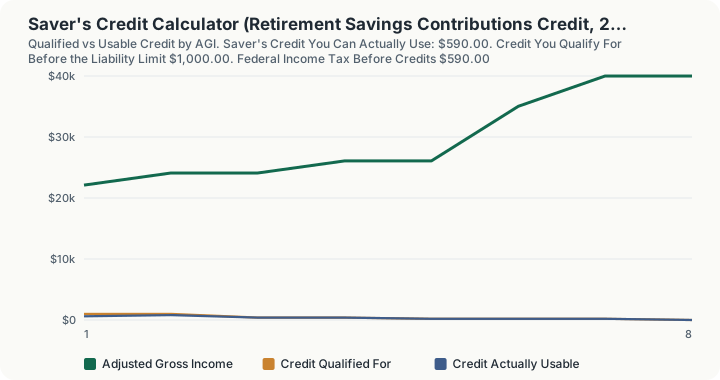
Quick Answer: A single filer with $22,000 of AGI who put $2,000 into a retirement account can actually use $590 of the Saver's Credit. The 50% applicable rate produces a tentative credit of $1,000, but federal income tax before credits is only $590, and because IRC 25B is non-refundable the remaining $410 is forfeited outright. It is not refunded and it does not carry forward.
What does this calculator do?
The Retirement Savings Contributions Credit, universally called the Saver's Credit, is claimed on Form 8880 under IRC section 25B. It rewards low- and moderate-income households for putting money into an IRA, a 401(k), a 403(b), a 457(b), a SIMPLE, a SEP or an ABLE account. The credit applies to at most $2,000 of contributions per individual, so the largest possible credit is $1,000 per person, or $2,000 on a joint return where both spouses contribute.
Two features of the credit cause almost all of the confusion, and this calculator is built around both.
The first is that the applicable percentage is a step function, not a taper. Your AGI puts you in a 50%, 20%, 10% or 0% band, and the bands have hard edges. One extra dollar of AGI at an edge does not shave the credit slightly; it cuts it by more than half.
The second is that the credit is non-refundable. IRC 25B sits among the nonrefundable personal credits, so it can only reduce a tax liability to zero. It never generates a refund. The households the 50% band is aimed at are, by definition, low-income households, and a low income often means the standard deduction has already erased most of the federal income tax the credit was meant to offset. The tentative credit is then larger than the liability it is allowed to reduce, and the difference is simply lost. This calculator reports the tentative credit, the liability that caps it, the usable credit and the forfeited amount as four separate figures rather than presenting the tentative credit as if it were money in hand.
How is this calculated?
The engine performs six operations, in this order.
Allowed Credit = min(r_AGI × min(C_capped, C_net), T_liability)
Step 1: Total the qualified contributions. Your contributions are added to your spouse's contributions only when the filing status is married filing jointly. In every other status the spouse figure is ignored entirely.
Step 2: Subtract testing-period distributions. The gross contribution total is reduced, floored at zero, by the distributions you entered under IRC 25B(d)(2). This figure is taken from your input; the engine does not look it up or infer it.
Step 3: Apply the $2,000 per-person cap. Your own contribution is capped at $2,000. On a joint return the spouse's contribution is capped at $2,000 separately, so the joint ceiling is reached as two individual caps and not as a single pooled $4,000 figure. The creditable contributions are then the lesser of the capped total from this step and the net total from Step 2.
Step 4: Look up the applicable rate for your AGI band. The engine compares your AGI to the 2026 limits for your filing status from IRS Notice 2025-67. Each band is inclusive of its upper bound, so at exactly the 50% limit the rate is still 50%. For single and married-filing-separately filers the 2026 edges are $24,250, $26,250 and $40,250.
Step 5: Compute the tentative credit and the liability that caps it. The tentative credit is the rate times the creditable contributions. Separately, the engine computes your federal ordinary income tax by subtracting the 2026 standard deduction for your filing status from your AGI and running the remainder through the 2026 brackets.
Step 6: Take the lesser of the two, and report the shortfall. The allowed credit is the smaller of the tentative credit and that liability. Whatever the liability cannot absorb is reported as the forfeited credit.
The engine also computes the distance from your AGI to the next band edge, and what the credit would become one band down: the same creditable contributions at the next rate, again capped by the same liability.
Worked Example
Single filer, AGI $22,000, $2,000 contributed to a workplace 401(k), no spouse, no testing-period distributions.
Step 1: Total the qualified contributions. $2,000 + $0 (not a joint return) = $2,000
Step 2: Subtract testing-period distributions. $2,000 - $0 = $2,000 of net qualified contributions
Step 3: Apply the $2,000 per-person cap. min($2,000, $2,000) = $2,000 of creditable contributions
Step 4: Find the applicable rate. $22,000 is at or below the $24,250 fifty-percent limit, so the rate is 50%
Step 5a: Compute the tentative credit. $2,000 x 0.50 = $1,000
Step 5b: Compute taxable income. $22,000 - $16,100 standard deduction = $5,900
Step 5c: Compute the tax before credits. $5,900 x 10% (the first 2026 single bracket runs to $12,400) = $590
Step 6a: Take the lesser figure. min($1,000, $590) = $590 of usable credit
Step 6b: Measure the shortfall. $1,000 - $590 = $410 forfeited
Step 7: Price the band edge. $24,250 - $22,000 = $2,250 of AGI headroom, and one dollar past that edge the credit falls to min($2,000 x 0.20, $590) = $400.
What does this calculator not account for?
- The eligibility gates are not tested. You must be 18 or over, not a full-time student, and not claimable as someone else's dependent. The engine does not ask, and will happily compute a credit for someone who fails one of those tests.
- Testing-period distributions are your figure, not the engine's. IRC 25B(d)(2) reduces qualified contributions by retirement distributions taken across the two prior tax years, the current year, and the period up to your return due date. Nothing is inferred; if you leave the input at zero, the engine assumes zero.
- Other credits are not modelled. The liability used as the ceiling here is federal ordinary income tax computed from AGI and the standard deduction alone. Other nonrefundable credits, which under the ordering rules may absorb liability before the Saver's Credit reaches it, are not applied, and refundable credits such as the EITC are ignored. If you claim other nonrefundable credits, your real usable Saver's Credit may be smaller than the figure shown.
- Itemised deductions are not supported. The standard deduction is always used.
- Only one year is priced. The credit's interaction with a multi-year contribution plan is not modelled.
- The 2026 figures are the only ones loaded. The AGI limits come from IRS Notice 2025-67 and the brackets and standard deduction from Rev. Proc. 2025-32.
What mistakes do people make with this?
- Treating the tentative credit as money. The headline number most tools show is the tentative credit. In the base case here that is $1,000, of which $410 never exists.
- Assuming the $2,000 cap is pooled on a joint return. It is per individual. A couple where one spouse contributes $4,000 and the other nothing gets $2,000 of creditable contributions, not $4,000.
- Expecting a taper. Crossing $24,250 as a single filer does not trim the credit by a few dollars. In the base case it drops the credit from $590 to $400 on one dollar of AGI.
- Forgetting that a pre-tax deferral lowers AGI. Because 401(k) deferrals are already excluded from AGI, contributing more can move you down a band and raise the rate at the same time as it raises the contribution.
- Overlooking a distribution. A rollover handled badly, or a small withdrawal two years ago, can reduce the qualified contributions under 25B(d)(2) and shrink the credit.
Frequently Asked Questions
Why is my Saver's Credit only $590 when I qualified for $1,000?
What is the AGI limit for the Saver's Credit in 2026?
Can a couple get a $2,000 credit?
Does contributing more always increase the credit?
How much does one dollar of extra AGI cost at a band edge?
Sources
- IRS Notice 2025-67, "2026 Amounts Relating to Retirement Plans and IRAs", the 2026 AGI limitations under IRC 25B(b)(1)(A) to (D): irs.gov/pub/irs-drop/n-25-67.pdf
- IRS Revenue Procedure 2025-32 (Internal Revenue Bulletin 2025-45), the 2026 federal brackets and standard deduction used to compute the liability ceiling: irs.gov/pub/irs-drop/rp-25-32.pdf