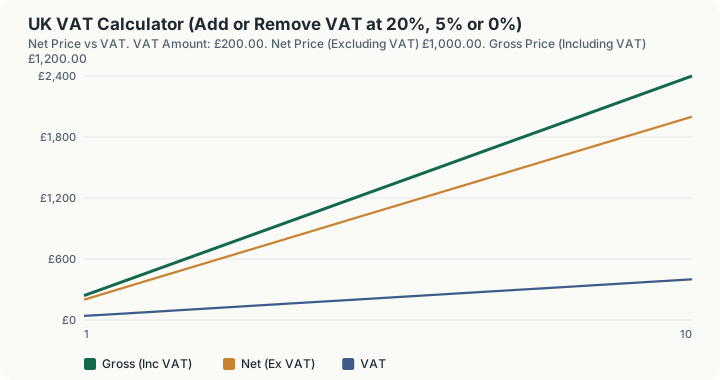
Quick Answer: Adding standard-rate VAT to a £1,000 net price adds £200.00, giving a gross price of £1,200.00. Working in the other direction is not the same sum: removing VAT from a £1,000 gross price gives £166.67 of VAT and £833.33 net, because the VAT is one sixth of the gross, not one fifth.
What does this calculator do?
This calculator adds VAT to a net price or removes it from a gross price, at the standard rate of 20%, the reduced rate of 5%, or the zero rate. It also checks a turnover figure against the registration and deregistration thresholds.
The single most common VAT error is treating the two directions as symmetrical. Adding 20% and then removing 20% does not return you to where you started, and the section below explains why.
How is this calculated?
Adding VAT to a net amount is straightforward multiplication:
VAT = Net × rate; Gross = Net × (1 + rate)
Removing VAT from a gross amount uses the VAT fraction, because the VAT is a proportion of the gross rather than of the net:
VAT = Gross × rate/(1 + rate)
At the standard rate that fraction is 0.2 / 1.2, which simplifies to one sixth. At the reduced rate it is 0.05 / 1.05, or one twenty-first.
Threshold check. If a turnover figure is entered, it is compared against two separate thresholds: registration is required once rolling 12-month taxable turnover exceeds £90,000, and deregistration becomes permissible once expected turnover falls below £88,000. The gap between them is deliberate, so that businesses hovering near the line are not forced to register and deregister repeatedly.
Worked Example
Adding standard-rate VAT to a quoted net price
A tradesman quotes £1,000 for a job and needs the figure to put on the invoice.
Step 1: The rate. Standard rate, so r = 20%
Step 2: The VAT. £1,000 x 20% = £200.00
Step 3: The gross price. £1,000.00 + £200.00 = £1,200.00
Removing VAT from a gross price
Now the same £1,000 as a VAT-inclusive figure on a receipt, with the net needed for the return.
Step 4: The VAT fraction at 20%. 0.20 / 1.20 = 1/6 = 16.67% of gross
Step 5: Extract the VAT. £1,000 x 1/6 = £166.67
Step 6: The net amount. £1,000.00 - £166.67 = £833.33
Step 7: Why it is not £200. £200 is one fifth of £1,000. The VAT inside a gross price is one sixth of it, and £200.00 - £166.67 = £33.33 is the size of that error on a single £1,000 invoice.
Step 8: The round trip that proves it. Remove VAT from £1,200 gross: £1,200 x 1/6 = £200.00, leaving £1,000.00 net, exactly back to step 1
Steps 2 and 5 are both right, for different questions. The rule of thumb is that one fifth goes up and one sixth comes down, and confusing the two is the most common VAT error on a small business return.
The reduced rate
Step 9: Adding 5% to £1,000 net. £1,000 x 5% = £50.00, gross £1,050.00
Step 10: Removing 5% from £1,000 gross. £1,000 x (0.05 / 1.05) = £1,000 x 1/21 = £47.62, net £952.38
The one-fifth-versus-one-sixth gap of £33.33 at the standard rate becomes a gap of just £2.38 at the reduced rate, because 1/20 and 1/21 are far closer together than 1/5 and 1/6. The error is largest exactly where it matters most.
Scaling, and the registration check
Step 11: A £200 net line at the standard rate. VAT £40.00, gross £240.00
Step 12: A £400 net line. VAT £80.00, gross £480.00
VAT is strictly proportional, with no bands or allowances inside the rate itself.
Step 13: Turnover of £95,000. Above the £90,000 threshold: registration required
Step 14: Turnover of £89,000. Between £88,000 and £90,000: no action required
Step 15: Turnover of £80,000. Below the £88,000 deregistration threshold
The £2,000 corridor in step 14 is deliberate. Registration is compulsory once rolling 12-month taxable turnover passes £90,000, but deregistration is only permitted below £88,000, so a business hovering on the line is not forced in and out of the register every quarter.
What does this calculator not account for?
- Which rate applies to which supply. Classification is the hard part of VAT and this calculator does not attempt it. Zero-rating, exemption and the reduced rate have detailed and sometimes counterintuitive boundaries.
- Exempt and outside-the-scope supplies. Exempt is not the same as zero-rated: zero-rated supplies count toward taxable turnover for registration and allow input VAT recovery, exempt supplies do not.
- The Flat Rate Scheme, under which a business pays a fixed percentage of gross turnover instead of accounting for input and output VAT separately.
- Partial exemption, the Capital Goods Scheme, the Cash Accounting Scheme and the Annual Accounting Scheme.
- Input VAT recovery. This calculates VAT on a single amount, not a VAT return position.
- The reverse charge, which applies to certain construction services and cross-border supplies.
- Northern Ireland's position under the Windsor Framework for goods moving to and from the EU.
What mistakes do people make with this?
- Dividing a gross price by 1.2 and then subtracting, versus multiplying by 1/6. These give the same answer, but subtracting 20% of the gross does not. £1,000 minus 20% is £800, which is wrong by £33.33.
- Assuming zero-rated and exempt are interchangeable. A zero-rated business can reclaim input VAT and must count that turnover toward the £90,000 threshold. An exempt business generally cannot reclaim input VAT and its exempt turnover does not count.
- Using the registration threshold to decide when to deregister. They are different figures, £90,000 and £88,000, and using the wrong one leads to deregistering too early.
- Forgetting that the registration test is a rolling 12-month test, not a financial-year test. It can be triggered part way through a year, and there is also a forward-looking test if turnover is expected to exceed the threshold within the next 30 days alone.
- Rounding VAT per line rather than per invoice, which can produce small discrepancies against a supplier's own calculation.
Frequently Asked Questions
Why is removing VAT not just subtracting 20%?
What is the VAT fraction?
When must I register for VAT?
Can I deregister once I am below £90,000?
Does zero-rated turnover count toward the threshold?
Sources
- HM Revenue and Customs (HMRC), the official authority for the national tax authority this calculator relates to. gov.uk/government/organisations/hm-revenue-customs
All figures verified on 30 August 2026 and mirrored in engine/tables/2026/uk-2026-27.json
Also consulted: GOV.UK: "VAT rates on different goods and services", gov.uk/vat-rates; GOV.UK: "VAT registration: when to register", registration threshold £90,000; GOV.UK: "VAT: increasing the registration and deregistration thresholds", deregistration threshold £88,000, both effective 1 April 2024.