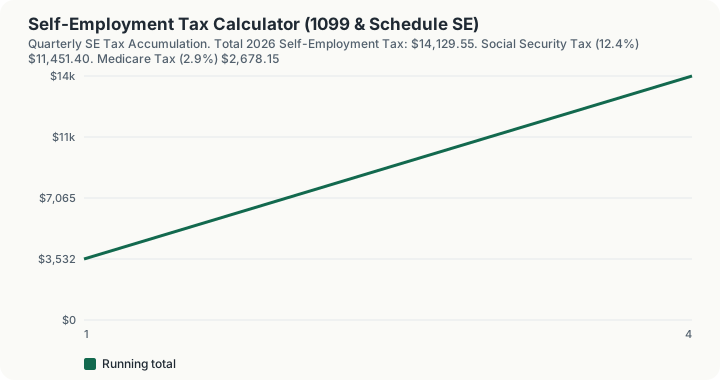
Quick Answer: A freelancer with $100,000 in net 1099 profit and no W-2 wages owes $14,129.55 in self-employment tax for 2026, of which $7,064.78 is deductible above the line on Form 1040.
Overview
Self-employment tax is how Social Security and Medicare taxes get collected from people who work for themselves instead of a W-2 employer. A traditional employee and employer each pay 7.65% of wages (6.2% Social Security plus 1.45% Medicare), for a combined 15.3%. A self-employed person is both the employee and the employer, so the full 15.3% (formally called SECA tax, for Self-Employment Contributions Act) falls on one person's Schedule SE.
This calculator starts from net business profit, the bottom line from Schedule C after business expenses, and applies the IRS's 92.35% adjustment before calculating tax. That adjustment exists because the employer-side half of SECA tax is not itself subject to SECA tax, mirroring how a W-2 employer's matching FICA contribution is never taxed as the employee's income. From that adjusted figure, 12.4% goes to Social Security (up to the annual wage base cap) and 2.9% goes to Medicare (with no cap).
Because many people who freelance or run a side business also hold a W-2 job, this calculator accepts a W-2 wages field and reduces the remaining Social Security wage base capacity accordingly. Social Security tax is only owed on earnings up to the annual cap across all sources combined, W-2 and self-employment together, so someone whose W-2 wages already exceed the cap owes no additional Social Security portion on their self-employment income, only the uncapped Medicare portion.
How This Is Calculated
For 2026, the Social Security wage base cap is $184,500, set annually by the Social Security Administration and indexed to national average wage growth. There is no cap on the Medicare portion; every dollar of SE taxable earnings is subject to the 2.9% Medicare rate regardless of how high net profit climbs, and above the Additional Medicare Tax threshold a further 0.9% applies on top of that. The threshold is $200,000 for a single filer, $250,000 for married filing jointly, and $125,000 for married filing separately. None of the three is indexed for inflation. If net business profit falls below $400, no self-employment tax is owed at all, matching the IRS's own filing threshold for Schedule SE.
Note that the two formulas above deliberately differ. The Additional Medicare Tax is part of what you owe, but it is not part of what you may deduct: IRC section 164(f) allows half of the Social Security and regular Medicare portions only. A high earner who halves the total tax bill will overstate the deduction.
The 50% deduction in the last line is not a reduction of the tax itself, it is a separate above-the-line deduction claimed on Form 1040 that lowers adjusted gross income, roughly offsetting the fact that a W-2 employee never pays income tax on the employer's half of FICA either.
Worked Example
Scenario 1: Full-time 1099 income, no W-2 wages. Net business profit of $100,000, $0 in W-2 wages subject to Social Security.
Step 1: Apply the 92.35% adjustment.
Step 2: Determine remaining Social Security capacity.
Since $92,350 is less than the $184,500 remaining capacity, the full amount is subject to Social Security tax.
Step 3: Social Security tax.
Step 4: Medicare tax (uncapped).
Step 5: Total self-employment tax.
Step 6: Above-the-line deduction.
Step 7: Effective SE rate.
Scenario 2: Side hustle stacked on top of a high W-2 salary. Net business profit of $50,000, $190,000 in W-2 wages, which already exceeds the $184,500 Social Security wage base on its own.
SE taxable earnings: $50,000 × 0.9235 = $46,175. Remaining Social Security capacity: max(0, $184,500 − $190,000) = $0, since the W-2 wages alone already exceed the cap. Social Security tax on the self-employment income is therefore $0. Medicare tax still applies in full, uncapped: $46,175 × 2.9% = $1,339.08. Total self-employment tax is just $1,339.08, dramatically lower than Scenario 1 despite a smaller profit gap, purely because the W-2 income already used up the Social Security wage base.
Scenario 3: Below the filing threshold. Net business profit of $350, under the $400 minimum. Total self-employment tax is $0; Schedule SE is not required to be filed for self-employment earnings under $400.
Carrying Scenario 1 Across the Four Estimated Payments
The quarterly schedule divides the annual liability into four equal installments, which is what a self-employed filer with steady income actually sends to the IRS.
Step 8 -- Q1. Installment $3,532.39, of which Social Security $2,862.85 and Medicare $669.54. Paid to date $3,532.39
Step 9 -- Q2. Same installment again. Paid to date $7,064.78
Step 10 -- Q3. Paid to date $10,597.16
Step 11 -- Q4. Paid to date $14,129.55
The Q2 cumulative figure is worth a second look: $7,064.78 is exactly the above-the-line deduction from Step 6. By the June installment you have paid in the half of the SE tax that comes back as a deduction, and the second half of the year is the part that costs you outright. Note also that the schedule assumes even income; a business that earns most of its profit late in the year can use the annualised income installment method on Form 2210 instead, which this page does not model.
What This Does Not Account For
- The Additional Medicare Tax. A separate 0.9% surtax applies to combined wages and self-employment income above $200,000 (single) or $250,000 (married filing jointly), reported on Form 8959. This calculator computes only the base 2.9% Medicare rate, not the additional surtax layer.
- Federal and state income tax. Self-employment tax is calculated independently of income tax. Net business profit is also subject to ordinary federal (and often state) income tax on top of the SECA tax computed here.
- Quarterly estimated tax penalties. The IRS expects self-employed taxpayers to pay estimated tax quarterly; underpayment can trigger penalties under IRC Section 6654 that this calculator does not model.
- Business expense and depreciation nuances. This tool starts from net profit as a single input; it does not calculate Schedule C itself, including depreciation methods, home office deductions, or vehicle expense elections that determine that net profit figure.
- Multiple business entities or partnerships. Income from a partnership (Schedule K-1) or an S-corporation is treated differently for self-employment tax purposes than sole proprietor Schedule C income, and this calculator assumes a single sole proprietorship or single-member LLC context.
- State-level self-employment or franchise taxes. Some states impose their own business-level taxes independent of the federal SECA calculation shown here.
Common Pitfalls
- Forgetting the Additional Medicare surtax. High earners often calculate the base 15.3% SECA rate correctly but forget the extra 0.9% Medicare surtax that kicks in once combined income crosses the statutory threshold, understating their true liability.
- Applying the Social Security cap per income source instead of in aggregate. The wage base cap applies across all earned income combined, W-2 and self-employment together. Someone with both should reduce their remaining Social Security capacity by prior W-2 wages before calculating the self-employment portion, exactly as this calculator does.
- Confusing the 50% deduction with a 50% tax reduction. The deduction lowers adjusted gross income for income tax purposes; it does not cut the self-employment tax bill itself in half.
- Using gross revenue instead of net profit. Self-employment tax is calculated on net profit after business expenses, not on total revenue or gross receipts.
- Skipping the 92.35% adjustment. Applying the 15.3% combined rate directly to net profit, without first multiplying by 0.9235, overstates the tax owed on every dollar of profit.
Frequently Asked Questions
What is the self-employment tax rate for 2026?
Why is only 92.35% of my net profit taxed?
Do I still owe self-employment tax if I also have a W-2 job?
Is the 50% self-employment tax deduction the same as a tax credit?
Do I owe self-employment tax if my net profit is under $400?
How does self-employment tax interact with quarterly estimated payments?
Sources
- Internal Revenue Service, Publication 505, Tax Withholding and Estimated Tax. irs.gov/publications/p505
- Internal Revenue Service, Instructions for Schedule SE (Form 1040), Self-Employment Tax. irs.gov
- Social Security Administration, 2026 Social Security Changes Fact Sheet (annual wage base determination). ssa.gov
Also consulted: Internal Revenue Service, Form 8959 Instructions, Additional Medicare Tax.