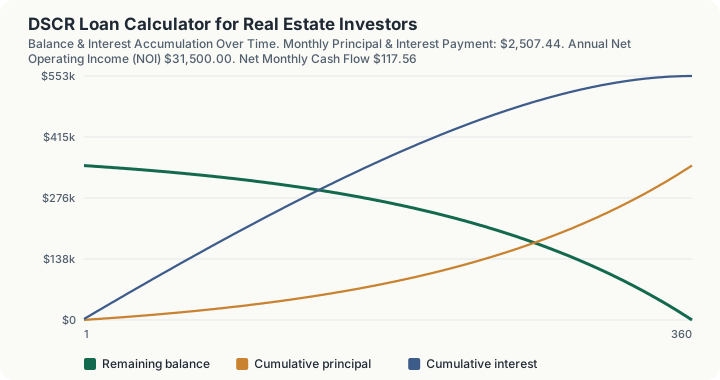
Quick Answer: A $350,000 DSCR loan at 7.75% against a property renting for $3,500/month with a 25% expense ratio produces a $2,507.44 monthly payment and a 1.05x Debt Service Coverage Ratio, a marginal deal that clears break-even but falls short of most lenders' 1.20x-1.25x minimum.
Overview
A DSCR loan is a mortgage designed for real estate investors, underwritten around what the property earns rather than what the borrower earns. Instead of verifying your W-2 income, tax returns, and personal debt-to-income ratio the way a conventional mortgage does, a DSCR lender looks almost entirely at the Debt Service Coverage Ratio: does the rental income the property generates comfortably cover the mortgage payment?
This makes DSCR loans popular with self-employed investors, people who own several rental properties already (and whose personal debt-to-income ratio looks maxed out on paper even though the properties cash flow fine), and anyone buying through an LLC where personal income documentation doesn't map cleanly onto the deal. The tradeoff is that DSCR loans typically carry a rate premium over an owner-occupied conventional mortgage, often 0.5 to 1.5 percentage points higher, and usually require a larger down payment, commonly 20-25%.
The DSCR itself is calculated as annual Net Operating Income (gross rent minus operating expenses, not counting the mortgage payment) divided by annual debt service (the total yearly principal and interest payment). A ratio of 1.00x means the rental income exactly breaks even against the mortgage payment. Most DSCR programs want to see 1.00x to 1.25x or higher, and some lenders won't approve a loan below 1.00x at all, since that would mean the property loses money on debt service before accounting for any other cost.
How This Is Calculated
- Monthly principal and interest. Standard mortgage amortization on the loan amount, rate, and term you enter.
- Annual debt service. The monthly payment multiplied by 12.
- Net Operating Income (NOI). Gross monthly rental income is annualized (multiplied by 12), then reduced by the operating expense ratio you enter, which represents property taxes, insurance, HOA dues, maintenance reserves, and vacancy allowance as a percentage of rent. NOI deliberately excludes the mortgage payment itself; that's what DSCR is designed to measure separately.
- DSCR. NOI divided by annual debt service. Above 1.00x means the property's income covers the loan payment; below 1.00x means it doesn't.
- Monthly cash flow. NOI divided by 12, minus the monthly principal and interest payment, showing what's actually left over (or short) each month after the mortgage is paid.
Worked Example
A $350,000 loan at 7.75% APR over a 30-year term, against a property renting for $3,500 per month with a 25% operating expense ratio:
- Monthly rate: 7.75% ÷ 12 = 0.6458333%
- Monthly principal and interest: $2,507.44
- Annual debt service: $2,507.44 × 12 = $30,089.28
- Annual gross rent: $3,500 × 12 = $42,000
- Net Operating Income: $42,000 × (1 − 25%) = $31,500.00
- DSCR: $31,500.00 ÷ $30,089.28 = 1.05x
At 1.05x, this deal covers its own debt service with a small cushion, but sits below the 1.20x-1.25x minimum many DSCR programs require. Compare a stronger-rent scenario: the same loan against $4,200 monthly rent (20% higher) produces NOI of $37,800.00 and a DSCR of 1.26x, clearing the typical institutional minimum. And a weaker scenario, rent at $2,975 with a 35% expense ratio, produces NOI of just $23,205.00 and a DSCR of 0.77x, a deal that would not cash flow enough to cover its own mortgage payment and would likely be declined outright.
Crossing 1.25x, One Dollar of Rent at a Time
The qualification band on this page is a genuine threshold, and it is worth walking because it is the number an underwriter actually reads.
At $4,179 of monthly rent. Net operating income is $37,611.00 against $30,089.28 of annual debt service. The engine returns a DSCR of 1.25x and the note reads Marginal: covers debt service but below the common 1.20x-1.25x minimum.
At $4,180, one dollar later. Net operating income is $37,620.00, the DSCR still displays as 1.25x, and the note flips to Strong: clears most lenders' 1.25x threshold. One dollar of monthly rent moves the file from marginal to strong, because the displayed ratio is rounded to two decimals while the test is run on the unrounded figure. Two files can show an identical 1.25x on this page and receive opposite verdicts, and that is a property of the display rather than of the underwriting.
How far the baseline is from clearing. At the $3,500 default the engine returns a DSCR of 1.05x, $117.56 of monthly cash flow, and the marginal note. Rent has to rise by $680 a month, from $3,500 to $4,180, to reach the strong band on the same loan. The alternative lever is loan size: hold rent at $3,500 and the same 1.25x is reached at a $292,000 loan, where monthly principal and interest falls to $2,091.92 and cash flow rises to $533.08. That is $58,000 less leverage for the same property.
The lower cliff, at 1.00x. At $3,345 of rent the engine returns 1.00x and $1.31 of monthly cash flow: the property covers its debt service by just over a dollar a month. Below that the note changes again. Pushing the operating expense ratio from 25% to 36% takes NOI to $26,880.00, the DSCR to 0.89x and monthly cash flow to minus $267.44, and the note reads Fails.
Term length is the most violent input. Switching from a 30-year to a 15-year amortisation raises monthly principal and interest from $2,507.44 to $3,294.47 and drops the DSCR from 1.05x to 0.80x, with cash flow at minus $669.47. Nothing about the property changed; only the schedule the debt is repaid on.
What the ratio here does not include. The operating expense percentage is a single blended figure applied to gross rent, so property tax, insurance, HOA, maintenance and vacancy are not itemised and cannot be varied separately. The engine assumes full occupancy at the rent you enter, charges no capital expenditure reserve beyond whatever you fold into the expense ratio, and models a fully amortising loan: an interest-only DSCR product, which many lenders offer precisely to lift the ratio, cannot be represented on this page.
What This Does Not Account For
- Vacancy risk beyond the expense ratio. The operating expense ratio is a simplification; a property that sits vacant for months at a time will see actual NOI drop well below this steady-state estimate.
- Down payment and closing cost requirements. DSCR loans typically require 20-25% down and often carry higher origination fees than conventional loans; neither is reflected in this monthly payment calculation.
- Prepayment penalties. Many DSCR loans include a prepayment penalty period (commonly 3-5 years), which affects the true cost of an early sale or refinance.
- Interest rate type. This assumes a fixed rate for the full term; some DSCR products are adjustable-rate.
- Portfolio-level underwriting. Some DSCR lenders evaluate a borrower's full portfolio of properties together rather than this single deal in isolation.
Common Pitfalls
- Using gross rent instead of net operating income. DSCR is not gross rent divided by the mortgage payment; it's net income after real operating costs. Skipping the expense ratio dramatically overstates the ratio.
- Assuming a DSCR above 1.00x guarantees approval. Most lenders have a program-specific minimum well above breakeven, commonly 1.20x-1.25x, and some charge a rate premium for ratios closer to 1.00x even if they'll approve the loan.
- Ignoring how sensitive DSCR is to small rent or expense changes. Because it's a ratio, a modest rent increase or expense reduction can move a marginal deal into comfortable qualifying territory, and the reverse is just as true.
- Forgetting that DSCR excludes the mortgage payment from NOI. Some borrowers mistakenly subtract the loan payment when estimating NOI, double-counting it since DSCR already divides by the debt service separately.
Frequently Asked Questions
What DSCR do I need to qualify for an investment property loan?
Does a DSCR loan check my personal income at all?
How is Net Operating Income different from cash flow?
Can I use projected rent for a property I haven't purchased yet?
Why do DSCR loans have higher rates than conventional mortgages?
Sources
- Federal Housing Finance Agency (FHFA): investment property underwriting standards referenced for conventional-loan DSCR context. fhfa.gov
- Consumer Financial Protection Bureau (CFPB): non-QM and investor loan disclosure practices under Regulation Z. ecfr.gov/current/title-12/chapter-X/part-1026
Also consulted: Appraisal Institute: Uniform Residential Appraisal Report and rent schedule (Form 1007) standards used for market rent estimation.