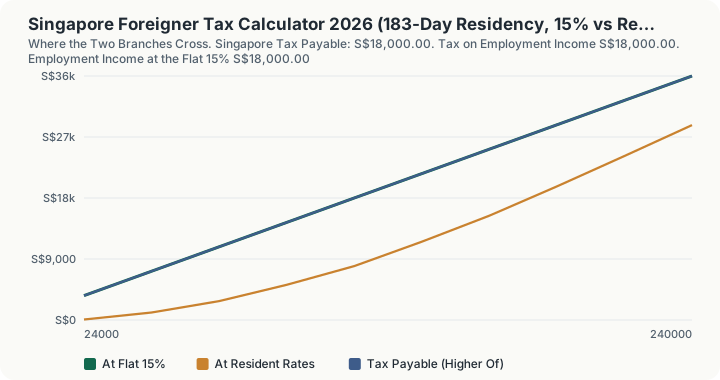
Quick Answer: A foreigner earning S$120,000 who exercised employment in Singapore for 150 days in the calendar year is a non-resident, 33 days short of the 183-day threshold, and owes S$18,000 in Singapore tax. That comes from the flat 15% branch of the higher-of test, since 15% of S$120,000 is S$18,000 against S$7,950 at resident rates with no reliefs. Being a tax resident on the same income would have cost S$7,950, so non-residence costs S$10,050 and the effective rate is 15.00%.
What does this calculator do?
For a foreigner working in Singapore, the tax bill is decided by a day count before it is decided by anything else. IRAS classifies you by the number of days you exercised employment in Singapore during the calendar year, and the three bands are unforgiving in how differently they treat the same salary.
Sixty days or fewer and your employment income is exempt outright. Between 61 and 182 days you are a non-resident, taxed at the flat 15% or at resident progressive rates with no reliefs, whichever produces the higher tax. At 183 days or more you are a tax resident, taxed on the ordinary progressive schedule with access to personal reliefs. A three-year administrative concession also exists: a continuous stay or period of work spanning three consecutive calendar years is treated as resident for all three.
Two features catch people out. The higher-of test is computed on tax amounts, not on rates, and its progressive branch is run with no reliefs at all, because reliefs are a resident-only benefit. And non-employment income of a non-resident, meaning rent, pension and director's fees, is taxed separately at a flat 24%.
How is this calculated?
Residency is settled first, then the branch follows from it. For a non-resident:
T = max(0.15E, ProgressiveTax (E)) + 0.24 × O
where E is Singapore employment income and O is other Singapore income. The progressive term uses the resident band table but is given no reliefs.
Step 1: Classify by day count. 150 days is above 60 and below 183, and the three-year concession is not claimed, so the status is non-resident.
Step 2: Measure the distance to residency. 183 - 150 = 33 days short
Step 3: Compute the flat branch. S$120,000 x 15% = S$18,000
Step 4: Compute the progressive branch on the same income with no reliefs. First S$20,000 at 0% gives S$0; next S$10,000 at 2% gives S$200; next S$10,000 at 3.5% gives S$350; S$40,000 to S$80,000 at 7% gives S$2,800; S$80,000 to S$120,000 at 11.5% gives S$4,600. S$0 + S$200 + S$350 + S$2,800 + S$4,600 = S$7,950
Step 5: Take the higher of the two. max(S$18,000, S$7,950) = S$18,000, on the flat 15% basis
Step 6: Report what the higher-of test cost against the lower branch. S$18,000 - S$7,950 = S$10,050
Step 7: Tax other Singapore income separately at the flat 24%. S$0 x 24% = S$0
Step 8: Add the two to get total tax payable. S$18,000 + S$0 = S$18,000
Step 9: Effective rate on total income. S$18,000 / S$120,000 = 15.00%
Step 10: Income after tax. S$120,000 - S$18,000 = S$102,000
The resident computation is always run as well, so the price of the day count is visible rather than implied.
Step 11: Resident tax on the same S$120,000, reliefs defaulting to zero. S$7,950
Step 12: What non-residence costs. S$18,000 - S$7,950 = S$10,050
At 183 days, or with the three-year concession, employment and other income are assessed together in one resident computation with reliefs allowed, and the separate 24% charge does not arise. At 60 days or fewer, employment income drops to nil while other Singapore income still bears the 24%.
Worked Example
A regional manager on a S$120,000 Singapore package spends 150 days exercising employment in Singapore, with no rent or director's fees.
Step 1: Day count decides the regime. 150 days sits in the 61 to 182 band, so non-resident
Step 2: Flat branch, 15% of employment income. S$120,000 x 0.15 = S$18,000
Step 3: Progressive branch, no reliefs. S$200 + S$350 + S$2,800 + S$4,600 = S$7,950
Step 4: Higher-of test picks the flat branch. S$18,000
Step 5: Other income at 24%. S$0 = S$0
Step 6: Total Singapore tax payable. S$18,000
Step 7: Take-home. S$120,000 - S$18,000 = S$102,000
Thirty-three more days would have moved the same salary onto resident rates at S$7,950, before any reliefs. That is S$10,050 turning on a calendar.
What does this calculator not account for?
- Reliefs are deliberately ignored on the non-resident path. This is correct behaviour, not a gap: IRAS allows reliefs only to tax residents. On the resident path the relief figure is whatever you typed, uncomputed and unchecked, subject only to the S$80,000 cap.
- No Personal Income Tax Rebate is applied on the resident branch, and none can be. The resident computation is called with no rebate percentage or cap, so the rebate is zero in every case. Separately, IRAS had published no YA 2026 rebate as at the source read date of 30 August 2026. Rebates are announced Budget by Budget, so treat that as unannounced rather than confirmed absent; IRAS granted 60% capped at S$200 for YA 2025 and 50% capped at S$200 for YA 2024.
- The 60-day exemption is applied by day count alone. The engine never asks what you do, so it will exempt a director's employment income at 45 days even though IRAS would not.
- The three-year administrative concession is a yes or no switch you set yourself. The engine does not test continuity of stay across calendar years; if you say yes, it returns resident and overrides the day count outright.
- All other income is taxed at 24% as a single bucket. Rent, director's fees and pension are not distinguished, there is no deemed rental expense deduction on the non-resident path, and no withholding tax mechanics.
- No tax treaty relief, no foreign tax credit, no Not Ordinarily Resident scheme, no Area Representative apportionment, and no employment pass or SPR-specific CPF treatment.
- Days are entered by you. The engine does not derive them from travel dates.
What mistakes do people make with this?
Assuming 15% is the non-resident rate. It is one branch of a two-branch test. Above roughly S$369,000 of employment income the resident schedule averages more than 15%, so the progressive branch overtakes the flat rate and a non-resident pays the progressive figure.
Claiming reliefs as a non-resident. They are not available, which is why this calculator ignores the relief input unless you are resident.
Confusing the 24% and the 15%. Employment income uses the higher-of test built on 15%. Rent, pension and director's fees use a flat 24%, assessed separately.
Thinking the 60-day exemption covers everything. It covers employment income only, and not for directors, public entertainers or non-resident professionals. Other Singapore income is still taxed at 24%.
Counting only working days. Weekends, public holidays and temporary absences such as a holiday or an overseas business trip all count toward the day total.
Frequently Asked Questions
How much tax does a foreigner pay on S$120,000 in Singapore?
How many days do I need in Singapore to be a tax resident?
Is non-resident employment income really taxed at 15%?
How is rental income of a non-resident taxed in Singapore?
Can a non-resident claim personal reliefs?
Sources
- Inland Revenue Authority of Singapore, "Individual Income Tax Rates", iras.gov.sg/taxes/individual-income-tax/basics-of-individual-income-tax/tax-residency-and-tax-rates/individual-income-tax-rates: read 2026-08-30 for the flat 15% or resident rates whichever is higher rule, the 24% non-resident rate on other income, and the resident band table.
- Inland Revenue Authority of Singapore, "Working Out My Tax Residency", iras.gov.sg/taxes/individual-income-tax/basics-of-individual-income-tax/tax-residency-and-tax-rates/working-out-my-tax-residency: read 2026-08-30 for the 60-day exemption, the 61 to 182 day band, the 183-day threshold and the three-year administrative concession.
- Inland Revenue Authority of Singapore, "Tax Reliefs", iras.gov.sg/taxes/individual-income-tax/basics-of-individual-income-tax/tax-reliefs-rebates-and-deductions/tax-reliefs: read 2026-08-30 for the rule that only a tax resident can claim tax relief, and the S$80,000 relief cap.