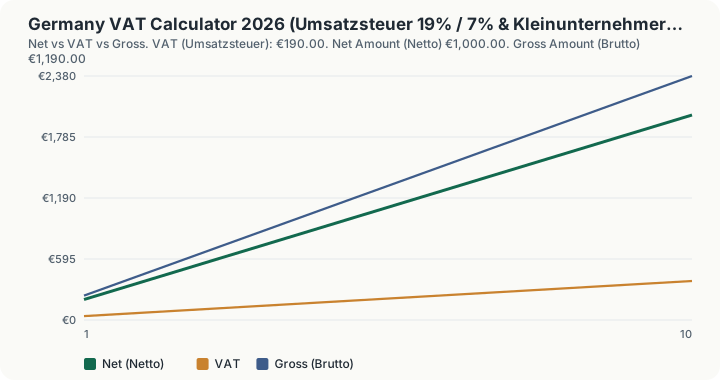
Quick Answer: A €1,190 gross invoice at the standard rate contains €190.00 of Umsatzsteuer, leaving €1,000.00 net. That is the 19/119 VAT fraction, which is 15.97% of the gross. Subtracting 19% of the gross figure instead gives €963.90, understating the net by €36.10 on this invoice, and it is the single most common German VAT error.
What does this calculator do?
German Umsatzsteuer runs on three rates. The Regelsteuersatz of 19% under §12 Abs.1 UStG applies to most supplies. The ermäßigter Steuersatz of 7% under §12 Abs.2 covers the statutory catalogue: most food, books, newspapers, public transport, cultural admissions and hotel accommodation. A 0% rate under §12 Abs.3 applies to qualifying photovoltaic installations.
The arithmetic looks trivial and is routinely got wrong in one direction. Going from net to gross is a multiplication anyone can do. Going from gross to net is not: €119 gross at 19% contains €19 of VAT, not €22.61. The correct operation is the VAT fraction, gross x r/(1+r), which is 19/119 for the standard rate and 7/107 for the reduced rate. This calculator implements both directions explicitly and shows the size of the error the wrong method produces, because that error compounds silently across every line of a bookkeeping export.
The second thing it checks is Kleinunternehmer status under §19 Abs.1 UStG, which now has two thresholds rather than one. Prior-year Gesamtumsatz must not have exceeded €25,000, and current-year turnover must not exceed €100,000. Both conditions have to hold.
How is this calculated?
Adding: VAT = Net × r; Removing: VAT = Gross × r/(1 + r)
Step 1: Select the rate. 19% standard, 7% reduced, or 0% for qualifying photovoltaics. The calculator does not classify your supply; you choose the rate.
Step 2: If adding, multiply the net amount by the rate. That is the VAT, rounded to the cent.
Step 3: If adding, add the VAT to the net. That is the gross.
Step 4: If removing, multiply the gross amount by r/(1+r). That is the VAT, rounded to the cent.
Step 5: If removing, subtract the VAT from the gross. That is the net.
Step 6: Express the VAT fraction as a percentage of gross. r divided by (1 + r), times 100. At 19% this is 15.97%.
Step 7: Compute the naive wrong net, for comparison. Gross minus (rate times gross). This is what the incorrect method produces, and the calculator reports it deliberately so the two can be seen side by side.
Step 8: Report the size of the error. The correct net minus the naive wrong net.
Step 9: Test the prior-year Kleinunternehmer threshold. Prior calendar year Gesamtumsatz must not have exceeded €25,000.
Step 10: Test the current-year threshold. Current calendar year turnover must not exceed €100,000.
Step 11: Report status and headroom. Both tests must pass to qualify. Headroom is €25,000 less the prior-year turnover.
Worked Example
A freelancer holds a €1,190 gross invoice at the standard rate and needs the net figure and the VAT for their Umsatzsteuervoranmeldung.
Step 1: The rate. Regelsteuersatz, so r = 19%
Step 2: The VAT fraction. 0.19 / 1.19 = 15.97% of gross
Step 3: Extract the VAT. €1,190 x (19 / 119) = €190.00
Step 4: The net amount. €1,190.00 - €190.00 = €1,000.00
Now the wrong method, for contrast:
Step 5: Deducting the rate from the gross. €1,190 x 19% = €226.10
Step 6: The wrong net that produces. €1,190.00 - €226.10 = €963.90
Step 7: The error. €1,000.00 - €963.90 = €36.10 understated on a single €1,190 invoice
Building the same invoice the other way round confirms the arithmetic:
Step 8: Adding VAT to €1,000 net. €1,000 x 19% = €190.00
Step 9: The gross. €1,000.00 + €190.00 = €1,190.00, which closes the loop exactly.
And the Kleinunternehmer test, on the defaults of €20,000 prior-year and €50,000 current-year turnover:
Step 10: Prior-year test. €20,000 is at or under €25,000, so this test passes
Step 11: Current-year test. €50,000 is at or under €100,000, so this test passes
Step 12: Status. Both hold, so the business qualifies as Kleinunternehmer, with €5,000 of headroom to the prior-year limit.
What does this calculator not account for?
- It does not classify supplies into rate bands. Whether a given good or service falls in the §12 Abs.2 catalogue is a substantive VAT question and it is not modelled. Choose the rate; the arithmetic follows.
- Input VAT (Vorsteuer) is not netted off. This computes output VAT on one amount. It is not a Umsatzsteuervoranmeldung and it does not produce a payable or refundable position.
- VAT-exempt supplies under §4 UStG are not modelled and are structurally different from the 0% rate: exempt supplies generally carry no input VAT recovery, while zero-rated ones do.
- Cross-border rules are absent. Reverse charge (§13b), intra-EU supplies and acquisitions, the One Stop Shop, imports and distance selling all change who accounts for the tax and none are covered.
- The Kleinunternehmer test uses only the two figures you enter. It does not know whether you have opted out of the exemption (a five-year binding waiver under §19 Abs.3), whether the business started mid-year, or how the turnover is composed. It applies the two statutory thresholds and nothing else.
- It does not model what happens at the moment you cross €100,000. The calculator reports that you fail the test. It does not split the year, restate earlier invoices, or compute the VAT on the transaction that broke the ceiling.
- The comparison table is a scale exercise, not tax advice. It applies the selected rate to multiples of the computed net amount, in fifths, to show how net, VAT and gross scale together.
- Rounding is to the cent at each step. German invoicing rules on rounding at line-item versus invoice level are not modelled.
What mistakes do people make with this?
- Deducting the rate from a gross figure. €1,190 minus 19% is not the net of €1,190. The gap is €36.10 on this invoice and scales linearly, so it is roughly €3,031 wrong on €100,000 of gross turnover at the standard rate.
- Assuming the VAT fraction is "about 19%". It is 15.97%. The two are far enough apart that a bookkeeping system using the wrong one will never reconcile.
- Using 19/119 for a 7% supply. The reduced-rate fraction is 7/107, which is 6.54% of gross. Applying the standard fraction to a food or book invoice overstates the VAT by more than half.
- Reading the €25,000 limit as a current-year test. It is the prior calendar year's Gesamtumsatz. A business that had €30,000 last year loses the exemption this year even if this year's turnover is trivial.
- Reading the €100,000 limit as an annual review. It is a hard in-year ceiling. Exceeding it ends the exemption from that transaction onward, not from 1 January of the following year, which means the transaction that breaks it is itself affected.
- Forgetting that only one threshold has to fail. §19 Abs.1 imposes both conditions. Passing the current-year test does not rescue a business that failed the prior-year one.
- Treating the 0% photovoltaic rate as a general green rate. It applies only to qualifying installations under §12 Abs.3, not to energy supplies at large.
Frequently Asked Questions
How do I calculate net from a gross amount in Germany?
What is the German VAT fraction?
What are the Kleinunternehmer limits for 2026?
What falls under the 7% reduced rate?
Does a Kleinunternehmer charge VAT?
Is there really a 0% VAT rate in Germany?
Sources
- §12 UStG, gesetze-im-internet.de/ustg_1980/__12.html, read 2026-08-30: Abs.1 "Die Steuer beträgt für jeden steuerpflichtigen Umsatz 19 Prozent der Bemessungsgrundlage"; Abs.2 "Die Steuer ermäßigt sich auf sieben Prozent für die folgenden Umsätze"; Abs.3, the 0% rate for qualifying photovoltaic supplies.
- §19 UStG, gesetze-im-internet.de/ustg_1980/__19.html, read 2026-08-30: the Kleinunternehmerregelung, with the prior-year test "25 000 Euro nicht überschritten hat" and the current-year test "100 000 Euro nicht überschreitet".
Full citation block, with the German phrase each constant was taken from, is in engine/primitives/germany-business-tax.ts section 1.