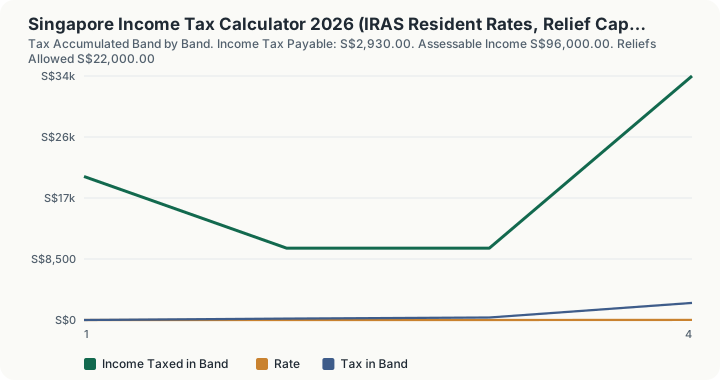
Quick Answer: A Singapore tax resident earning S$96,000 a year and claiming S$22,000 of personal reliefs has a chargeable income of S$74,000 and owes S$2,930 in income tax. That is an effective rate of 3.05% on assessable income, against a marginal rate of 7.00%. The same income with no reliefs claimed would produce S$5,190 of tax, so the reliefs are worth S$2,260.
What does this calculator do?
Singapore taxes resident individuals on a progressive schedule that runs from 0% to 24% across thirteen bands. The first S$20,000 of chargeable income is taxed at nothing, and the bands climb slowly through the middle of the range, which is why effective rates in Singapore sit so far below marginal rates. At S$96,000 of income the marginal rate is 7% but the effective rate is barely above 3%.
Three things decide the bill, and they happen in a fixed order. First, personal reliefs are added up and capped at S$80,000 for the Year of Assessment. Second, the allowed reliefs are subtracted from assessable income to give chargeable income, which is what the bands are actually applied to. Third, any Personal Income Tax Rebate is taken off the gross tax as a percentage of the tax, capped in dollars.
That last ordering matters more than it looks. A rebate is a percentage of tax, never of income, and both recent rebates carried a S$200 dollar cap. A rebate advertised as 60% is worth the full 60% only to a taxpayer with less than about S$333 of tax; above that the cap swallows the percentage. This calculator defaults the rebate to zero, because IRAS had published no rebate for YA 2026 as at the source read date.
How is this calculated?
The resident computation is:
T = max(0, ProgressiveTax (I − min(R, 80,000)) − min(ProgressiveTax × p, c))
where I is assessable income, R is reliefs claimed, p is the rebate percentage and c is the rebate cap.
Step 1: Add employment income to other taxable income. S$96,000 + S$0 = S$96,000 assessable income
Step 2: Cap total reliefs at S$80,000. min(S$22,000, S$80,000) = S$22,000 allowed
Step 3: Record any relief lost to the cap. S$22,000 - S$22,000 = S$0 lost
Step 4: Subtract allowed reliefs to get chargeable income. S$96,000 - S$22,000 = S$74,000
Step 5: First band, on the first S$20,000 at 0%. S$20,000 x 0% = S$0
Step 6: Second band, the next S$10,000 at 2%. S$10,000 x 2% = S$200
Step 7: Third band, the next S$10,000 at 3.5%. S$10,000 x 3.5% = S$350
Step 8: Fourth band, income from S$40,000 to S$74,000 at 7%. S$34,000 x 7% = S$2,380
Step 9: Sum the bands for gross tax. S$0 + S$200 + S$350 + S$2,380 = S$2,930
Step 10: Apply the rebate as a percentage of gross tax, capped in dollars. min(S$2,930 x 0%, S$200) = S$0
Step 11: Net tax payable. S$2,930 - S$0 = S$2,930
Step 12: Effective rate against assessable income. S$2,930 / S$96,000 = 3.05%
The calculator also runs the identical computation a second time with reliefs set to zero, so the value of the reliefs is measured rather than asserted.
Step 13: Gross tax on S$96,000 of chargeable income with no reliefs. S$200 + S$350 + (S$40,000 x 7% = S$2,800) + (S$16,000 x 11.5% = S$1,840) = S$5,190
Step 14: What the reliefs saved. S$5,190 - S$2,930 = S$2,260
Worked Example
A salaried Singaporean earns S$96,000 with no rental or trade income and claims S$22,000 of reliefs, roughly Earned Income Relief plus CPF Relief at that salary.
Step 1: Assessable income. S$96,000 + S$0 = S$96,000
Step 2: Reliefs, well under the cap. S$22,000 claimed, S$22,000 allowed
Step 3: Chargeable income. S$96,000 - S$22,000 = S$74,000
Step 4: Tax through the bands. S$0 + S$200 + S$350 + S$2,380 = S$2,930
Step 5: Rebate, none announced for YA 2026. S$0
Step 6: Net tax payable. S$2,930
Step 7: Spread over the year for budgeting. S$2,930 / 12 = S$244.17 per month
Step 8: Income after tax. S$96,000 - S$2,930 = S$93,070
The marginal rate is 7.00%, so an extra S$1,000 of chargeable income costs S$70 in tax until the S$80,000 boundary, where the rate steps up to 11.5%.
What does this calculator not account for?
- No Personal Income Tax Rebate is applied for YA 2026, and none is assumed. IRAS had published no YA 2026 rebate as at the source read date of 30 August 2026. A rebate is announced Budget by Budget and is not a standing feature of the Act, so this should be read as unannounced rather than as confirmed absent. The prior-year pattern the code carries is YA 2025 at 60% capped at S$200 and YA 2024 at 50% capped at S$200. The rebate percentage and cap are user inputs precisely so that a later announcement needs no code change.
- Reliefs are a single number you supply. The calculator does not compute Earned Income Relief, CPF Relief, spouse, child, parent, grandparent-caregiver, NSman, SRS or CPF cash top-up reliefs from your circumstances, and it does not check that what you entered is actually claimable. The S$22,000 default is an approximation of Earned Income Relief plus CPF Relief for a S$96,000 salary, not a computed figure.
- The S$80,000 cap is applied to your total as a single ceiling. There is no modelling of the individual sub-limits inside particular reliefs.
- No CPF contribution calculation. Employee CPF contributions are not deducted from income here, and employer CPF is excluded from income by assumption rather than by computation.
- Capital gains and one-tier dividends are excluded by instruction, not by logic. The input help tells you not to enter them; the engine taxes whatever you do enter.
- No withholding, instalments or Auto-Inclusion Scheme timing. Singapore assesses annually and bills in arrears. The monthly figure shown is the annual bill divided by twelve for budgeting only, not a payment schedule.
- Residency is assumed. This calculator applies resident rates unconditionally. Non-residents are a different computation entirely.
What mistakes do people make with this?
Applying the marginal rate to the whole income. At S$74,000 of chargeable income the marginal rate is 7%, but 7% of S$74,000 is S$5,180, nearly double the real S$2,930. Only the slice above S$40,000 is taxed at 7%.
Applying the bands to salary rather than chargeable income. The bands run on income after reliefs. Using S$96,000 instead of S$74,000 overstates the bill by S$2,260.
Expecting a rebate to repeat. The YA 2025 rebate was 60% capped at S$200. Nothing carries forward automatically, and this calculator defaults it to zero.
Overvaluing a percentage rebate. With a S$200 cap, a 60% rebate on S$2,930 of tax is worth S$200, not S$1,758. The cap binds at about S$333 of tax.
Assuming the S$80,000 relief cap affects you. It almost never does at ordinary incomes. It is built to bite on very large child relief and CPF cash top-up claims.
Frequently Asked Questions
How much income tax do I pay on S$96,000 in Singapore?
What is the difference between assessable and chargeable income?
Is there a personal income tax rebate for YA 2026?
What is the highest income tax rate in Singapore?
How much are my tax reliefs actually worth?
What happens if I claim more than S$80,000 of reliefs?
Sources
- Inland Revenue Authority of Singapore, "Individual Income Tax Rates", iras.gov.sg/taxes/individual-income-tax/basics-of-individual-income-tax/tax-residency-and-tax-rates/individual-income-tax-rates: read 2026-08-30 for the YA 2024 onwards resident rate table and the Personal Income Tax Rebate history.
- Inland Revenue Authority of Singapore, "Tax Reliefs", iras.gov.sg/taxes/individual-income-tax/basics-of-individual-income-tax/tax-reliefs-rebates-and-deductions/tax-reliefs: read 2026-08-30 for the S$80,000 personal income tax relief cap applying to the total of all reliefs claimed for each Year of Assessment.