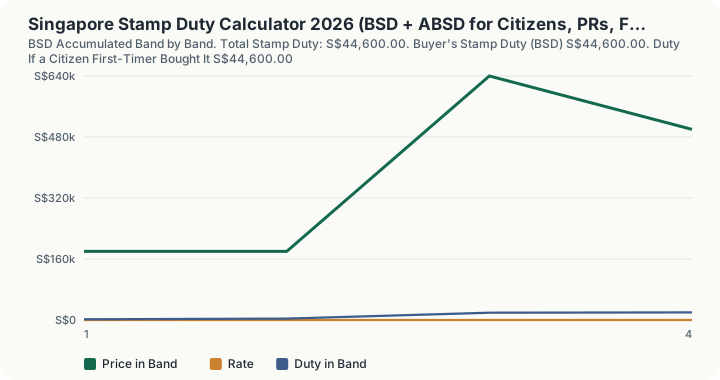
Quick Answer: A Singapore Citizen buying a first residential property at S$1,500,000 pays S$44,600.00 of stamp duty, all of it Buyer's Stamp Duty and none of it ABSD. That is an effective 2.973% of the price, with a top BSD band of 4%. The same flat bought by a foreigner would carry 60% ABSD on the whole price on top, payable within 14 days and not financeable.
What does this calculator do?
Singapore charges two entirely separate duties on a property purchase, and they work in completely different ways.
Buyer's Stamp Duty (BSD) is banded. Every buyer of every property pays it, residential or not, citizen or not. It runs from 1% on the first S$180,000 up to 6% on the portion of a residential price above S$3 million, and because the lower bands are charged at 1% to 4%, the effective rate is always well below the top marginal rate.
Additional Buyer's Stamp Duty (ABSD) is flat. It is a single percentage applied to the entire price, determined by who you are and how many residential properties you already own. It is not a banded top-up and it does not interact with BSD in any way. For a foreigner at 60%, ABSD is not a surcharge on the BSD; it is roughly seventeen times the BSD, and it dominates every other cost in the transaction.
Conflating the two is the commonest error in Singapore stamp duty arithmetic, and it is why a calculator quoting only BSD is close to useless for anyone who is not a citizen first-time buyer. The two are computed by visibly different paths here for that reason.
Both duties are charged on the purchase price or the market value, whichever is higher. If a valuation exceeds what you are paying, the valuation is the base.
How is this calculated?
BSD = ⌊∑_b (price within band b) × r_b⌋; ABSD = ⌊P × a⌋
Total = BSD + ABSD
where $P$ is the dutiable value and $a$ is the flat ABSD rate for the buyer profile. Both duties are rounded down to the nearest dollar, subject to a minimum duty of S$1 where a duty is chargeable at all.
The BSD bands for residential property, on or after 15 February 2023: first S$180,000 at 1%, next S$180,000 at 2%, next S$640,000 at 3%, next S$500,000 at 4%, next S$1,500,000 at 5%, and the remainder at 6%. Non-residential property uses the same bands up to S$1,500,000 and then stops at a 5% top rate, with no 6% band.
The ABSD rates on or after 27 April 2023: a Singapore Citizen pays nothing on a first residential property, 20% on a second and 30% on a third or subsequent. A Singapore PR pays 5% on a first, 30% on a second and 35% on a third or subsequent. A foreigner pays 60% on any residential property. An entity pays 65%, and a trustee pays 65%. There is no ABSD on non-residential property at all.
Step 1: Tax the first S$180,000 of the price at 1%. S$180,000 x 1% = S$1,800.00
Step 2: Tax the next S$180,000 at 2%. S$180,000 x 2% = S$3,600.00
Step 3: Tax the next S$640,000 at 3%, taking the price to S$1,000,000. S$640,000 x 3% = S$19,200.00
Step 4: The remaining S$500,000 falls in the 4% band, which runs to S$1,500,000. S$500,000 x 4% = S$20,000.00
Step 5: Sum the bands to get BSD, rounded down to the nearest dollar. S$1,800 + S$3,600 + S$19,200 + S$20,000 = S$44,600.00
Step 6: Express BSD as a share of the whole price. S$44,600 / S$1,500,000 = 2.973%
Step 7: Apply the flat ABSD rate for a Singapore Citizen first-timer to the whole price. S$1,500,000 x 0% = S$0.00
Step 8: Total stamp duty. S$44,600.00 + S$0.00 = S$44,600.00
Step 9: Add the duty to the price to get the real cash requirement. S$1,500,000 + S$44,600 = S$1,544,600.00
Note the shape of steps 1 to 5 against step 7. BSD accumulates slice by slice, which is why its effective rate of 2.973% is well below its 4% marginal rate. ABSD does nothing of the kind: it is one multiplication against the entire price, with no bands and no relief for the lower portions.
Worked Example
Take a foreigner buying a residential property at S$2,000,000: IRAS's own worked example.
Step 1: Tax the first S$180,000 at 1%. S$180,000 x 1% = S$1,800.00
Step 2: Tax the next S$180,000 at 2%. S$180,000 x 2% = S$3,600.00
Step 3: Tax the next S$640,000 at 3%. S$640,000 x 3% = S$19,200.00
Step 4: Tax the next S$500,000 at 4%, taking the price to S$1,500,000. S$500,000 x 4% = S$20,000.00
Step 5: The remaining S$500,000 falls in the 5% band. S$500,000 x 5% = S$25,000.00
Step 6: Total BSD. S$1,800 + S$3,600 + S$19,200 + S$20,000 + S$25,000 = S$69,600.00
Step 7: Apply the 60% foreigner ABSD rate to the entire price. S$2,000,000 x 60% = S$1,200,000.00
Step 8: Total stamp duty. S$69,600.00 + S$1,200,000.00 = S$1,269,600.00
Step 9: Express ABSD as a multiple of BSD. S$1,200,000 / S$69,600 = 17.24 times the BSD
Step 10: Total duty as a percentage of price. S$1,269,600 / S$2,000,000 = 63.48%
Step 9 is the number that reframes the transaction. Every discussion of BSD bands, every argument about whether the 5% band or the 6% band applies, is worth a few tens of thousands of dollars. The buyer profile is worth S$1.2 million on the same property at the same price. A citizen first-timer buying that identical S$2,000,000 flat pays S$69,600 in total.
Certain buyers may qualify for ABSD remission or relief: most notably under free trade agreements that give nationals of a small number of countries citizen-equivalent treatment, and under the married-couple remission where a matrimonial home is bought jointly and the previous property is sold within the statutory window. None of those is modelled here, and each depends on conditions this calculator cannot test.
What does this calculator not account for?
- Housing developers are deliberately omitted from the buyer list. Their ABSD rate is 35% plus an additional 5% that is non-remittable, with a remission regime attached, and a figure conditional on a remission cannot be stated honestly without modelling the remission itself. Developers should not use this calculator.
- It does not model ABSD remission or relief. The married-couple remission, free trade agreement relief for nationals of certain countries, and the various remissions for redevelopment and en bloc purchases all change the answer and all depend on eligibility conditions this tool cannot verify.
- It does not decide the dutiable value. Both duties are charged on the higher of price and market value. That is a valuation question; enter whichever is higher.
- It does not count your properties for you. The property count is of residential properties owned wholly, partially or jointly. A half share in an inherited flat counts as one, and getting this wrong moves you between rate bands worth hundreds of thousands of dollars.
- It does not model Seller's Stamp Duty, payable on disposal within the holding period, nor Additional Conveyance Duties on transfers of shares in property-holding entities.
- It does not model the ABSD (Trust) refund mechanism, under which the 65% trustee rate may be partially refunded where identifiable beneficial owners exist.
- It does not include legal fees, valuation fees, agent commission or the mortgage stamp duty, all of which are separate transaction costs.
- It does not model the timing. Duty is due within 14 days of the document being signed in Singapore, or 30 days if signed overseas. Late payment attracts penalties not computed here.
What mistakes do people make with this?
- Thinking ABSD is banded like BSD. It is not. It is a flat percentage of the entire price from the first dollar. There is no lower-band relief and no progression.
- Quoting only BSD. For anyone other than a citizen first-timer this understates the duty by an order of magnitude. A citizen buying a second property at S$1.5 million pays S$44,600 of BSD and S$300,000 of ABSD.
- Assuming the mortgage covers it. It does not. Stamp duty must be paid in cash or from CPF within 14 days, and it sits entirely outside the loan-to-value calculation.
- Miscounting properties. A partial interest counts. Overseas properties generally do not count for ABSD, but every residential property in Singapore owned wholly, partially or jointly does.
- Assuming a PR is treated like a citizen. A PR pays 5% ABSD on a first property where a citizen pays nothing, and 30% on a second where a citizen pays 20%.
- Forgetting non-residential property carries BSD too. There is no ABSD on commercial or industrial property, but BSD still applies, topping out at 5% rather than 6%.
- Buying through a company to avoid ABSD. An entity pays 65%, the highest rate in the table, higher than a foreigner's.
Frequently Asked Questions
How much stamp duty does a foreigner pay in Singapore?
Is ABSD calculated on the price above a threshold, or on the whole price?
Can I include stamp duty in my mortgage?
What is the stamp duty on a second property for a Singapore Citizen?
Do I pay ABSD on commercial property?
Sources
- Inland Revenue Authority of Singapore, "Buyer's Stamp Duty (BSD)", iras.gov.sg: read 2026-08-30. Source of the BSD rates "On or after 15 Feb 2023" for both residential and non-residential property, and of the rounding rule: "BSD is rounded down to the nearest dollar, subject to a minimum duty of $1." iras.gov.sg/taxes/stamp-duty/for-property/buying-or-acquiring-property/buyer's-stamp-duty-(bsd)
- Inland Revenue Authority of Singapore, "Additional Buyer's Stamp Duty (ABSD)", iras.gov.sg: read 2026-08-30. Source of the ABSD rates "on or after 27 Apr 2023" for citizens, permanent residents, foreigners, entities and trustees, of the identical rounding rule, and of the housing developer rate that this calculator deliberately excludes. iras.gov.sg/taxes/stamp-duty/for-property/buying-or-acquiring-property/additional-buyer's-stamp-duty-(absd)
Also consulted: Both IRAS pages state that the duties are chargeable on the purchase price or the market value of the property, whichever is higher; Band and flat-rate arithmetic implemented in engine/primitives/singapore-stamp-duty.ts, with BSD and ABSD computed by separate code paths so that the banded and flat mechanisms cannot be conflated.