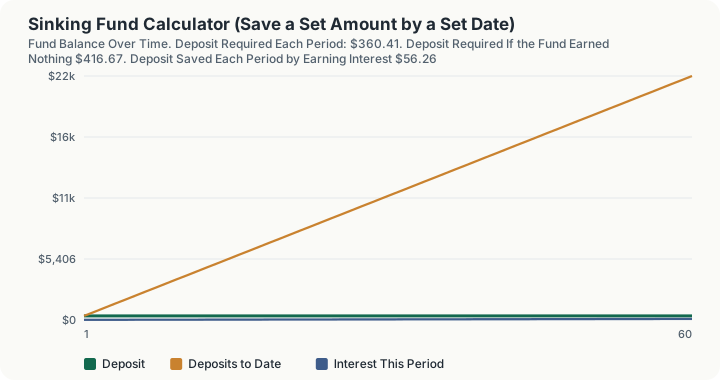
Quick Answer: To reach $30,000 in five years, starting from $5,000 already saved, with monthly deposits into an account paying 4% a year, you need to deposit $360.41 a month. Sixty deposits total $21,624.60 and interest supplies the remaining $3,375.40, which is 11.3% of the target. Without interest the same goal would need $416.67 a month, so the account is saving you $56.26 every month.
What does this calculator do?
A sinking fund is money set aside on a schedule for a known future expense, and the phrase is worth recovering from corporate finance because the discipline it names is exactly what most personal budgets lack. A roof, a car replacement, a tax bill, a wedding, a deposit. All of them are foreseeable and dated, and all of them get financed at credit card rates by households that could have funded them at a deposit rate instead.
The arithmetic is an ordinary annuity solved for the payment. What makes the page worth reading rather than just using is the decomposition it forces. Of the $30,000 target, $5,000 is already there, $21,624.60 arrives as deposits, and $3,375.40 is interest. That last figure is not large, and saying so plainly is more useful than implying otherwise: over five years at 4%, interest does about a ninth of the work. The deposits do the rest.
The schedule on this page rolls the balance forward period by period, and the final deposit absorbs whatever rounding has accumulated so that the closing balance lands exactly on the target rather than a few cents either side. That is a deliberate property of every schedule in this engine and it is tested.
One structural choice is yours: whether the deposit lands at the start or the end of each period. Depositing at the start gives every payment one extra period of interest, which lowers the required amount slightly.
How is this calculated?
The required deposit is the ordinary annuity payment that carries the existing balance to the target:
PMT = (FV − PV(1 + i)ⁿ)/(((1 + i)ⁿ − 1)/i)
with $i$ the periodic rate and $n$ the number of deposits. For deposits at the start of each period the annuity-due form divides that result by $(1 + i)$.
Step 1: Convert the horizon into periods. 5 years x 12 deposits a year = 60 deposits
Step 2: Convert the annual rate into a periodic rate. 4% / 12 = 0.333333% per month
Step 3: Grow the money already saved to the target date. $5,000 x (1.00333333)^60 = $6,104.98 That is what the $5,000 becomes on its own, without another deposit.
Step 4: Find what the deposits must supply. $30,000.00 - $6,104.98 = $23,895.02
Step 5: Divide by the annuity factor for 60 periods at 0.333333%. The factor is ((1.00333333)^60 - 1) / 0.00333333 = 66.29927 $23,895.02 / 66.29927 = $360.41 a month
Step 6: Compute what the same goal would need with no interest at all. $30,000.00 - $5,000.00 = $25,000.00 $25,000.00 / 60 = $416.67 a month
Step 7: Take the difference. $416.67 - $360.41 = $56.26 a month saved by earning interest
Step 8: Total the deposits. $360.41 x 60 = $21,624.60
Step 9: Derive the interest contribution. $30,000.00 - $5,000.00 - $21,624.60 = $3,375.40
Step 10: Express it as a share of the target. $3,375.40 / $30,000.00 = 11.3%
Worked Example
The month-by-month roll forward makes the mechanism concrete, and the first and last periods are the interesting ones.
Step 1: Open with the existing balance. Starting balance: $5,000.00
Step 2: Month one, deposits at the end of the period. Interest first: $5,000.00 x 0.333333% = $16.67 Then the deposit: $5,000.00 + $16.67 + $360.41 = $5,377.08
Step 3: Month two. Interest: $5,377.08 x 0.333333% = $17.92 Balance: $5,377.08 + $17.92 + $360.41 = $5,755.41
Step 4: Jump to the final month. By then the balance is large enough that a single month's interest is $98.47, nearly six times the $16.67 earned in month one. That growth in the interest line is the whole of what compounding does over a five-year horizon.
Step 5: Land exactly on the target. The final deposit is adjusted by twenty cents, to $360.61, absorbing the rounding accumulated over sixty periods so the closing balance is $30,000.00 exactly rather than $29,999.80.
Step 6: Check the totals reconcile. Deposits $21,624.80 including the final adjustment, plus $3,375.20 of interest, plus the $5,000 opening balance, equals $30,000.00.
Step 7: Compare against the no-interest case. $416.67 a month for sixty months is $25,000.00 of deposits against $21,624.60 with interest. The account did $3,375.40 of the saving for you, which is real but is a ninth of the job. The deposits are the other eight ninths, and no rate available on a five-year savings horizon changes that.
Carrying the Fund to the Target Date
Step 8: End of month twelve. Deposits to date $4,324.92, balance $9,608.81, cumulative interest $283.89
Step 9: End of month twenty-four. Deposits to date $8,649.84, balance $14,405.38, cumulative interest $755.54
Step 10: End of month thirty-six. Deposits to date $12,974.76, balance $19,397.38, cumulative interest $1,422.62
Step 11: End of month sixty. Deposits to date $21,624.80, balance $30,000.00, cumulative interest $3,375.20
Three years in, the fund has collected $1,422.62 of interest. The remaining two years collect $1,952.58, more than the first three years managed. Interest in a sinking fund is back-loaded because it is paid on a balance that only exists once the deposits have built it, which is the practical argument for starting the fund early even at a low deposit rather than starting it late at a high one.
What does this calculator not account for?
- Tax on the interest. The rate you enter is applied gross. In a taxable account the effective rate is lower, and entering the after-tax rate is the correct fix.
- Inflation. The target is a nominal amount at a future date. If the thing you are saving for costs more by then, the target you entered is too low, and this page will not tell you so.
- Rate changes. One constant periodic rate is applied for the whole horizon. A savings account rate is not fixed for five years.
- Fees, minimum balances, or withdrawal restrictions on the account.
- Contribution limits of any kind.
- Variable deposits. Every deposit is the same size. A plan that saves more in some months than others needs a different tool.
- Missed deposits, early withdrawals, or any behaviour other than the schedule shown.
- Investment risk. The rate is treated as certain. If you intend to invest rather than deposit, the required contribution is not a required contribution, it is an expected one, and a bad sequence of returns can leave you short on the date that matters.
What mistakes do people make with this?
- Setting the target in today's prices for something you will buy in five years. A roof is not a fixed number. Uprate the target for the price change you expect, or you will be short by the difference.
- Using an investment return where a savings rate belongs. A dated goal with no flexibility on the date is the classic case for a deposit account. The certainty is the product you are buying.
- Entering the annual rate as the periodic rate. The field wants the annual rate and divides it by the deposits per year. Entering 0.33 where 4 belongs will look plausible and be wrong by a factor of twelve.
- Assuming interest does most of the work over short horizons. Here it does 11.3% of a five-year target. Over twenty years the balance shifts substantially; over five it does not.
- Forgetting the money you already have. The $5,000 opening balance grows to $6,104.98 on its own and reduces the required deposit by $92.08 a month, from $452.49 to $360.41. Leaving it out of the calculation overstates what you need to save.
- Treating the schedule's final adjusted deposit as an error. It is the rounding of sixty periods gathered into one place so that the fund lands exactly on the target.
- Choosing start-of-period deposits and then paying at the end. The difference is small over five years but it is real, and the model assumes you do what you told it.
Frequently Asked Questions
What is a sinking fund?
How much do I need to save each month to reach $30,000 in five years?
How much of the target does interest actually supply?
Should I deposit at the start or the end of the month?
Should I invest a sinking fund instead of saving it?
Why is the last deposit slightly different from the others?
Sources
- U.S. Securities and Exchange Commission, Investor.gov compound interest reference. investor.gov/financial-tools-calculators/calculators/compound-interest-calculator
- FDIC, Money Smart financial education program. fdic.gov/consumer-resource-center/money-smart
This calculator uses no statutory data and no published tables. The target, the horizon, the opening balance, the rate and the deposit frequency are all supplied by the user.
Also consulted: The payment is solved by the shared annuity solver in engine/primitives/tvm.ts, under the standard time-value-of-money equation with the outflow-negative sign convention, and the resulting schedule is reconciled so that the sum of deposits and interest equals the target exactly; For the rate to enter, the account you would actually use is the only authority. Advertised savings rates change frequently and no figure is assumed here.