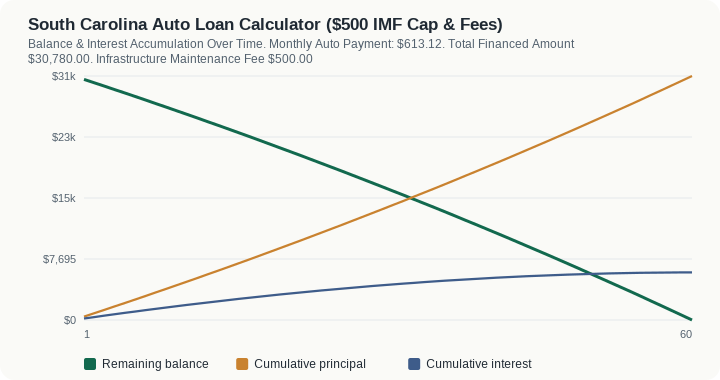
Quick Answer: $613.12 a month is where this page starts a Charleston or Greenville buyer: a $35,000 car, the $225 closing fee that Consumer Affairs presumes reasonable, $5,000 paid at signing, and five years at 7.25%. Instead of sales tax the state takes a flat $500.00 Infrastructure Maintenance Fee, SCDMV adds $55 for title and a two-year plate, and $30,780.00 is financed.
The $500 Ceiling Changes Everything
South Carolina stopped charging sales tax on vehicles that must be registered on July 1, 2017. In its place is the Infrastructure Maintenance Fee under S.C. Code 56-3-627. The Department of Revenue's Information Letter #22-17 describes it as 5% of the gross proceeds of a sale by a licensed SCDMV dealer, or 5% of fair market value on a sale by anyone else, "not to exceed $500" in either case. Sales subject to the fee are exempt from state and local sales and use taxes, so no Charleston, Columbia or Greenville local rate applies.
The cap means the fee is a true percentage only on cheap vehicles. Five percent of $10,000 is $500, so any deal whose net price reaches $10,000 pays exactly $500, and a $90,000 truck pays the same $500 as an $11,000 sedan. With this page's $225 closing fee in the base, the cap binds from a vehicle price of $9,775 upward.
Collection runs through the dealer: Information Letter #22-17 says a dealer that offers to license, title or register the vehicle must collect the fee and remit it to the SCDMV. On a private sale the buyer pays it to SCDMV at registration. An owner who moves to South Carolina and registers a vehicle already registered out of state pays a flat $250, and active duty military members and their families are exempt under 56-3-627(D)(2).
How is this calculated?
The config passes the shared purchase tax module a 5% rate, a $500 hard cap, a taxable closing fee and an allowed trade-in, and no local rate:
- Net price = vehicle price + closing fee minus trade-in.
- IMF = the smaller of net price x 5% and $500.
- Fixed fees = $55.00: a $15 title and the $40 two-year passenger registration. They are not part of the net price.
- Delivered price = price + closing fee + IMF + $55.
- Loan = the step 4 total, less whatever the trade and your cash cover. The monthly figure is a plain fixed-rate installment, computed as on the general auto loan calculator.
Step 2 is the reason the "Net Price Before the Cap" output can look large while the fee stays fixed. Above $10,000 of net price that figure stops affecting the answer.
Worked Example
Three sticker prices on the Quick Answer's financing. Watch the IMF column refuse to move:
| Vehicle price | IMF | Delivered | Financed | Payment | Interest |
|---|---|---|---|---|---|
| $22,000 | $500.00 | $22,780.00 | $17,780.00 | $354.17 | $3,469.92 |
| $35,000 | $500.00 | $35,780.00 | $30,780.00 | $613.12 | $6,007.01 |
| $52,000 | $500.00 | $52,780.00 | $47,780.00 | $951.75 | $9,324.76 |
Below the cap the fee behaves like a normal 5% tax. An $8,000 Columbia commuter car, $225 closing fee, nothing down, otherwise as above, nets $8,225 and an IMF of $411.25. It finances $8,691.25 at $173.12 a month.
Hold the $30,780.00 loan and vary only its length: 36 months costs $953.92 a month and $3,561.09 in interest; 48 months, $740.64 and $4,770.73; 72 months, $528.47 and $7,269.92; 84 months, $468.32 and $8,559.24. Every one of those interest figures is larger than the IMF itself, which is the honest way to think about where the money goes on a South Carolina car loan.
Trade-Ins Under a Capped Fee
A trade-in still comes off the net price, but on most deals it no longer changes the fee. Bring a $10,000 trade to the Quick Answer purchase and the net price only falls to $25,225, still far above $10,000, so the IMF stays $500.00 and the "IMF Saved by Trade-In" line reads $0. The payment falls to $413.92 only because less is borrowed.
The credit matters only when it pulls the net price under $10,000. A $30,000 car with a $22,000 trade and the $225 fee nets $8,225, the IMF drops to $411.25, and the trade saves $88.75 of fee. That is the most a South Carolina trade can ever save on a dealer purchase: the gap between $500 and 5% of whatever net price remains.
Closing Fees and Dealer Financing Under Title 37
The dealer's documentation charge is called a closing fee in South Carolina, and S.C. Code 37-2-307 governs it. There is no fixed dollar cap. Before charging one, a dealer files notice with the Department of Consumer Affairs of the maximum it intends to charge. A proposed fee of $225 or less is treated as approved; anything higher can be reviewed for reasonableness against the dealer's actual closing costs. The fee must appear on the contract, on a sign in the dealership, and in any advertisement for a specific vehicle.
Dealer-arranged credit falls under the consumer credit sales rules in the same title. Section 37-2-201 caps the credit service charge at the greater of a rate schedule the creditor has filed and posted under section 37-2-305, or 18% annually on what remains of the amount financed. A creditor that misses its filing is held to 18% until it files.
Rank and Neighbours
Put the Quick Answer car through each of the fifty state calculators, every one left on the fee and local setting it opens with, and South Carolina's $500.00 is the fifth lightest charge; Oregon, Alaska, Montana and New Hampshire alone come in under it. North Carolina's 3% Highway Use Tax gives $1,073.97 on the same deal, and Georgia's Title Ad Valorem Tax $2,491.93.
What does this calculator not account for?
- County vehicle property tax. South Carolina counties tax vehicles every year, paid in advance, and that bill can exceed the one-time IMF quickly. It is not modeled.
- Private-party sales, where the fee is based on fair market value rather than your price.
- The $250 new-resident fee and the military exemption.
- Senior registration rates and title and plate fees other than the $15 and $40 used here.
- Closing fees above $225, which you can enter but which the calculator cannot test for reasonableness.
What mistakes do people make with this?
- Applying 6% plus local sales tax to a car. Registered vehicles pay the IMF instead.
- Negotiating hard on the trade to save tax. Above $10,000 net, it saves none.
- Shopping down a price tier to save IMF. A $14,000 car pays the same $500 as a $40,000 one.
- Ignoring the annual property tax when comparing a South Carolina purchase with Georgia's one-time TAVT.
- Overlooking the closing fee sign. The dealer must post the fee, so ask for it before negotiating.
Frequently Asked Questions
What is the sales tax on a car in South Carolina?
Why does a $22,000 car and a $52,000 car pay the same tax in South Carolina?
Does a trade-in reduce the IMF?
Is there a limit on dealer closing fees in South Carolina?
What is the most a car dealer can charge in finance charges in South Carolina?
Sources
- South Carolina Department of Revenue, Information Letter #22-17, Infrastructure Maintenance Fee and sales and use tax on motor vehicles. dor.sc.gov/resources-site/lawandpolicy/Advisory%20Opinions/IL22-17.pdf
- South Carolina Code of Laws Title 37 Chapter 2 (sections 37-2-201, 37-2-305, 37-2-307). scstatehouse.gov/code/t37c002.php
- South Carolina Code of Laws section 56-3-627, Infrastructure Maintenance Fee. scstatehouse.gov/code/t56c003.php