Quick Answer: Tennessee imposes no state-level tax on capital gains, so an investor realizing a $100,000 gain owes $0 in Tennessee state tax and keeps the full $100,000, subject only to federal tax.
How This Is Calculated
Tennessee taxes no individual income, and its former levy on interest and dividends did not survive; nothing in current law reaches a realized capital gain. A resident selling appreciated property owes the state nothing on the profit, which makes the planning question here a federal and timing one rather than a rate one.
There is no rate schedule to reproduce, so the two identities the calculator applies are simply these.
What the calculator does with your inputs:
- Start with the net gain. The figure you enter is the gain left after capital losses and loss carryforwards have been netted against it.
- Look for a Tennessee rate schedule. There is none to look up, so the state line resolves to zero before any bracket arithmetic runs. The other-income field has no effect here; it is kept so the page compares cleanly against states where it does matter.
- Effective rate. Zero divided by the realized gain is 0.00%, and it stays 0.00% whether the gain is $10,000 or $10 million.
- Net proceeds. The gain passes through the state layer whole.
- What is still owed. Federal capital gains tax and the federal net investment income tax are unaffected by residence in a no-tax state and are calculated separately.
Worked Example
Consider an investor residing in Tennessee who realizes $100,000 in capital gains alongside $75,000 in ordinary income during the year.
- Check the state rate. Tennessee does not levy an individual income tax, and it does not carve out a separate tax on investment gains either, so the state rate applied to this sale is 0.00%.
- Compute the state tax. $100,000 × 0.00% = $0.00. No state return, no state estimated payments, and no state withholding apply to this capital gain.
- Net proceeds. The investor retains the full $100,000 gain after state tax, compared to an investor in a high-tax state who might lose 5% to 13% of the same gain to state liability.
- Federal liability remains. Tennessee's 0% state rate does not eliminate federal exposure: the gain is still subject to federal long-term or short-term capital gains brackets under IRC § 1(h), plus the 3.8% NIIT surtax where applicable.
How Large Can the Gain Get Before Tennessee Takes Anything
On a state with brackets, the useful question is where the next edge sits and what crossing it costs. Running that question against this calculator produces an unusual answer, and it is worth stating exactly rather than paraphrasing: there is no gain size at which the Tennessee figure stops being $0.00.
Sweeping the gain from $0 to $100,000,000 in $20,000,000 steps returns $0.00 at $0, at $20,000,000, at $40,000,000, at $60,000,000, at $80,000,000 and at $100,000,000, with a change of $0.00 between every consecutive pair. The effective rate output holds at 0.00% across the whole range and the marginal rate output holds at 0.00% with it. The $100,000,000 stopping point is the calculator's input maximum, a form limit, not a threshold in Tennessee law; the answer does not change as it is approached.
The next $1,000, and the next $1,000,000
The marginal figure follows directly. Each additional $1,000 of gain costs $0.00. So does each additional $1,000,000. There is no point in the range where the increment becomes anything else, which is the whole difference between this page and a graduated one: on a bracketed state the cost of the next unit is a step function, and here it is a flat line at zero.
What the twelve-row schedule shows
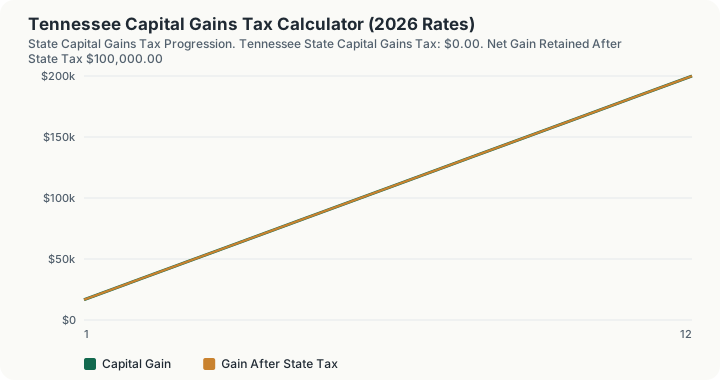
The schedule built from the $100,000 default runs the gain up in even steps from $16,666.67 to $200,000. State Tax Due reads $0.00 in all twelve rows. Because of that, the Gain After State Tax column reproduces the Capital Gain column exactly: $50,000 retained at a $50,000 gain, $100,000 at $100,000, $150,000 at $150,000, $200,000 at $200,000. In a state with a rate schedule those two columns diverge and the gap widens down the table. Here they never separate by a cent, and the calculator's headline and net-proceeds outputs agree with that: $0.00 due, $100,000.00 retained.
Right method against wrong method
The error this page most often has to correct is a Hall-era one. The Hall income tax was a real Tennessee levy, so a seller who remembers it sometimes reserves against a gain at a rate they half recall. Two things are wrong with that at once. The tax has been repealed for tax periods beginning on or after 1 January 2021, and even while it was in force it reached interest from bonds and notes and dividends from stock, never a capital gain on the sale of stock or real estate. The calculator prices the correct answer at $0.00 and the retained amount at $100,000.00 on the default gain, so any amount reserved against a Tennessee capital gains liability is, to the cent, an amount reserved against nothing. A seller who withheld 3% of a $100,000 gain would be holding $3,000 with no Tennessee return to attach it to.
A limitation this page has to state
The Other Taxable Income field has no effect on the output. Sweeping it from $0 to $10,000,000 returns $0.00 at every point, with a change of $0.00 between them, because the calculation short-circuits the moment it finds no Tennessee rate schedule to look up. Nothing is stacked and no brackets are walked, so the salary figure never reaches the arithmetic. The field is retained only so this page's input set matches the states where stacking genuinely moves the number, and a reader who changes it and sees no movement is seeing the engine behave correctly rather than failing.
The corollary is that this calculator cannot tell you what a gain costs. It tells you what Tennessee charges on it, which is nothing, and it does not net out the federal capital gains tax, the 3.8% net investment income tax, or a nonresident liability owed to the state where the asset sits. The $100,000.00 it reports as retained is a pre-federal figure.
Federal Rules That Still Apply
The state number is zero, so what remains is entirely federal: - The one-year line. More than a year of holding gives long-term treatment at 0%, 15%, or 20%. A year or less is taxed at ordinary federal rates. - Net Investment Income Tax. A federal 3.8% tax under IRC § 1411 reaches net investment income above $200,000 of modified AGI for single filers and $250,000 for joint filers. - Federal estimated payments. The IRS generally expects them when you will owe $1,000 or more after withholding and credits, and generally treats 90% of the current year's tax or 100% of the prior year's as enough to avoid the penalty. Tennessee asks for no matching payment. - Loss offsets. IRC § 1211 nets capital losses against capital gains and allows up to $3,000 of excess loss against ordinary income, carrying the rest forward.
What Tennessee Charges Instead
Tennessee's history here is recent enough to cause confusion. The Hall income tax, enacted in 1929 and named for the senator who sponsored it, applied only to interest from bonds and notes and dividends from stock. The rate was cut by one point a year starting in 2017, and the Department of Revenue states the tax is repealed for tax periods that begin on January 1, 2021, or later, with no return to file for those years. Two things follow. Tennessee now has no individual income tax of any kind, and even when the Hall tax was in force it did not reach capital gains from selling stock or real estate.
Revenue comes instead from a sales and use tax with local option rates added by counties and cities, which is among the higher combined burdens in the country, from franchise and excise taxes levied on businesses rather than individuals, and from local property tax. A Tennessean selling appreciated shares meets none of those on the gain. Someone selling a Tennessee business does have to think about the entity's franchise and excise position, which is separate from the owner's own gain.
Residency and Source Rules
Tennessee borders eight states, most of which tax capital gains, so mixed-state situations are ordinary here rather than exotic. What matters is where you were a resident when the gain was recognized and where the asset is sourced. Moving from Georgia or North Carolina in November does not clear a gain recognized in June. A part-year year gets split, and the former state applies its own domicile test. Real property sold in Kentucky or Virginia is generally taxed by that state on the gain from the property located there, and that obligation exists no matter how long you have lived in Nashville.
What This Does Not Account For
This page is exact about the state answer, which is zero. Everything below sits outside the calculator and still has to be worked out separately: - Federal capital gains tax: long-term rates of 0%, 15%, or 20%, and short-term gains taxed at ordinary rates reaching 37%. - Net Investment Income Tax: the 3.8% federal tax under IRC § 1411 on net investment income above $200,000 of modified AGI for single filers and $250,000 for married filing jointly. - Alternative Minimum Tax: federal AMT under IRC § 55, which reaches the bargain element on an incentive stock option exercise. - Section 1031 like-kind exchanges: federal deferral for real property held for productive use in a trade or business or for investment. - Qualified Small Business Stock: the federal gain exclusion under IRC § 1202, which has its own holding period and issuer tests. - Tax owed to another state: a gain sourced to a state that does tax it, which this calculator does not model.
Common Pitfalls
- Thinking the Hall tax repeal is what makes gains untaxed. The Hall tax reached interest and dividends. Capital gains were outside it before 2021 as well.
- Filing a Hall return for a recent year. The tax is repealed for tax periods beginning on or after January 1, 2021, and the state instructs taxpayers not to file for those years.
- Overlooking the federal estimate. No Tennessee payment exists to trigger the habit, and a large sale can require a federal payment in the quarter it closes.
- Selling a business without separating the entity's taxes from your own. Franchise and excise tax follows the business; the gain on your ownership interest is a federal matter.
- Missing basis adjustments. Depreciation taken on a rental increases the gain through unrecaptured section 1250 gain, taxed federally at up to 25%.
Frequently Asked Questions
Does Tennessee have a state capital gains tax?
What happened to the Hall income tax?
How are short-term and long-term gains taxed in Tennessee?
Can capital losses offset capital gains in Tennessee?
Are quarterly estimated payments required on a Tennessee gain?
Are retirement distributions taxed in Tennessee?
Sources
- Tennessee Department of Revenue, Hall Income Tax: the tax applied only to interest from bonds and notes and dividends from stock, and is repealed for tax periods that begin on January 1, 2021, or later. tn.gov/revenue.html
- IRS, Topic no. 409, Capital Gains and Losses.. irs.gov
- IRS, Publication 550, Investment Income and Expenses (Including Capital Gains and Losses).. irs.gov/publications/p550
Also consulted: IRS, Estimated Taxes: the $1,000 threshold and the current-year and prior-year safe harbors.