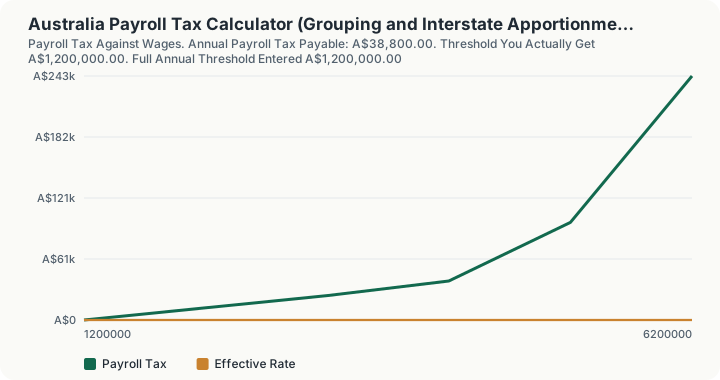
Quick Answer: On the calculator's placeholder defaults, A$2,000,000 of wages against a A$1,200,000 threshold at 4.85% produces A$38,800.00 of annual payroll tax. The threshold and rate are placeholders, not law: payroll tax is a state tax, there is no Commonwealth payroll tax, and neither figure is verified from a primary source.
What does this calculator do?
The most expensive thing about Australian payroll tax is not the rate. It is that the threshold you think shelters your first tranche of wages is very often only partly yours. Two rules cut it down, they are the source of most under-assessments, and they compound.
Before that, the disclosure that governs this whole page. Payroll tax is imposed by the states and territories. There is no Commonwealth payroll tax, so it does not appear on the Federal Register of Legislation and no rate here can be verified against a Commonwealth primary source. The calculator therefore ships no rates: the annual threshold and the tax rate are user inputs, and the loaded defaults of A$1,200,000 and 4.85% are placeholders demonstrating the mechanism, not any jurisdiction's current figures. Choosing a state from the dropdown selects which revenue office is named in the results. It does not load that jurisdiction's threshold or rate.
Each jurisdiction imposes payroll tax under its own Act:
| Jurisdiction | Act | Authority |
|---|---|---|
| NSW | Payroll Tax Act 2007 (NSW) | Revenue NSW |
| VIC | Payroll Tax Act 2007 (Vic) | State Revenue Office Victoria |
| QLD | Payroll Tax Act 1971 (Qld) | Queensland Revenue Office |
| SA | Payroll Tax Act 2009 (SA) | RevenueSA |
| WA | Pay-roll Tax Assessment Act 2002 (WA) | RevenueWA |
| TAS | Payroll Tax Act 2008 (Tas) | State Revenue Office Tasmania |
| ACT | Payroll Tax Act 2011 (ACT) | ACT Revenue Office |
| NT | Payroll Tax Act 2009 (NT) | Territory Revenue Office |
Thresholds range across roughly a factor of three between jurisdictions, so no national default is meaningful. What is common everywhere, and what the engine models, is the structure: a flat rate on wages above an annual threshold, with that threshold shared between grouped employers and apportioned between jurisdictions by wage share.
Note also that taxable wages are broad. They include salaries, commissions, bonuses, allowances, most contractor payments, employer superannuation contributions and the grossed-up value of fringe benefits. Employers who enter only gross salaries understate the base before any of the threshold rules even apply.
How is this calculated?
Using the loaded defaults: wages in this jurisdiction A$2,000,000, total Australian wages A$2,000,000, threshold A$1,200,000, rate 4.85%, not grouped, no additional levy.
- Step 1: Compute the interstate wage share. This jurisdiction grants only the share of its threshold that your wages here bear to your total Australian wages. A$2,000,000 / A$2,000,000 = 1.0
- Step 2: Take your share of any group threshold. Not grouped, so the whole threshold is available. group proportion = 1.0
- Step 3: Apportion the threshold by both proportions. A$1,200,000 x 1.0 x 1.0 = A$1,200,000.00
- Step 4: Subtract the apportioned threshold from wages paid in the jurisdiction. max(0, A$2,000,000 - A$1,200,000) = A$800,000.00
- Step 5: Apply the rate to the taxable wages. A$800,000 x 4.85% = A$38,800.00
- Step 6: Add any additional levy on wages above its own separate threshold. max(0, A$2,000,000 - A$10,000,000) x 0% = A$0.00
- Step 7: Total the annual payroll tax. A$38,800.00 + A$0.00 = A$38,800.00
- Step 8: Express as an effective rate on total wages. A$38,800.00 / A$2,000,000 = 1.94%
That last step is worth pausing on. The effective rate is 1.94%, not the 4.85% headline, because the threshold shelters the first A$1,200,000 entirely. Budgeting off the headline rate overstates the liability by more than half at this wage level.
Worked Example
The two threshold rules are where self-assessments go wrong. Work them separately, then together, on the same defaults.
Interstate apportionment. Suppose you pay A$1,000,000 of wages in this jurisdiction out of A$2,000,000 across Australia. The wage share is 0.5, so the apportioned threshold is A$1,200,000 x 0.5 = A$600,000. Taxable wages are A$1,000,000 - A$600,000 = A$400,000, and the tax is A$400,000 x 4.85% = A$19,400.00. An employer who claimed the full A$1,200,000 threshold in every state would show nothing payable here at all.
Grouping. Related employers (common control, shared employees, tracing of interests) are grouped and share one threshold between them. Back at A$2,000,000 of wages entirely in this jurisdiction, but with a 50% share of the group threshold: apportioned threshold A$1,200,000 x 0.5 = A$600,000, taxable wages A$1,400,000, tax A$1,400,000 x 4.85% = A$67,900.00. That is A$29,100 more than the A$38,800 an ungrouped employer with the identical wages bill would pay.
Both together. They multiply rather than alternate. A$1,000,000 of A$2,000,000 Australia-wide, and a 50% group share:
A$1,200,000 x 0.5 x 0.5 = A$300,000 of threshold. Taxable wages A$1,000,000 - A$300,000 = A$700,000, tax A$700,000 x 4.85% = A$33,950.00. A quarter of the threshold, on half the wages.
What does this calculator not account for?
- The threshold and rate are unverified placeholders. A$1,200,000 and 4.85% are not any jurisdiction's current figures. Obtain both from your state revenue office and replace them.
- Threshold phase-out. Some jurisdictions do not grant the threshold in full and instead phase it out as wages rise, so that large employers get none of it. The engine grants the threshold in full, reduced only by the apportionment proportions. This is not modelled.
- A second, higher rate band. Some jurisdictions apply a higher rate above a second wages threshold. The engine applies a single flat rate. The additional levy input handles a mental-health-levy style surcharge above a separate threshold, but that is a flat add-on, not a second rate band on the main schedule.
- Rebates, exemptions and concessions for apprentices, trainees, charities and regional employers.
- Whether particular contractor payments fall inside the wage definition. The calculator takes your wages figure as given.
What mistakes do people make with this?
- Claiming the full threshold in every state. Each jurisdiction grants only your wage share of its threshold. Doing this across three states triples the shelter you are actually entitled to.
- Ignoring grouping because the entities file separately. Grouping is about control and connection, not about how returns are lodged.
- Entering salaries only. Superannuation contributions, the grossed-up value of fringe benefits, bonuses, allowances and most contractor payments are all in the base.
- Budgeting at the headline rate. At A$2,000,000 of wages the effective rate is 1.94%, not 4.85%.
- Assuming a phase-out jurisdiction behaves like this model. If your threshold shrinks as wages rise, this calculator will understate the tax.
Frequently Asked Questions
Why are the threshold and rate not filled in for my state?
How much does grouping actually cost?
Do grouping and interstate apportionment stack?
Why is my effective rate so much lower than the rate I entered?
What is the additional levy input for?
Sources
- Internal Revenue Service, the official authority for the tax rules this calculator relates to. irs.gov
Also consulted: Revenue NSW, Payroll Tax Act 2007 (NSW); State Revenue Office Victoria, Payroll Tax Act 2007 (Vic); Queensland Revenue Office, Payroll Tax Act 1971 (Qld); RevenueSA, Payroll Tax Act 2009 (SA); RevenueWA, Pay-roll Tax Assessment Act 2002 (WA); State Revenue Office Tasmania, Payroll Tax Act 2008 (Tas); ACT Revenue Office, Payroll Tax Act 2011 (ACT); Territory Revenue Office, Payroll Tax Act 2009 (NT).
No Commonwealth primary source exists for payroll tax, and legislation.gov.au carries no payroll tax law because there is none federally. The authorities that publish the real thresholds and rates are: