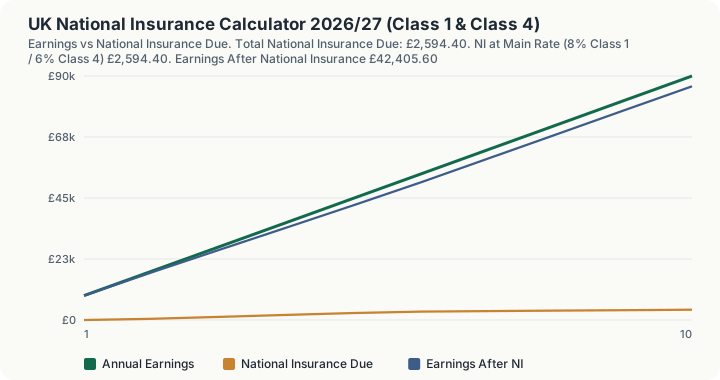
Quick Answer: An employee earning £45,000 a year pays £2,594.40 in Class 1 employee National Insurance (8% on the £32,430 above the £12,570 Primary Threshold). A self-employed person with the same £45,000 in annual profit pays only £1,945.80 in Class 4 NI (6% on the same band), and their employer pays no separate NI on self-employed profits at all.
Overview
This calculator covers UK National Insurance (NI), the UK-wide payroll and self-employment contribution system administered by HMRC (identical rates and thresholds apply in England, Wales, Scotland, and Northern Ireland -- NI is not devolved). It models the three most common categories for the 2025/26 and 2026/27 tax years: Class 1 contributions paid by employees on their salary, the separate Class 1 secondary contribution paid by their employer, and Class 4 contributions paid by the self-employed on their trading profits.
Employee Class 1 NI has fallen sharply in recent years: the main rate was cut from 12% to 10% in January 2024, then to 8% in April 2024, where it has stayed for 2025/26 and 2026/27. Class 4 self-employed NI followed a similar path, settling at 6% on the main band. Employer NI moved the opposite direction: the Autumn Budget 2024 raised the employer rate from 13.8% to 15% and lowered the threshold at which it starts from £9,100 to £5,000 a year, both effective from 6 April 2025 and unchanged for 2026/27 -- a substantial net increase in the cost of employing staff, partly offset for smaller employers by a larger £10,500 Employment Allowance.
How This Is Calculated
Class 1 (employee): 8% on earnings between the Primary Threshold (£12,570/year, £242/week) and the Upper Earnings Limit (£50,270/year, £967/week), then 2% on anything above the UEL. Nothing is due on earnings below the Primary Threshold.
Class 1 secondary (employer): 15% on earnings above the Secondary Threshold of £5,000/year (£96/week) -- note this threshold is lower and the rate structure has no upper band, unlike the employee's contribution. Eligible employers can offset up to £10,500/year of this liability using the Employment Allowance, which most small and medium employers can claim in full against their first employee(s).
Class 4 (self-employed): 6% on profits between the same £12,570 Lower Profits Limit and £50,270 Upper Profits Limit, then 2% above -- the identical band structure to Class 1 employee NI, but at a lower main rate and with no separate employer-side charge, since the self-employed have no employer.
Worked Example
An employee on £45,000
Step 1 -- Earnings below the Primary Threshold. The first £12,570 is free of NI, so £0.00 is due on it
Step 2 -- The main rate band. £45,000 - £12,570 = £32,430 falls between the Primary Threshold and the £50,270 Upper Earnings Limit
Step 3 -- NI at 8%. £32,430 x 8% = £2,594.40
Step 4 -- The upper rate band. £45,000 is below £50,270, so nothing reaches the 2% band: £0.00
Step 5 -- Total employee Class 1 NI. £2,594.40 + £0.00 = £2,594.40, an effective rate of 5.77%
Step 6 -- Earnings after NI. £45,000.00 - £2,594.40 = £42,405.60
Step 7 -- The employer's separate charge. (£45,000 - £5,000) x 15% = £6,000, which the £10,500 Employment Allowance absorbs entirely, leaving £0.00 net for an employer with this single employee
Crossing the Upper Earnings Limit
Step 8 -- The same employee on £75,000, main rate band. £50,270 - £12,570 = £37,700, and £37,700 x 8% = £3,016.00
Step 9 -- The upper rate band. £75,000 - £50,270 = £24,730, and £24,730 x 2% = £494.60
Step 10 -- Total. £3,016.00 + £494.60 = £3,510.60, an effective rate of 4.68%
Step 11 -- The marginal rate at the boundary. The pound before £50,270 costs 8p; the pound after costs 2p
Step 11 is the counterintuitive bit, and step 10 is its consequence: a £75,000 earner has a lower effective NI rate than a £45,000 earner, 4.68% against 5.77%. National Insurance is the one major UK charge whose marginal rate falls as you earn more, which is why the effective rate peaks at exactly £50,270 and declines from there.
The ladder, from the computed table
Step 12 -- £9,000 of earnings. Below the threshold, so £0.00
Step 13 -- £27,000. (£27,000 - £12,570) x 8% = £1,154.40
Step 14 -- £45,000. £2,594.40
Step 15 -- £54,000, just past the limit. £3,016.00 + (£3,730 x 2%) = £3,090.60
Step 16 -- £90,000, double the base case. £3,016.00 + (£39,730 x 2%) = £3,810.60
Doubling earnings from £45,000 to £90,000 raised the NI bill by less than 47%, from £2,594.40 to £3,810.60. Above the limit each extra £9,000 of salary adds a flat £180, and that is all it will ever add.
The self-employed comparison
Step 17 -- Class 4 main rate band on £45,000 of profit. £45,000 - £12,570 = £32,430, the identical band to step 2
Step 18 -- NI at 6%. £32,430 x 6% = £1,945.80
Step 19 -- The saving against an employee on the same figure. £2,594.40 - £1,945.80 = £648.60, exactly two percentage points of the £32,430 band
The band structure is identical; only the main rate differs, 6% against 8%. Add that the self-employed have no employer-side charge at all, and the total NI cost of £45,000 earned through self-employment is £1,945.80 against £8,594.40 if the same £45,000 were paid as a salary by an employer who could not claim the Employment Allowance. That gap, not the £648.60, is what actually drives the incorporation and contracting decisions the UK tax system spends so much effort policing.
What This Does Not Account For
- Class 2 NI, a small flat-rate contribution (£3.65/week) that protects a self-employed person's National Insurance record for state pension and benefit purposes; since 2024/25 it is treated as paid automatically once profits exceed £6,845 (2024/25) without actually being charged, and remains available to pay voluntarily below that level.
- Category letters other than the standard Category A. Different NI categories apply to married women with a historic reduced-rate election, employees under 21, apprentices under 25, and veterans in their first year of civilian employment, several of which pay 0% employer NI up to the Upper Secondary Threshold rather than the standard £5,000 threshold.
- Directors' NI, which is calculated on an annual (not per-period) earnings basis and can produce different in-year timing even though the annual result follows the same rate structure.
- The Employment Allowance eligibility rules, which exclude single-director companies with no other employees and employers whose total employer NI liability last year exceeded £100,000; this calculator assumes the full £10,500 allowance is available.
- Multiple employments or a mix of employment and self-employment in the same year, where NI is calculated per employment/source and then subject to an annual maximum, which can mean an overpayment refund is due.
- Pension contributions via salary sacrifice, which reduce the salary subject to NI (for both employee and employer) below the gross figure entered here.
Common Pitfalls
- Assuming employer NI has the same rate structure as employee NI. The employer rate is a flat 15% above a much lower £5,000 threshold, with no reduced upper-band rate -- very different from the employee's 8%/2% split at a much higher £50,270 threshold.
- Forgetting the Employment Allowance is claimed by the employer, not automatic. It must be claimed through payroll software or HMRC's system each tax year, and some employers (notably single-director companies) are not eligible at all.
- Comparing employee and self-employed take-home pay without adjusting for NI. At identical gross earnings, a self-employed person's lower 6% Class 4 rate (versus 8% Class 1) means a meaningfully different net position, before even considering that employees also benefit from employer pension contributions and other benefits self-employed people must fund themselves.
- Overlooking the near-flat marginal NI rate for high earners. Because the rate drops from 8% to just 2% above the Upper Earnings Limit, National Insurance becomes a much smaller drag on additional pound of salary for higher earners than for those still within the main band -- the opposite pattern from Income Tax's rising marginal rates.
- Not accounting for the 2025/26 employer NI increase when budgeting for new hires. The combination of a 15% rate and a £5,000 threshold, versus the previous 13.8% rate and £9,100 threshold, meaningfully raised the cost of employing staff on modest salaries specifically.
Frequently Asked Questions
Why did my take-home pay change even though my salary didn't?
Do I pay National Insurance on income from savings, dividends, or rental property?
Is Class 2 National Insurance gone completely?
Why does the employer pay NI on top of what I pay?
Does the Employment Allowance apply to every employer?
Sources
- GOV.UK guidance: "Rates and thresholds for employers 2026 to 2027" -- gov.uk/guidance/rates-and-thresholds-for-employers-2026-to-2027. gov.uk/guidance/rates-and-thresholds-for-employers-2026-to-2027
- HM Revenue and Customs (HMRC), the official authority for the national tax authority this calculator relates to. gov.uk/government/organisations/hm-revenue-customs
Also consulted: GOV.UK: "National Insurance rates and categories" -- gov.uk/national-insurance-rates-letters; GOV.UK: "Self-employed National Insurance rates" -- gov.uk/self-employed-national-insurance-rates; HM Treasury, Autumn Budget 2024 (30 October 2024): employer Class 1 secondary NI rate raised to 15% and the Secondary Threshold lowered to £5,000, both effective 6 April 2025; Employment Allowance raised to £10,500.