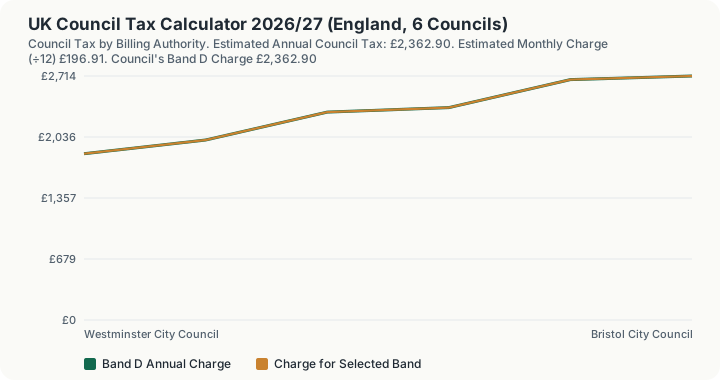
Quick Answer: A Band D property in Birmingham owes £2,362.90 in Council Tax for 2026/27. The identical Band D property in Westminster owes only £1,850.00 -- a difference of over £500 a year purely from which local authority sets the bill, even before any single-occupant discount is applied.
Overview
This calculator covers Council Tax in England only. Council Tax funds local authorities (billing councils, plus police, fire, and in some areas parish precepts) and is calculated from two things: the valuation band (A-H) assigned to a property based on its estimated value on 1 April 1991, and the Band D charge each individual council sets for the coming tax year. Scotland has its own council tax system, also using bands A-H but built on different 1991 valuations and different multipliers, and Wales uses a nine-band system (A-I) based on 2003 valuations -- neither is modeled here, and figures from this calculator do not translate directly to a Scottish or Welsh property.
Because Council Tax is set independently by each of England's roughly 300 billing authorities, there is no single national rate. This calculator uses six illustrative England councils with verified 2026/27 Band D charges: Westminster (£1,850.00, historically one of the very lowest in the country), Leeds (£2,002.00), Manchester (£2,312.04), Birmingham (£2,362.90), Liverpool (£2,674.00), and Bristol (£2,714.00). For comparison, the England-wide average Band D charge for 2026/27 is £2,392, up 4.9% on 2025/26, per the government's own MHCLG statistical release. If your council isn't one of these six, check your own council's published rate -- the variation across England is substantial, and these six are meant as a representative range rather than a full directory.
How This Is Calculated
- Start from the council's published Band D charge for the tax year -- the reference figure every other band is calculated from.
- Apply the statutory England ratio for the property's valuation band. Each band is a fixed fraction of Band D: Band A = 6/9, B = 7/9, C = 8/9, D = 9/9 (the reference), E = 11/9, F = 13/9, G = 15/9, H = 18/9 (exactly double Band D).
- Apply the single-occupant discount, if it applies. A property occupied by only one adult as their main home qualifies for a flat 25% discount off the full charge, regardless of valuation band.
The figures shown are each council's own core Band D charge as published for 2026/27 -- the amount a two-adult household in that band would pay before any individual discount, exemption, or benefit (such as Council Tax Reduction/Support for low-income households) is applied. Some bills also carry an additional parish council precept on top of the figures shown here, where the property falls within a parished area.
Worked Example
Band D, no discount, across the six councils:
| Council | Band D 2026/27 |
|---|---|
| Westminster | £1,850.00 |
| Leeds | £2,002.00 |
| Manchester | £2,312.04 |
| Birmingham | £2,362.90 |
| Liverpool | £2,674.00 |
| Bristol | £2,714.00 |
Westminster, Band A (ratio 6/9):
- £1,850.00 × (6 ÷ 9) = £1,233.33
Birmingham, Band D, single-occupant discount:
- Full charge: £2,362.90
- 25% discount: £2,362.90 × 25% = £590.73
- Discounted charge: £1,772.18 (i.e. £2,362.90 × 75%)
Bristol, Band H (double Band D):
- £2,714.00 × 2 = £5,428.00, the highest single figure this calculator can produce from the six councils listed
What This Does Not Account For
- Every England council besides the six listed. With around 300 billing authorities in England, this is a representative sample, not a full directory -- your own council's rate may be meaningfully higher or lower than any of these six.
- Scotland and Wales, which use entirely separate council tax systems with different bands, valuations, and multipliers.
- Council Tax Reduction/Support, means-tested help for low-income households that can reduce or, in some cases, eliminate the bill entirely, administered separately by each council.
- Other discounts and exemptions -- students living together, severely mentally impaired residents, empty and unoccupied property premiums (which can more than double the charge on long-term empty homes), and disabled band reductions.
- Separate parish, town, and (in some areas) additional precepts that some councils add on top of the core district/unitary/borough Band D figure shown here.
- Adult Social Care precept flexibility, a portion some councils raise specifically for social care funding, which is generally already included in a council's published Band D figure but is a distinct line on some bills.
Common Pitfalls
- Assuming Council Tax bands reflect current property value. Bands are based on an estimated value as of 1 April 1991, not today's market value -- a property that has appreciated enormously since 1991 keeps its original band unless significantly extended or altered (which can trigger a revaluation on sale).
- Forgetting Westminster's low rate is genuinely unusual, not a typo. Westminster and a small number of other inner-London boroughs have had historically low Council Tax for decades due to their commercial tax base; most of England, and certainly most of the six councils here, charge considerably more.
- Not checking for empty-property premiums. A property empty and unfurnished for over a year can be charged a premium of 100% or more on top of the standard rate in many councils, a significant and often overlooked cost for landlords between tenancies or renovation projects.
- Overlooking the single-occupant discount. Many people living alone don't realise they qualify for the 25% reduction and continue paying the full household rate.
- Comparing Council Tax to Stamp Duty or property taxes in other countries directly. Council Tax is an ANNUAL, recurring local-government charge, unlike the one-off Stamp Duty Land Tax paid at purchase -- the two serve entirely different purposes and shouldn't be confused when budgeting for a home.
Frequently Asked Questions
Why does the same size of house cost so much more in one council than another?
Does this calculator apply to Scotland or Wales?
How do I find out my own property's Council Tax band?
Is the 25% single-occupant discount the only discount available?
Why is my actual bill higher than the Band D figure shown here, times my band's ratio?
How much can a council raise Council Tax by each year?
Can I pay Council Tax monthly, and does that change the total?
Sources
- HM Revenue and Customs (HMRC), the official authority for the national tax authority this calculator relates to. gov.uk/government/organisations/hm-revenue-customs
Also consulted: GOV.UK statistical release: "Council Tax levels set by local authorities in England 2026 to 2027" -- gov.uk/government/statistics/council-tax-levels-set-by-local-authorities-in-england-2026-to-2027; Each council's own published 2026/27 Council Tax setting (Westminster City Council, Leeds City Council, Manchester City Council, Birmingham City Council, Liverpool City Council, Bristol City Council); Valuation Office Agency (VOA): Council Tax band lookup and the statutory England band-to-Band-D ratio table.