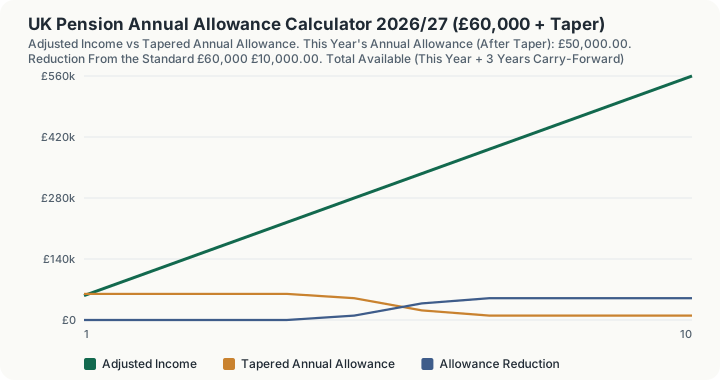
Quick Answer: With £220,000 threshold income and £280,000 adjusted income, the tapered Annual Allowance falls from £60,000 to £50,000 (a £10,000 reduction). Adding three years of £10,000-a-year unused carry-forward brings the total available allowance to £80,000, leaving £40,000 of headroom after a planned £40,000 contribution this year.
Overview
This calculator covers the UK Pension Annual Allowance, a UK-wide limit (identical in England, Wales, Scotland, and Northern Ireland) on how much can be paid into registered pension schemes each tax year -- combining an individual's own contributions, any employer contributions, and (for defined benefit schemes) the value of pension growth -- without triggering a tax charge. For 2025/26 and 2026/27, the standard Annual Allowance is £60,000.
High earners face a tapered version of the allowance. The taper only applies when both of two separate income tests are exceeded: "threshold income" (broadly, total taxable income minus the individual's own pension contributions) above £200,000, and "adjusted income" (broadly, total taxable income plus all pension contributions, including the employer's) above £260,000. Where both apply, the £60,000 allowance reduces by £1 for every £2 of adjusted income above £260,000, down to a minimum floor of £10,000, reached once adjusted income hits £360,000.
On top of the current year's (possibly tapered) allowance, carry-forward lets unused allowance from the previous three tax years be added to the current year's total, provided the individual was a member of a registered pension scheme in each of those years. This makes a single large contribution -- for example, from a bonus, inheritance, or business sale -- far more tax-efficient than several smaller, evenly spread ones for someone who hasn't been maximizing contributions recently.
How This Is Calculated
- Check whether the taper applies at all. If threshold income is £200,000 or below, the full £60,000 allowance applies regardless of adjusted income -- the second test is never even reached.
- If threshold income exceeds £200,000, check adjusted income. If adjusted income is £260,000 or below, again the full £60,000 applies.
- If both thresholds are exceeded, reduce the allowance. For every £2 of adjusted income above £260,000, the allowance falls by £1, down to a floor of £10,000 (reached at £360,000 adjusted income).
- Add carry-forward. Sum any unused allowance from each of the previous three tax years (using that year's own allowance, tapered or not, for that year) to the current year's allowance.
- Compare planned contributions against the total available allowance. Anything above the total triggers the Annual Allowance Charge, broadly taxed at the individual's marginal Income Tax rate(s).
Worked Example
£220,000 threshold income, £280,000 adjusted income:
- Threshold income (£220,000) exceeds £200,000, and adjusted income (£280,000) exceeds £260,000 -- the taper applies
- Excess over £260,000: £280,000 − £260,000 = £20,000
- Reduction: £20,000 ÷ 2 = £10,000
- This year's allowance: £60,000 − £10,000 = £50,000
- Adding three years of £10,000 unused carry-forward: £50,000 + £30,000 = £80,000 total available
- Against a planned £40,000 contribution this year: £40,000 remaining headroom, no Annual Allowance Charge due
Below the taper threshold: £180,000 threshold income, £280,000 adjusted income:
- Threshold income (£180,000) does not exceed £200,000, so the taper never applies -- irrelevant that adjusted income is high
- Full £60,000 allowance available, unreduced
Very high earner: £350,000 threshold income, £400,000 adjusted income:
- Excess over £260,000: £140,000 → reduction would be £70,000, far more than the maximum possible £50,000 reduction
- Allowance floors out at the statutory minimum: £10,000
Contributions exceeding total available allowance:
- £180,000 threshold / £200,000 adjusted income, no taper, no carry-forward, but a £100,000 contribution planned
- Total available allowance: £60,000; contribution: £100,000
- Excess subject to the Annual Allowance Charge: £40,000
What This Does Not Account For
- The Money Purchase Annual Allowance (MPAA), a separate, much lower £10,000 limit that applies once someone has started flexibly drawing income from a defined-contribution pension -- not modeled here, which assumes no MPAA trigger has occurred.
- Defined benefit pension input amount calculations, which use a specific formula (broadly, 16× the increase in annual pension, plus any lump sum increase) rather than a simple contribution figure -- this calculator assumes contribution-style inputs suitable for defined contribution schemes.
- The precise definitions of "threshold income" and "adjusted income," which involve specific statutory add-backs and deductions (e.g. certain salary sacrifice arrangements, relief at source vs net pay scheme mechanics) beyond the simplified inputs used here.
- The Lifetime Allowance, which was abolished from 6 April 2024 and replaced by separate lump sum allowances -- not relevant to the Annual Allowance modeled here.
- Scheme pays elections, which let an individual's pension scheme pay some or all of an Annual Allowance Charge on their behalf from the pension pot itself, rather than the individual paying HMRC directly.
- Carry-forward eligibility conditions, including the requirement to have been a member of a registered pension scheme (even with no contributions) in each of the three carry-forward years -- this calculator assumes eligibility and asks only for the unused amount.
Common Pitfalls
- Confusing threshold income and adjusted income. Both must exceed their respective limits for the taper to apply at all -- a high adjusted income alone, with threshold income at or below £200,000, does not trigger any reduction.
- Forgetting employer contributions count toward the adjusted income test. A generous employer pension contribution, or defined benefit accrual, can push adjusted income well above an individual's own salary and personal contributions alone.
- Assuming carry-forward is unlimited. It only reaches back three tax years, and each year's own (possibly tapered) allowance for that year is the ceiling on how much can be carried from it -- carry-forward cannot resurrect an allowance larger than what actually applied at the time.
- Missing that the minimum tapered allowance is £10,000, not zero. Even the very highest earners retain some allowance every year, which is often a source of confusion given how aggressively the taper reduces the standard £60,000.
- Not planning around bonus or one-off payment timing. A large bonus that pushes adjusted income over £260,000 in a single tax year can retroactively make that year's contributions less tax-efficient than expected, even if the individual's typical annual income is well below the threshold.
Frequently Asked Questions
Does the taper apply the same way to everyone earning over £260,000?
What happens if I contribute more than my available allowance?
Can I still use carry-forward if I didn't contribute anything in a previous year?
Is the £60,000 Annual Allowance the same as the Lifetime Allowance?
Why does the taper stop reducing my allowance at £10,000?
Sources
- HM Revenue and Customs (HMRC), the official authority for the national tax authority this calculator relates to. gov.uk/government/organisations/hm-revenue-customs
Also consulted: GOV.UK: "Tax on your private pension contributions: Annual Allowance" -- gov.uk/tax-on-your-private-pension/annual-allowance; GOV.UK guidance: "Pension schemes: work out your tapered Annual Allowance" -- gov.uk/guidance/pension-schemes-work-out-your-tapered-annual-allowance; HM Treasury: Spring Budget 2023 and subsequent Finance Act, raising the standard Annual Allowance to £60,000, the taper thresholds to £200,000/£260,000, and the taper floor to £10,000, effective 6 April 2023 and unchanged through 2026/27.