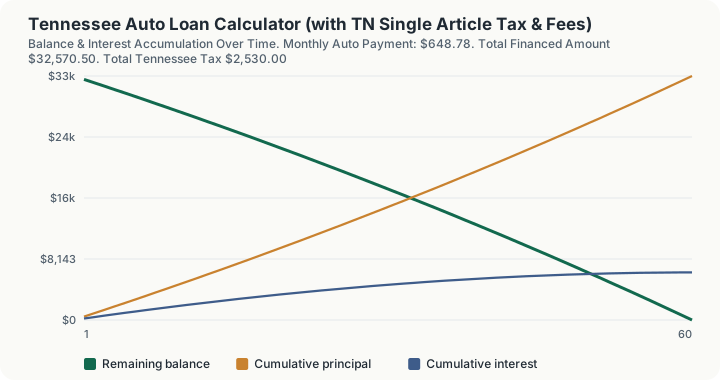
Quick Answer: A $35,000 car in Tennessee with $5,000 cash down, a 2.25% county rate, a 60-month term, and a 7.25% APR carries a $648.78 monthly payment. Total tax is $2,530.00, made up of $2,450 of state tax, $44 of state single article tax, and $36 of county tax. A calculator that multiplies $35,000 by a "combined 9.25%" reports $3,237.50 and is wrong by $707.50.
Overview
Tennessee is the state where the combined rate you see in a rate lookup is not the rate you pay on a car, and the gap is large enough to change which car you buy.
The reason is the single article rule. Tennessee's local option sales tax applies only to the first $1,600 of the price of a single article, under Tenn. Code Ann. § 67-6-702(a)(1). Above $1,600 the county gets nothing more. Because county rates top out at 2.75% by statute, the local tax on a car is a fixed dollar amount, never more than $44, and $36 at the common 2.25% rate. It is not a percentage of your car at all.
The state then adds a piece back. Under § 67-6-228 and § 67-6-702(d), a state single article tax of 2.75% applies to the slice of the price between $1,600 and $3,200. Nothing above $3,200 is subject to it, so that piece also has a ceiling: $44.
Put together, the real Tennessee formula for a net price $N$ is three separate lines, and only the first of them scales with the price of the car:
- 7% of the full net price, under § 67-6-202
- 2.75% of the band from $1,600 to $3,200, maximum $44
- your county rate applied to the first $1,600, maximum $44
The practical effect is that Tennessee looks expensive at the top of the rate table and behaves closer to a flat 7% state on a real car. On a $35,000 purchase the two capped pieces contribute $80 combined, about 0.23% of the price, and they contribute exactly the same $80 on a $70,000 purchase.
One more Tennessee particular: the tax is collected by the county clerk of the buyer's county of residence, not where the dealership sits. Crossing a county line to shop does not change your rate, and at $8 of spread between the lowest and highest county outcomes on a $35,000 car, it would hardly be worth it if it did.
Auto Loan APR by Credit Score
The APR columns below are national averages, not Tennessee figures. No primary source publishes average auto loan APR by state: Experian's report has no geographic cut, the CFPB publishes state origination volume but no rates, and the New York Fed publishes state delinquency only. The payment column is the part that is specific to Tennessee, because it runs this calculator's own Tennessee tax and fee rules at each tier's rate.
| Credit Tier | VantageScore 4.0 | Avg New APR | Avg Used APR | Est. Payment in Tennessee |
|---|---|---|---|---|
| Super prime | 781-850 | 4.55% | 6.30% | $607.95 |
| Prime | 661-780 | 6.23% | 8.77% | $633.17 |
| Nonprime | 601-660 | 9.67% | 14.03% | $686.75 |
| Subprime | 501-600 | 13.44% | 19.42% | $748.44 |
| Deep subprime | 300-500 | 16.01% | 21.77% | $792.22 |
Payment assumptions: $35,000 vehicle price, $0 trade-in, $5,000 cash down, $0 dealer documentation fee, 60-month term, new-vehicle APR applied to the Tennessee delivered price including tax and statutory fees. At the 6.39% overall new-car average the same purchase costs $635.60 a month.
The score bands are VantageScore 4.0, not FICO. The same borrower can land in a different tier under each model, so a FICO score pulled from a card issuer will not always match the band here. Source: Experian, State of the Automotive Finance Market, Q1 2026, slide 45.
What Moves Your Payment
Each row changes one input and leaves the rest at the baseline below. The dollar effects are this calculator's own output for Tennessee, not a rule of thumb.
| Factor | What Changes | Effect on Monthly Payment | Effect on Total Interest |
|---|---|---|---|
| Vehicle Price | Each extra $1,000 of price raises both the amount financed and the sales tax base, so the tax rises with it. | +$21.32 | +$208.83 |
| Trade-In Allowance | A $1,000 allowance cuts the amount financed by $1,000 and reduces the sales tax base by the same amount, so it saves tax as well as principal. | -$21.31 | -$208.82 |
| Cash Down Payment | A $1,000 larger down payment cuts the amount financed by $1,000. It never reduces the sales tax, which is assessed on the price, not on what you borrow. | -$19.92 | -$195.16 |
| Dealer Doc Fee | A $100 higher documentation fee adds $100 to the amount financed and is inside the sales tax base, so it is taxed on top of itself. | +$2.13 | +$20.89 |
| Longer Term | Stretching the same balance from 60 months to 72 months spreads the principal over twelve more payments at the same rate. | -$89.57 | +$1,336.32 |
Baseline: $35,000 vehicle price, $0 trade-in, $5,000 cash down, $0 documentation fee, 60 months at 7.25% APR, giving a $648.78 payment and $6,356.57 of total interest.
How This Is Calculated
Tennessee stacks three pieces: a 7% state rate on the whole base, a state single article tax on one $1,600 band, and a county rate limited to the first $1,600. Five steps.
1. Net taxable base. Tenn. Code Ann. § 67-6-510(a) taxes the net difference between the sales price and the credit actually given for the article taken in trade. Doc fees are part of "sales price" under § 67-6-102, which forbids deducting the seller's own costs, so the fee stays in the base.
2. State tax. The only piece that scales with the price of the car.
3. State single article tax. 2.75% of the band between $1,600 and $3,200.
when the base exceeds $1,600, and zero otherwise. Its maximum is $44.
4. County local option tax. Your county rate on the first $1,600 only, separately capped at $44.
5. Fees, financing, and amortization. A fixed $40.50 for the $14 title fee and the $26.50 state base registration, outside the tax base. Then the trade-in reduces what you borrow, having already reduced what you are taxed on:
The balance amortizes as a fixed-rate installment loan:
where $P$ is the financed amount, $i$ is the monthly rate (APR ÷ 12), and $n$ is the term in months. Each period's interest is the outstanding balance times $i$, the remainder reduces principal, and the schedule reconciles to zero at maturity.
About County Rates
No county rate table appears on this page, and that is a deliberate accuracy choice. The Tennessee Department of Revenue's live rate map could not be read directly, and the rates circulating for Nashville, Memphis, Chattanooga, and Murfreesboro come from secondary sources that mix general sales tax rates with automotive treatment. Publishing a rate that turns out to be the general rate would be worse than publishing none.
One county rate here is sourced to an official county page: Knox County's clerk publishes 2.25% on the first $1,600, a $36 maximum, on its own vehicle tax calculator. That is the default in the input above.
There is also an unresolved question in Davidson County. Nashville adopted a 0.5% local transit surcharge effective 1 February 2025, and whether that surcharge reaches motor vehicles, and whether it is subject to the $1,600 base limitation if it does, was not confirmed. A Nashville buyer should ask the Davidson County Clerk directly.
The good news is that this uncertainty barely matters to your payment. The entire span from a 0% county rate to the 2.75% statutory ceiling is $44 of tax on any car above $1,600. Get the rate wrong and your estimate is off by tens of dollars, not hundreds.
Worked Example
Tennessee is the state where a combined rate is most misleading. The local option tax reaches only the first $1,600 and stops at $44, and a separate state single article tax applies to the slice between $1,600 and $3,200. On an expensive car those two pieces are effectively fixed.
- Vehicle price: $35,000
- Trade-in allowance: $0
- Cash down: $5,000
- Doc fee: $0
- County rate: 2.25%
- Term: 60 months at 7.25% APR
Step 1 -- The net taxable base. Sales price less the credit given for the article taken in trade: $35,000 - $0 = $35,000.00
Step 2 -- State tax at 7%. $35,000.00 x 7% = $2,450.00
Step 3 -- State single article tax on the $1,600 to $3,200 band. 2.75% x ($3,200 - $1,600) = $44.00
Step 4 -- County local option tax, on the capped slice. 2.25% x $1,600 = $36.00
Step 5 -- Total tax. $2,450.00 + $44.00 + $36.00 = $2,530.00
Step 6 -- Title and state registration, outside the base. $14.00 title + $26.50 registration = $40.50
Step 7 -- Total delivered price. $35,000 + $2,530.00 + $40.50 = $37,570.50
Step 8 -- Amount financed. $37,570.50 - $0 trade-in - $5,000 cash down = $32,570.50
Step 9 -- The monthly payment. $32,570.50 at 7.25% over 60 months = $648.78
Step 10 -- Month 1. $32,570.50 x (7.25% / 12) = $196.78 interest, $452.00 principal, balance $32,118.50
Step 11 -- Month 2. $32,118.50 x (7.25% / 12) = $194.05 interest, $454.73 principal, balance $31,663.77. Cumulative interest: $390.83
Step 12 -- The accumulation. Interest through month 12 is $2,177.46 with $26,962.60 outstanding. Over the full term, $6,356.57
Move to the 2.75% statutory ceiling and the county piece rises from $36 to $44. Total tax becomes $2,538.00, a difference of $8.00 on a $35,000 car. A percentage model would have predicted $175 for that same half point.
Add a $10,000 trade-in and the base falls to $25,000, the state piece to $1,750, and the total tax to $1,830.00. The payment drops to $435.65. The credit was worth $700.00, which is 7% of the allowance and nothing more, because the local and single article pieces were already at their caps and had nothing left to give back.
At the other end of the price range the caps have not bitten yet. A $1,500 car pays $105 of state tax, no single article tax at all, and 2.25% of the whole $1,500 in county tax, being $33.75. A $2,400 car pays $22 of single article tax, exactly half the eventual maximum, because only $800 of the band has been used.
What This Does Not Account For
- County wheel taxes. Many Tennessee counties levy a flat annual wheel tax at registration renewal, reportedly $0 to $75 depending on the county, with figures circulating for Davidson, Shelby, Knox, and Hamilton. Those amounts are secondary-source and were not verified, so none are included. Ask your county clerk.
- County plate fees. The $26.50 here is the state base registration. County clerks add a plate fee on top; Knox County shows $29 for a standard plate, taking title and plate together to $77. That add-on varies by county and is not modelled.
- Davidson County's transit surcharge. See above. Unresolved for vehicles.
- A typical doc fee. Tennessee caps nothing here and no primary source establishes a statewide typical amount, so the field starts at $0 rather than at a guess. Whatever your dealer charges is taxable, at 7% on the state piece.
- Proof of tax paid on the trade-in. Tenn. Comp. R. & Reg. 1320-5-1-.02(1) allows the department to require evidence that tax was previously paid on the article taken in trade. A trade that cannot be documented may not earn the credit.
- Historic single-article variations. The $1,600 limitation is the general rule, and a small number of jurisdictions have historically applied single article treatment differently. That was not re-verified for 2026.
- GAP insurance, extended warranties, and aftermarket add-ons, unless you fold them into the vehicle price yourself.
- Tennessee has no annual ad valorem property tax on a personal vehicle, so unlike Virginia there is no recurring value-based bill. The wheel tax, where a county levies one, is a flat amount.
Common Pitfalls
- Multiplying the price by a combined 9.25%. This is the defining Tennessee error and it is expensive in the wrong direction: $3,237.50 predicted against $2,530.00 due on a $35,000 car. Buyers who budget from it overestimate their out-the-door cost by $707.50 and sometimes talk themselves out of a car they could afford.
- Assuming a lower-rate county saves real money. The whole span from 0% to the 2.75% ceiling is $44. Registering in a neighbouring county to save tax is not a strategy in Tennessee, and it is not permitted anyway, because the clerk of your county of residence collects.
- Shopping across a county line for a better rate. The tax follows the buyer's residence, not the dealership.
- Overstating what the trade-in saves. A $10,000 trade-in on a $35,000 car saves $700, not $925, because the two capped pieces do not move.
- Confusing the state single article tax with the local base limitation. They are separate rules, they use different bands, and they happen to share the same $44 ceiling. One is a state tax on the $1,600 to $3,200 slice; the other limits what your county may tax to the first $1,600.
- Forgetting the doc fee is taxable. It is inside "sales price" under § 67-6-102, so it carries 7% on top of its own amount.
- Judging the loan by the payment alone. Stretching this $32,570.50 balance from 60 to 72 months lowers the payment to $559.21 and raises total finance charges to $7,692.88.
Frequently Asked Questions
What is the sales tax on a car in Tennessee?
Why is my Tennessee car tax lower than 9.25% of the price?
What is the Tennessee single article tax?
Does a trade-in reduce car sales tax in Tennessee?
Do I pay tax where I buy the car or where I live?
Does Tennessee charge an annual property tax on my car?
Sources
- Tennessee Department of Revenue, Single Article and Special Tax Rates guidance. tn.gov/revenue.html
- Consumer Financial Protection Bureau, Truth in Lending Act (Regulation Z, 12 CFR § 1026.22) disclosure requirements for installment credit. ecfr.gov/current/title-12/chapter-X/part-1026
Also consulted: Tenn. Code Ann. § 67-6-202 (state sales tax rate); Tenn. Code Ann. § 67-6-228 and § 67-6-702(d) (state single article tax, 2.75% on the $1,600 to $3,200 band); Tenn. Code Ann. § 67-6-702(a)(1) (local option single article base limitation, first $1,600); Tenn. Code Ann. § 67-6-510(a) and Tenn. Comp. R. & Reg. 1320-5-1-.02(1) (trade-in taxed on the net difference; evidence that tax was paid on the trade-in); Tenn. Code Ann. § 67-6-102 (definition of sales price; no deduction for the seller's costs, so doc fees are taxable); Tennessee Department of Revenue, County Clerk Tax Manual, June 2025; Knox County Clerk, motor vehicle sales tax calculator (2.25% local rate on the first $1,600; $14 title fee); Experian, State of the Automotive Finance Market, Q1 2026, slide 45 (average new and used auto loan APR by VantageScore 4.0 credit tier; national, no state level cut published).