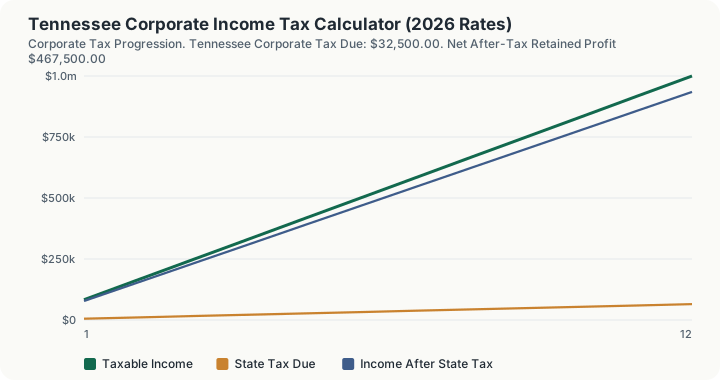
Quick Answer: On $500,000 of pre-apportioned taxable income, Tennessee's flat 6.50% corporate income tax rate produces $32,500.00 in state tax due and $467,500.00 in net after-tax profit.
How This Is Calculated
This page computes one thing: Tennessee's 6.50% excise tax on the apportioned net earnings figure you enter, less the credits you enter, floored at zero. The engine does not derive net earnings from federal taxable income, does not apply Tennessee addbacks, does not apportion, and does not limit NOL usage. Those steps happen before the number you type in.
- Net earnings are taken as supplied. The input asks for net apportioned taxable income in Tennessee and is used exactly as entered.
- The rate table holds one Tennessee band. It runs from $0 with no upper bound at 6.50%, so there is no bracket lookup and no threshold to cross. The sweep is linear across its whole range: $650.00 of tax at $10,000 of income, $3,250.00 at $50,000, $6,500.00 at $100,000, a constant $650.00 per $10,000 step.
- Credits reduce the tax. They are applied after the rate, dollar for dollar against the liability, not against net earnings.
- The floor is zero and nothing survives it. Credits exceeding the excise tax are discarded outright. No carryforward, no carryback, no refund is modelled.
- Effective and marginal outputs diverge under credits. On $500,000 with $15,000 of credits the engine returns $17,500.00 of tax, an effective rate of 3.50%, and a marginal rate of 6.50%. The first is a backward-looking average; only the second prices additional earnings.
- The tier table varies income, not years. Row i is your income times i over 6. Row 6 restates the entered figure and row 12 doubles it: $1,000,000 of net earnings and $65,000.00 of excise tax on the default input.
Worked Example
Using this calculator's baseline scenario: a corporation with $500,000 in taxable income apportioned to Tennessee.
- Start with apportioned net earnings. $500,000 has already been apportioned to Tennessee before any state-level tax is applied.
- Apply the flat 6.50% excise rate. $500,000 × 6.50% = $32,500.00. No bracket lookup is required.
- Subtract credits. At the default $0 of credits the excise tax stands at $32,500.00.
- Net retained profit. $500,000 − $32,500.00 = $467,500.00, before any separate federal liability.
With credits at zero the effective and marginal rates are both 6.50% at every income the engine accepts, from $0 to the $1,000,000,000 input ceiling. A corporation with $50,000 of Tennessee earnings and one with $50,000,000 face the same rate on the next dollar.
Pricing the Next Dollar, and the Last Useful Credit
Tennessee's schedule is flat, so no income threshold exists to walk. The one real discontinuity on this page sits on the credit input, and the sweep resolves it to the dollar.
At $32,499 of credits. Tennessee excise tax due is $1.00.
At $32,500 of credits, one dollar later. Tennessee excise tax due is $0.00. That dollar of credit was worth its full face value.
At $32,501 of credits. Tennessee excise tax due is $0.00 again. That dollar was worth nothing.
At coarser resolution the pattern is a straight line into a wall: $1,000.00 of tax at $31,500 of credits, $500.00 at $32,000, $0.00 at $32,500, each step down worth exactly $500.00. Then $33,000 and $33,500 of credits both return $0.00, deltas of $0.00. The 32,500th credit dollar is the last one this calculator will pay for.
That cliff is a property of the code, not of Tennessee law. The engine evaluates max(0, tax - credits) and has no mechanism for storing an unused credit, so a credit with real carryforward value is scored at zero here.
Working Backwards: How Much Income a Credit Absorbs
Hold credits at $32,500 and move income instead. The engine returns $0.00 of tax at $400,000, $450,000 and $500,000 of apportioned net earnings. At $500,200 it returns $13.00 and at $500,400 $26.00, steps of $13.00 per $200, which is 6.50% resuming precisely at the point the credit runs dry.
Further out the line stays straight: $3,250.00 of tax at $550,000 of earnings and $6,500.00 at $600,000. Across those points the effective rate output climbs 0.00%, 0.59%, 1.08% while the marginal rate output never moves off 6.50%. A $32,500 credit shelters exactly $500,000 of Tennessee net earnings.
The Marginal Cost of Another $1,000 of Tennessee Earnings
Each additional $1,000 of apportioned net earnings costs $65.00 in excise tax. The sweep shows four identical steps with no drift: $32,500.00 at $500,000, $32,565.00 at $501,000, $32,630.00 at $502,000, $32,695.00 at $503,000, $32,760.00 at $504,000.
Crediting Against Earnings Instead of Against Tax, Priced
The expensive mistake available here is subtracting the credit from net earnings and then applying 6.50%, rather than applying 6.50% and subtracting the credit from the result.
Correct, as this engine computes it. $500,000 of net earnings with $15,000 of credits: 6.50% of $500,000 is $32,500.00, less $15,000, leaves $17,500.00.
Incorrect, credit netted against earnings. $500,000 less $15,000 is $485,000, and the engine returns $31,525.00 of excise tax on that figure.
The error costs $14,025.00 on one return. A credit applied to the base returns 6.5 cents on the dollar; applied to the tax it returns a dollar. The ratio is fixed by the flat rate, so the proportion of the loss is identical at any income level.
What This Does Not Account For
- Tennessee's franchise tax. It is measured on net worth or on the value of in-state property, is reported on the same return as the excise tax, and is computed nowhere in this engine. Every figure on this page is excise tax only, and a Tennessee filer's actual bill is the sum of two taxes of which this page models one.
- Credit carryforward or refundability. Excess credits hit the zero floor and disappear.
- Any minimum tax. The flat branch is income times rate with no floor other than zero, so $0 of earnings returns $0.00.
- Federal corporate income tax (21% under IRC § 11).
- Specialized gross receipts taxes (e.g. Ohio CAT, Washington B&O, Texas Franchise Tax) where applicable.
- Base Erosion and Anti-Abuse Tax (BEAT) or Global Intangible Low-Taxed Income (GILTI) provisions.
- Local municipal corporate earnings taxes (e.g. NYC General Corporation Tax).
Common Pitfalls
- Reading the Excise Result as the Full Tennessee Bill: The franchise tax on the net worth measure is a separate computation this calculator does not perform at any input.
- Confusing No Personal Income Tax With No Corporate Tax: Tennessee's excise tax on corporate net earnings runs at 6.50% from the first dollar, $32,500.00 on the $500,000 default.
- Mistaking the Flat Rate for the Final Bill: The 6.50% applies to apportioned net earnings after additions, subtractions and loss carryforwards, none of which this page computes.
- Claiming Credits Past the Zero Point: $32,500, $33,000 and $33,500 of credits all produce $0.00 on the default earnings. The overclaim leaves no trace in the output.
Frequently Asked Questions
Does Tennessee have a corporate income tax?
What does an extra $1,000 of Tennessee net earnings cost?
How much in credits zeroes out the tax?
When are Tennessee corporate tax returns due?
Does Tennessee tax S-corporations and LLCs?
Sources
- Tennessee Department of Revenue: Corporate Tax Statutes and Guidance (2026). tn.gov/revenue.html
- Multistate Tax Commission (MTC): Uniform Apportionment and Allocation Guidelines. mtc.gov