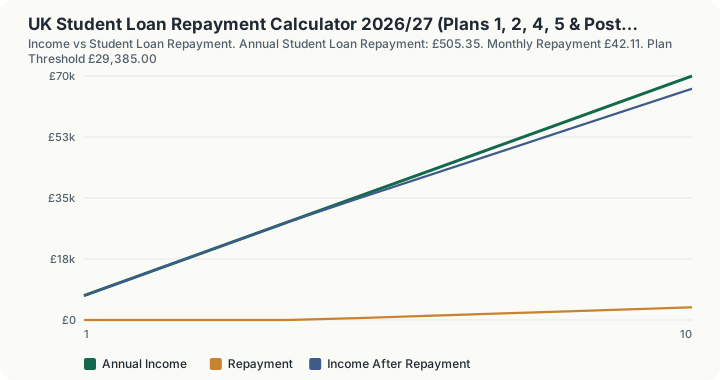
Quick Answer: On Plan 2 with an income of £35,000, you repay £505.35 a year, or £42.11 a month. That is 9% of the £5,615 by which your income exceeds the £29,385 threshold, not 9% of your whole salary. The same income on Plan 5, whose threshold is only £25,000, costs £900 a year instead.
What does this calculator do?
UK student loan repayments are charged as a percentage of income above a threshold, not on the whole of it. Which threshold applies depends on your plan, and the plans differ substantially: the gap between the Plan 4 threshold of £33,795 and the Plan 5 threshold of £25,000 is nearly £9,000, which is £790 a year of repayments at the same salary.
A postgraduate loan is repaid at the same time as an undergraduate one, not instead of it. Someone with a Plan 2 loan and a postgraduate loan pays 9% and 6% concurrently on the bands above each threshold, which is the detail most calculators get wrong.
How is this calculated?
Undergraduate plans are charged at 9% of income above the plan threshold:
Repayment = 0.09 × max(0, Income − Threshold)
Thresholds for 2026/27 are Plan 1 £26,900, Plan 2 £29,385, Plan 4 £33,795 and Plan 5 £25,000.
Postgraduate loans are charged at 6% of income above £21,000, computed independently and added to any undergraduate repayment. Because the postgraduate threshold is lower than every undergraduate threshold, someone with both loans is paying on two overlapping bands at once, giving a combined marginal rate of 15% on income above their undergraduate threshold.
The monthly figure shown is the annual amount divided by twelve. Repayments are actually deducted per pay period against a weekly or monthly threshold, so a month with irregular pay will not match exactly.
Worked Example
Plan 2 on a £35,000 salary
Step 1: The plan threshold. Plan 2 for 2026/27 = £29,385
Step 2: Income above it. £35,000 - £29,385 = £5,615
Step 3: The repayment. £5,615 x 9% = £505.35 a year
Step 4: Monthly. £505.35 / 12 = £42.11
Step 5: As a share of total income. £505.35 / £35,000 = 1.44%
Step 6: The marginal rate. The next £1 earned above £29,385 costs 9p
Steps 5 and 6 are six times apart, and the gap is the entire misunderstanding people have about this charge. Nobody on Plan 2 pays 9% of their salary. They pay 9% of the slice above the threshold, so the effective rate starts at zero at £29,385 and climbs asymptotically toward 9% as income rises.
Walking up the income ladder
The computed table steps income in £7,000 increments on Plan 2:
Step 7: £21,000 and £28,000. Both below the threshold, so £0.00 on each
Step 8: £35,000. £505.35, an effective rate of 1.44%
Step 9: £42,000. (£42,000 - £29,385) x 9% = £1,135.35, effective rate 2.70%
Step 10: £70,000, double the base case. (£70,000 - £29,385) x 9% = £3,655.35, effective rate 5.22%
Every £7,000 of extra income adds exactly £630, a straight line, but the effective rate is still only 5.22% at twice the base salary. This is why the plan behaves much more like a graduate tax with an allowance than like a loan repayment: the payment tracks income, not the balance outstanding.
The same salary on Plan 5
Step 11: The Plan 5 threshold. £25,000, £4,385 lower than Plan 2
Step 12: Income above it. £35,000 - £25,000 = £10,000
Step 13: The repayment. £10,000 x 9% = £900.00 a year, £75.00 a month, an effective rate of 2.57%
Step 14: The cost of the lower threshold. £900.00 - £505.35 = £394.65, which is exactly 9% of the £4,385 threshold difference
Same salary, same 9% rate, same graduate: £394.65 a year more, forever, purely because the course started after August 2023. The threshold, not the rate, is what distinguishes the plans.
Two loans at once
A Plan 2 graduate with a postgraduate loan, earning £40,000.
Step 15: The undergraduate repayment. (£40,000 - £29,385) x 9% = £10,615 x 9% = £955.35
Step 16: The postgraduate repayment. (£40,000 - £21,000) x 6% = £19,000 x 6% = £1,140.00
Step 17: Total. £955.35 + £1,140.00 = £2,095.35 a year, £174.61 a month, an effective rate of 5.24%
Step 18: The combined marginal rate above £29,385. 9% + 6% = 15p in every extra pound
The postgraduate loan costs more than the undergraduate one here despite its lower rate, because its £21,000 threshold is £8,385 lower and therefore catches a much wider band of income. Note also step 18: a Plan 2 graduate with a postgraduate loan on a higher-rate salary faces 40% income tax, 2% National Insurance and 15% of loan repayments, a 57% marginal deduction that no headline rate anywhere states.
What does this calculator not account for?
- Interest accruing on the balance. Student loan interest is set by reference to RPI and, on some plans, to income. This calculator shows what you repay in a year, not what happens to the outstanding balance.
- Whether the loan will ever be repaid in full. Plans are written off after a set period (25, 30 or 40 years depending on the plan), and many borrowers never clear the balance. Repayments are better understood as a graduate contribution than as a loan in the ordinary sense.
- Voluntary overpayments, which are permitted but rarely worthwhile for borrowers unlikely to clear the balance before write-off.
- Per-pay-period calculation. Deductions are made against weekly or monthly thresholds, so bonuses and irregular pay can produce a deduction in one period that annual figures do not reflect.
- Self Assessment. Self-employed borrowers repay through their tax return rather than payroll, based on total taxable income.
- Plan 3 (postgraduate) terminology. HMRC payroll guidance sometimes calls the postgraduate loan "Plan 3"; it is the same loan handled here.
- Repayments while overseas, where fixed thresholds by country apply rather than the UK ones.
What mistakes do people make with this?
- Thinking 9% applies to your whole salary. It applies only to the excess above the threshold. At £35,000 on Plan 2 the effective rate on total income is 1.44%, not 9%.
- Assuming a postgraduate loan replaces the undergraduate one. They run concurrently. Someone with both pays 15% at the margin above their undergraduate threshold.
- Picking a plan by start year alone. Plan 4 is defined by studying in Scotland, not by year. Plan 1 covers all Northern Ireland borrowers regardless of when they started.
- Comparing plans without checking the threshold. Plan 5 has the same 9% rate as Plan 2 but a threshold £4,385 lower, which costs an extra £394.65 a year at any income above both.
- Expecting overpayments to reduce a monthly deduction. They do not. The deduction is a function of income, not of the outstanding balance, until the loan is cleared entirely.
Frequently Asked Questions
Which plan am I on?
Do I repay a postgraduate loan on top of my undergraduate one?
Why is my repayment zero when I have a loan?
Does my repayment change if my balance is nearly cleared?
Should I overpay to clear it faster?
Sources
- GOV.UK guidance: "Rates and thresholds for employers 2026 to 2027", Plan 1 £26,900, Plan 2 £29,385, Plan 4 £33,795, Plan 5 £25,000, Postgraduate £21,000. gov.uk/guidance/rates-and-thresholds-for-employers-2026-to-2027
- HM Revenue and Customs (HMRC), the official authority for the national tax authority this calculator relates to. gov.uk/government/organisations/hm-revenue-customs
All figures verified on 30 August 2026 and mirrored in engine/tables/2026/uk-2026-27.json
Also consulted: GOV.UK: "Repaying your student loan", 9% on undergraduate plans, 6% on postgraduate loans.