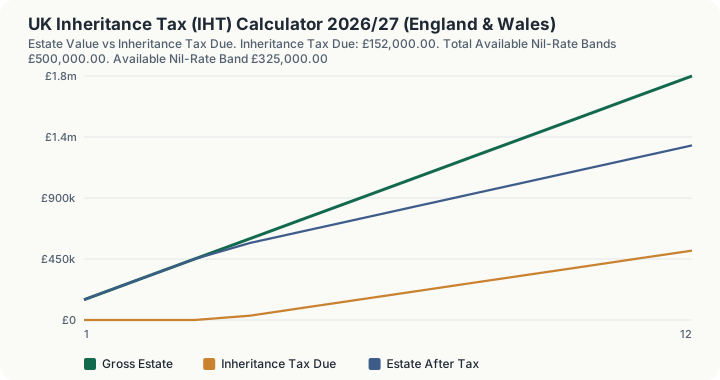
Quick Answer: On a £900,000 estate in England or Wales with £20,000 of debts, a home passing to children, and no charitable gifts or transferred allowances, Inheritance Tax due is £152,000 (40% of the £380,000 chargeable estate after the £325,000 nil-rate band and £175,000 residence nil-rate band). A married couple who transfer 100% of both allowances between them can shelter up to £1,000,000 combined before any IHT is due.
Overview
This calculator covers UK Inheritance Tax (IHT) as it applies to estates in England and Wales for the 2025/26 and 2026/27 tax years. IHT is a UK-wide tax administered by HMRC, so the same nil-rate band, residence nil-rate band, and 40%/36% rates apply across England, Wales, Scotland, and Northern Ireland -- unlike Stamp Duty or Council Tax, IHT is not a devolved, England-only tax. This tool is built around the most common scenario: a single estate passing under one will, with a main residence potentially passing to direct descendants, an optional spouse/civil-partner exemption, and an optional charitable gift.
Every threshold below has been verified directly against gov.uk. The nil-rate band (NRB) of £325,000 has been frozen since 6 April 2009. The residence nil-rate band (RNRB) of £175,000, introduced in 2017 and phased in fully by 2020, adds extra tax-free headroom when a home passes to children, grandchildren, or other direct descendants. Both bands were frozen through 5 April 2028 by the Autumn Statement 2022, extended through 5 April 2030 by Autumn Budget 2024, and extended a further year through 5 April 2031 by Autumn Budget 2025 (26 November 2025) -- so both figures apply unchanged for the whole of the 2026/27 tax year modeled here.
Because the NRB has never risen with inflation since 2009, more estates cross the IHT threshold every year simply because UK house prices and asset values have grown. Understanding exactly how the nil-rate bands, the taper, the spousal exemption, and the charity discount interact is the difference between an accurate estimate and a nasty surprise for your executor.
How This Is Calculated
- Net estate value. Debts, mortgages outstanding, and funeral costs are deducted from the gross estate. This net figure is also the one used for the £2 million residence nil-rate band taper test.
- Available nil-rate band (NRB). Everyone gets £325,000. If a spouse or civil partner died before this person and did not use all of their own NRB, the unused percentage transfers across, up to doubling the band to £650,000.
- Available residence nil-rate band (RNRB). An extra £175,000 is available only if a home the deceased lived in passes to direct descendants (children, step-children, grandchildren, etc.) -- not to siblings, parents, friends, or a discretionary trust for unrelated beneficiaries. Like the NRB, any unused percentage from a predeceased spouse or civil partner can transfer across, up to £350,000 combined.
- RNRB taper. For estates worth more than £2,000,000 (net of debts, before reliefs and exemptions), the RNRB is reduced by £1 for every £2 over that threshold. A single person's full £175,000 RNRB is tapered away entirely once the estate reaches £2,350,000.
- Spousal and charitable exemptions. Anything left to a spouse or civil partner is 100% exempt, however large. Anything left to a qualifying charity is also 100% exempt.
- The 36% reduced rate test. HMRC calculates a "baseline amount" -- broadly, the net estate after the spousal exemption, less the available NRB and tapered RNRB, before deducting the charitable gift itself. If the charitable gift is 10% or more of that baseline, the entire chargeable estate is taxed at the reduced 36% rate instead of the standard 40% rate.
- Tax due. The chargeable estate (net estate, less spousal and charitable exemptions, less all available nil-rate bands) is taxed at 40% or 36%.
This calculator handles the common single-component case: one will, one main residence, one spousal exemption figure, one charitable gift figure. It does not attempt to model estates split across multiple trusts, lifetime gift chains, or jointly-owned property passing outside the will -- see "What This Does Not Account For" below.
Worked Example
Baseline: £900,000 estate, £20,000 debts, house to children, no charity, no transfers
- Net estate: £900,000 − £20,000 = £880,000
- Available NRB: £325,000 (no transfer)
- Available RNRB: £175,000 (home passes to children, estate well under £2m, no taper)
- Total available bands: £500,000
- Chargeable estate: £880,000 − £500,000 = £380,000
- No charitable gift, so the standard 40% rate applies
- Inheritance Tax due: £380,000 × 40% = £152,000
- Net estate to beneficiaries: £900,000 − £20,000 debts − £152,000 tax = £728,000
Second death, full transferred allowances: £1,000,000 estate
If the first spouse to die left everything to the survivor (using none of their own NRB or RNRB), the survivor's estate inherits 100% of both unused allowances: £650,000 NRB + £350,000 RNRB = £1,000,000 available. A £1,000,000 estate with a home to children is then entirely tax-free.
Large estate, RNRB taper, and the 36% charity rate: £2,500,000 estate, £100,000 debts
- Net estate for the taper test: £2,400,000, which is £400,000 over the £2,000,000 threshold
- RNRB reduction: £400,000 ÷ 2 = £200,000, capped at the full £175,000 RNRB -- so the RNRB is tapered away to £0
- Available bands: £325,000 NRB only
- Baseline amount for the charity test: £2,400,000 − £325,000 = £2,075,000; 10% of that is £207,500
- Leaving exactly £207,500 to charity secures the reduced 36% rate on everything else
- Chargeable estate: £2,400,000 − £207,500 − £325,000 = £1,867,500
- Inheritance Tax due: £1,867,500 × 36% = £672,300 (versus £747,300 at the standard 40% rate -- a £75,000 saving from the charitable gift, on top of the £207,500 that goes to charity instead of the taxman)
What This Does Not Account For
- Business Property Relief (BPR) and Agricultural Property Relief (APR). Qualifying business and farming assets can currently receive up to 100% relief, though from 6 April 2026 combined BPR/APR relief above £1 million per estate is being restricted to 50% relief (i.e. an effective 20% rate on the excess) -- a major, separate reform not modeled here.
- Gifts made in the seven years before death ("potentially exempt transfers") and the taper relief that can reduce tax on gifts made 3-7 years before death.
- Trusts. Assets held in most trusts follow their own, separate IHT regime (including 10-yearly periodic charges) rather than the estate rules modeled here.
- Multiple-component estates, where different assets pass under the will, by survivorship (joint tenancy), or via a trust, each computed and potentially taxed separately by HMRC before being combined -- this calculator assumes a single component.
- The Pension IHT reform effective 6 April 2027, which will bring most unused defined-contribution pension pots into the taxable estate for the first time. Not modeled here since it does not apply to the 2026/27 tax year.
- Domicile and residence rules for long-term UK residents versus non-doms, which affect whether worldwide or only UK assets are in scope.
- Instalment options for tax on land, buildings, and some business assets, which let executors pay in annual instalments over up to 10 years rather than as a lump sum.
Common Pitfalls
- Assuming the residence nil-rate band always applies. It is lost entirely if the home passes to a sibling, friend, or non-descendant, or if the deceased never had a qualifying residence in the estate at all (renters get no RNRB).
- Missing the RNRB taper on larger estates. Because it is based on total net estate value, not just the home's value, even a modest house can lose its RNRB shelter if other assets push the total estate above £2 million.
- Forgetting that transferable NRB/RNRB requires a claim. HMRC does not apply it automatically -- the executor must claim the transfer on the second death using forms IHT402 (NRB) and IHT436 (RNRB), with evidence of what the first spouse's estate actually used.
- Confusing the 36% charity test's "baseline amount" with the full estate value. The 10% test is against a specific, narrower baseline (broadly net estate less the NRB/RNRB and spousal exemption), not against the gross estate -- so a gift that looks generous in isolation may still fall short of qualifying.
- Not accounting for the frozen thresholds. With the NRB and RNRB fixed until 5 April 2031 while house prices and other asset values continue to rise, an estate that is comfortably below the IHT threshold today may not be in a few years' time.
Frequently Asked Questions
Does this calculator apply to Scotland and Northern Ireland too?
Can a married couple really leave £1,000,000 tax-free?
What if the deceased never owned a home, or rented?
Is the 40% rate charged on the whole estate, or just the amount above the nil-rate bands?
How is the 36% reduced rate actually claimed?
Sources
- HM Revenue and Customs (HMRC), the official authority for the national tax authority this calculator relates to. gov.uk/government/organisations/hm-revenue-customs
Also consulted: GOV.UK: "Rates and allowances: Inheritance Tax thresholds and interest rates" -- gov.uk/guidance/rates-and-allowances-inheritance-tax-thresholds-and-interest-rates; GOV.UK: "Inheritance Tax" (overview, rates, and charity reduced rate) -- gov.uk/inheritance-tax; GOV.UK: "Inheritance Tax residence nil-rate band" guidance -- gov.uk/guidance/inheritance-tax-residence-nil-rate-band; GOV.UK policy paper: "Inheritance Tax nil-rate band and residence nil-rate bands from 6 April 2028" -- gov.uk/government/publications/inheritance-tax-nil-rate-band-and-residence-nil-rate-bands-from-6-april-2028; GOV.UK: "Valuing the estate of someone who has died," including transferring unused nil-rate bands -- gov.uk/valuing-estate-of-someone-who-died; HM Treasury, Autumn Budget 2025 (26 November 2025): confirmation that the nil-rate band and residence nil-rate band freeze is extended a further year to 5 April 2031.