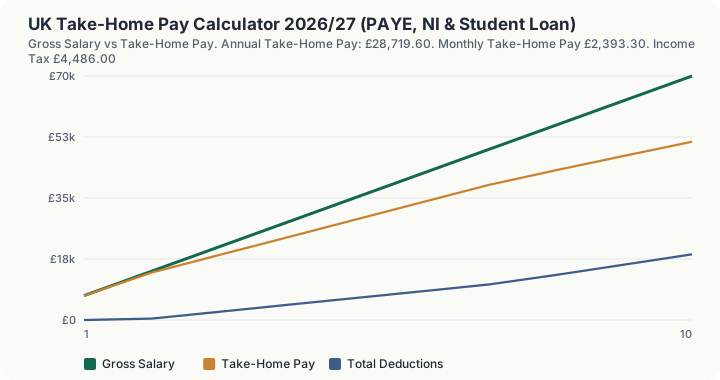
Quick Answer: A £35,000 salary in England, Wales or Northern Ireland leaves £28,719.60 a year, or £2,393.30 a month. That is £4,486 of Income Tax and £1,794.40 of National Insurance, a total deduction rate of 17.94%. The same salary in Scotland leaves £28,704.53, and adding a Plan 2 student loan takes it down to £28,214.25.
What does this calculator do?
Three separate deductions come out of a UK salary before you see it, and each has its own threshold and its own rules. They are not a single combined tax rate.
Income Tax starts above the £12,570 Personal Allowance and uses either the three rUK bands or the six Scottish ones. National Insurance starts at the same £12,570 but is not devolved, so it is identical everywhere in the UK. Student loan repayments start at a different threshold again, depending on the plan, and are unrelated to either.
This is why comparing salaries across the UK is not as simple as comparing headline rates. At £35,000 a Scottish taxpayer pays £15.07 more per year than an English one; at £60,000 the gap is far larger, because Scotland's higher rate starts at £43,663 rather than £50,270.
How is this calculated?
Step 1: Pension. The pension percentage is applied to gross salary to give the GROSS contribution, which is deducted from adjusted net income before Income Tax is computed. This matters above £100,000, where it can restore Personal Allowance lost to the taper. The relief then depends on the scheme:
- Relief at source (personal pensions, SIPPs, many workplace schemes): you pay 80% of the gross and the provider claims the other 20% from HMRC, whether or not you pay tax. If your marginal rate is higher, the rest of the relief comes from extending your basic and higher rate bands by the gross contribution, claimed through Self Assessment or your tax code. The calculator computes it as the tax on your salary less the tax on your salary minus the contribution, less the 20% already added, and deducts it from the Income Tax shown. A Scottish starter-rate taxpayer keeps the full 20%.
- Net pay (some workplace schemes): the gross comes off pay before Income Tax, so relief is at your marginal rate automatically, and a non-taxpayer gets none.
Step 2: Income Tax. Charged on salary above the £12,570 Personal Allowance, using the bands for the selected region. For England, Wales and Northern Ireland that is 20% on the first £37,700 of taxable income, then 40%, then 45%. For Scotland it is the six-band ladder from 19% starter to 48% top.
Step 3: National Insurance. Class 1 employee contributions at 8% on earnings between £12,570 and £50,270, then 2% on everything above:
NI = 0.08 × (min(S, 50,270) − 12,570) + 0.02 × max(0, S − 50,270)
Step 4: Student loan. 9% of salary above the plan threshold, if a plan is selected.
Step 5: Take-home pay is gross salary less Income Tax (after pension relief), National Insurance, the student loan repayment and what the pension costs you: 80% of the gross under relief at source, the full gross under net pay.
For example, £60,000 with a 10% relief-at-source contribution: £6,000 goes into the pot, £4,800 comes out of your pay, and extending the bands by £6,000 cuts Income Tax from £11,432 to £10,232. Take-home is £60,000 − £10,232 − £3,210.60 NI − £4,800 = £41,757.40, and the total relief is £2,400, 40% of the gross. The monthly figure is the annual total divided by twelve.
Worked Example
£35,000 salary, England:
- Income Tax: (£35,000 − £12,570) = £22,430 × 20% = £4,486.00
- National Insurance: the same £22,430 × 8% = £1,794.40
- Total deductions £6,280.40, a rate of 17.94%
- Take-home: £28,719.60, or £2,393.30 a month
£35,000 salary, Scotland:
- Starter: £3,967 × 19% = £753.73
- Basic: £12,989 × 20% = £2,597.80
- Intermediate: £5,474 × 21% = £1,149.54
- Income Tax £4,501.07, NI unchanged at £1,794.40
- Take-home: £28,704.53, only £15.07 less than in England at this salary
£60,000 salary, England (crossing two thresholds at once):
- Income Tax: £37,700 × 20% + £9,730 × 40% = £7,540 + £3,892 = £11,432
- NI: £37,700 × 8% + £9,730 × 2% = £3,016 + £194.60 = £3,210.60
- Take-home: £45,357.40. Note NI falls to 2% above £50,270 while Income Tax rises to 40%, so the two move in opposite directions at the same threshold.
What does this calculator not account for?
- Salary sacrifice, which reduces gross pay before both Income Tax and National Insurance and is therefore more efficient than the personal pension contribution modelled here.
- Employer pension contributions, which do not appear in take-home pay but form part of total reward.
- Your tax code. This assumes the standard code with a full Personal Allowance. A K code, an emergency code, or an adjustment for benefits or underpaid tax will change the result.
- Benefits in kind such as a company car or private medical insurance, which are taxed through the code.
- Postgraduate loans, charged at 6% concurrently with any undergraduate plan. Use the dedicated student loan calculator for both together.
- Non-salary income. Savings interest, dividends and rental income are taxed differently and are not part of PAYE.
- Pay-period effects. PAYE operates cumulatively per pay period, so a bonus month or a mid-year job change will not match a simple annual division.
What mistakes do people make with this?
- Treating tax and NI as one combined rate. They have different band structures above £50,270: Income Tax rises to 40% while NI drops to 2%. The combined marginal rate is 42% just above the threshold, not 60%.
- Assuming Scotland is always more expensive. At £35,000 the difference is £15.07 a year. Below roughly £30,000 Scotland is actually cheaper, thanks to its 19% starter band. The gap only becomes substantial at higher salaries.
- Expecting National Insurance to follow Scottish bands. NI is reserved and identical across the UK. Only Income Tax is devolved.
- Forgetting the student loan threshold is separate. It is not aligned to the Personal Allowance or the NI threshold, and differs by plan.
- Comparing a personal pension contribution to salary sacrifice. Salary sacrifice saves National Insurance as well as Income Tax; a personal contribution does not, so it is worth meaningfully less for the same amount.
- Dividing annual take-home by twelve and expecting the payslip to match. PAYE is cumulative and thresholds are applied per period, so months differ.
Frequently Asked Questions
Why is my payslip different from this figure?
Do I pay more tax in Scotland?
Why does National Insurance fall to 2% when Income Tax rises to 40%?
Does a pension contribution save National Insurance?
Is my postgraduate loan included?
Sources
- GOV.UK guidance: "Rates and thresholds for employers 2026 to 2027", NI thresholds and student loan plan thresholds. gov.uk/guidance/rates-and-thresholds-for-employers-2026-to-2027
- HM Revenue and Customs (HMRC), the official authority for the national tax authority this calculator relates to. gov.uk/government/organisations/hm-revenue-customs
All figures verified on 30 August 2026 and mirrored in engine/tables/2026/uk-2026-27.json
Also consulted: GOV.UK: "Income Tax rates and Personal Allowances", the rUK bands and the £12,570 allowance; gov.scot: "Scottish Income Tax: rates and bands, 2026 to 2027", the six Scottish bands; GOV.UK: "National Insurance rates and categories", Class 1 employee rates of 8% and 2%.