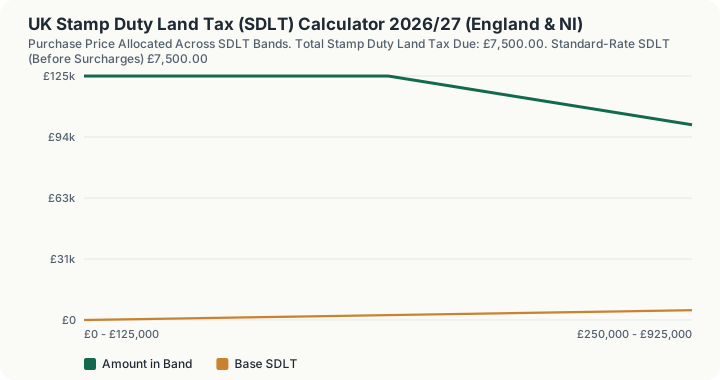
Quick Answer: A £350,000 standard residential purchase in England or Northern Ireland owes £7,500 in Stamp Duty Land Tax. The same £350,000 purchase as a second home or buy-to-let owes £24,500 (a £5,000 base charge plus a £17,500 additional-property surcharge), because the +5-percentage-point surcharge applies across the entire price, including the portion that would otherwise be tax-free.
Overview
This calculator covers Stamp Duty Land Tax (SDLT) on residential property purchases in England and Northern Ireland only. SDLT is not a UK-wide tax: Scotland charges its own Land and Buildings Transaction Tax (LBTT) instead, with entirely different bands and rates, and Wales charges its own Land Transaction Tax (LTT). If you are buying in Scotland or Wales, this calculator's figures do not apply to you -- use each nation's own devolved tax calculator instead.
Every rate and threshold here has been verified directly against gov.uk. The standard residential nil-rate threshold reverted from a temporarily raised level back down to £125,000 on 1 April 2025, following the expiry of the mini-budget-era thresholds. First-time buyer relief similarly reverted to a £300,000 nil-rate threshold with a £500,000 price cap above which the relief does not apply at all. The additional-property surcharge was raised from 3 to 5 percentage points at the Autumn Budget on 30 October 2024, and the non-UK-resident surcharge remains 2 percentage points, both stacking on top of the standard rate bands where applicable.
How This Is Calculated
SDLT is a banded (slice) tax, like UK Income Tax -- each portion of the price is taxed at the rate for that band only, not the whole price at the top rate reached.
Standard residential bands (home movers, not first-time buyers, single property):
| Portion of Price | Rate |
|---|---|
| £0-£125,000 | 0% |
| £125,001-£250,000 | 2% |
| £250,001-£925,000 | 5% |
| £925,001-£1,500,000 | 10% |
| Above £1,500,000 | 12% |
First-time buyer relief: if the price is £500,000 or less, the first £300,000 is taxed at 0% and the portion from £300,001 to £500,000 at 5%. If the price exceeds £500,000, this relief does not apply at all -- the standard bands above apply to the entire price from £0, with no partial benefit.
Additional-property surcharge: buying a residential property that means the buyer will own more than one adds a flat 5 percentage points on top of every standard band, including the portion that would otherwise sit in the 0% nil-rate band. This is calculated here as the standard-band tax plus 5% of the whole purchase price.
Non-UK-resident surcharge: an extra flat 2 percentage points on top of whichever rate structure otherwise applies (standard or additional-property), for buyers not present in the UK for at least 183 days in the 12 months before completion. This surcharge can stack with the additional-property surcharge, for a combined 7 points.
Worked Example
A home mover at £350,000
Step 1 -- The nil-rate slice. £125,000 x 0% = £0.00
Step 2 -- The 2% slice. £250,000 - £125,000 = £125,000, and £125,000 x 2% = £2,500.00
Step 3 -- The 5% slice. £350,000 - £250,000 = £100,000, and £100,000 x 5% = £5,000.00
Step 4 -- Total SDLT. £0.00 + £2,500.00 + £5,000.00 = £7,500.00
Step 5 -- The effective rate. £7,500 / £350,000 = 2.14%
Step 6 -- The marginal rate at this price. The next £1 of purchase price costs 5p, more than double the 2.14% average
Steps 5 and 6 are the number people confuse. Nobody pays 5% of £350,000; the 5% applies only to the £100,000 above £250,000. Every band boundary is a slice boundary, so raising an offer by £5,000 costs £250 of extra SDLT here, not a jump to a new rate on the whole price.
First-time buyer relief, and its cliff
Step 7 -- A first-time buyer at £295,000. The whole price sits inside the £300,000 FTB nil-rate band, so SDLT is £0.00
Step 8 -- A first-time buyer at £499,999. £300,000 at 0% plus (£499,999 - £300,000) x 5% = £9,999.95, an effective rate of 2.00%
Step 9 -- A first-time buyer at £505,000. The £500,000 cap is breached, so relief is withdrawn entirely and the standard bands apply from £0: £15,250.00
Step 10 -- The cliff. £5,001 more on the price costs £15,250.00 - £9,999.95 = £5,250.05 of extra SDLT
Step 10 is the only genuine cliff edge in the SDLT structure. Everywhere else the tax is sliced; here relief is all-or-nothing at £500,000, so an extra £5,001 of price costs more than itself in tax. A first-time buyer negotiating near that line should treat £500,000 as a hard ceiling rather than a round number.
Step 11 -- The same first-time buyer at £600,000. Standard bands throughout: £0 + £2,500 + (£350,000 x 5%) = £20,000.00
The additional-property surcharge
A second home or buy-to-let at £400,000.
Step 12 -- Standard-band tax first. £0 + £2,500 + (£150,000 x 5%) = £10,000.00
Step 13 -- The surcharge, applied to the whole price. £400,000 x 5% = £20,000.00
Step 14 -- Total. £10,000.00 + £20,000.00 = £30,000.00, an effective rate of 7.50%
The surcharge is twice the base charge here, and the reason is step 13: it applies to the entire price including the £125,000 that would otherwise be taxed at nothing. There is no nil-rate band for an additional property, only a nil-rate band on the standard-rate component of it.
The non-resident surcharge
Step 15 -- A non-UK resident buying the same £350,000 home. Base tax £7,500.00 plus £350,000 x 2% = £7,000.00
Step 16 -- Total. £7,500.00 + £7,000.00 = £14,500.00, an effective rate of 4.14%
The two surcharges stack, so a non-resident buying an additional property carries 7 points across the whole price on top of the standard bands. Note that this calculator covers England and Northern Ireland only: Scotland charges LBTT and Wales charges LTT, which are different taxes with different bands, not variants of SDLT.
What This Does Not Account For
- Multiple Dwellings Relief, which can reduce SDLT when a single transaction buys two or more residential properties (e.g. a house with an annexe), by averaging the price across dwellings.
- Linked transactions, where two or more property purchases between the same buyer and seller (or connected parties) are aggregated for SDLT purposes.
- Mixed-use and non-residential property rates, which use a different band structure (0%/2%/5% with no residential surcharges) and apply when a purchase includes commercial elements.
- The 3-year "replacing your main residence" refund, where a buyer who pays the additional-property surcharge because their previous main home hasn't sold yet can reclaim the surcharge if they sell within 3 years.
- Shared ownership, lease premium, and rent-based SDLT calculations for new long leases, which have their own separate rules (Net Present Value calculations on rent).
- Wales (Land Transaction Tax) and Scotland (Land and Buildings Transaction Tax), which are entirely separate devolved taxes with their own bands, not modeled here.
Common Pitfalls
- Assuming first-time buyer relief tapers gradually above £500,000. It does not -- it is a hard cliff-edge. A £500,001 first-time buyer purchase loses the entire relief, not just the benefit above the cap.
- Forgetting the additional-property surcharge applies to the whole price, not just the amount above £125,000. Many buyers wrongly assume the "nil-rate band" stays tax-free even on a second home; it does not once the surcharge applies.
- Confusing this calculator with Scotland's LBTT or Wales's LTT. These devolved taxes have different band structures and different first-time-buyer and additional-property rules; using SDLT figures for a Scottish or Welsh purchase will give the wrong answer.
- Overlooking the non-UK-resident surcharge's 183-day test, which is based on physical presence in the UK, not citizenship, visa status, or where tax is otherwise paid.
- Missing the interaction between first-time-buyer status and jointly buying with someone who isn't a first-time buyer -- HMRC generally requires every buyer on the transaction to qualify as a first-time buyer for the relief to apply at all.
Frequently Asked Questions
Is Stamp Duty the same across the whole UK?
Why did the nil-rate threshold change to £125,000?
Can the additional-property surcharge be refunded?
Does the first-time buyer relief apply if I'm buying with someone who has owned property before?
Do non-UK residents pay the surcharge even if they plan to live in the property?
When is SDLT actually due, and who pays it?
Does buying a second home always trigger the additional-property surcharge?
Why is the first-time buyer price cap set at exactly £500,000?
Sources
- HM Revenue and Customs (HMRC), the official authority for the national tax authority this calculator relates to. gov.uk/government/organisations/hm-revenue-customs
Also consulted: GOV.UK: "Stamp Duty Land Tax" (overview) -- gov.uk/stamp-duty-land-tax; GOV.UK: "Stamp Duty Land Tax: residential property rates" -- gov.uk/stamp-duty-land-tax/residential-property-rates; GOV.UK guidance: "Stamp Duty Land Tax: relief for first-time buyers" -- gov.uk/guidance/stamp-duty-land-tax-relief-for-first-time-buyers; GOV.UK guidance: "Higher rates of Stamp Duty Land Tax for additional dwellings" -- gov.uk/guidance/stamp-duty-land-tax-higher-rates-for-additional-dwellings; GOV.UK guidance: "Rates of Stamp Duty Land Tax for non-UK residents" -- gov.uk/guidance/rates-of-stamp-duty-land-tax-for-non-uk-residents; HM Treasury, Autumn Budget 2024 (30 October 2024): increase of the additional-property surcharge from 3 to 5 percentage points, effective 31 October 2024.