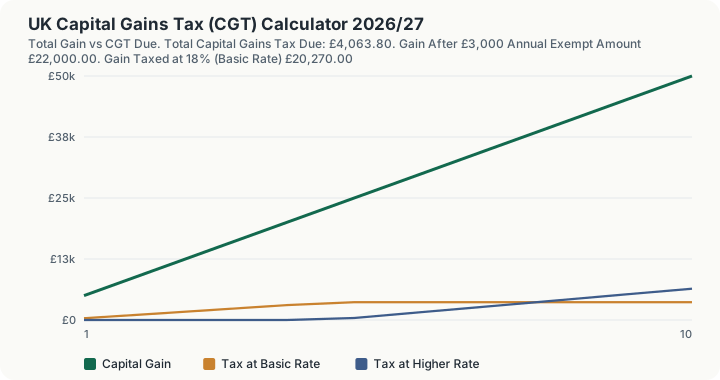
Quick Answer: On a £25,000 capital gain with £30,000 of other income for the year (counted gross, before the Personal Allowance), UK Capital Gains Tax due is £4,063.80 -- £3,648.60 at 18% on the £20,270 of gain that still fits inside the basic-rate band, and £415.20 at 24% on the remaining £1,730. The first £3,000 of the gain is tax-free under the Annual Exempt Amount.
Overview
This calculator covers UK Capital Gains Tax (CGT), the tax on the profit ("gain") made when disposing of a chargeable asset -- shares, funds, a second property, or other investments -- that applies across the whole United Kingdom (England, Wales, Scotland, and Northern Ireland alike; CGT is not devolved, unlike Stamp Duty or Council Tax). It covers the 2025/26 and 2026/27 tax years, with every figure verified directly against gov.uk.
The Annual Exempt Amount (AEA) -- the amount of gain each individual can realise tax-free every year -- is £3,000 for 2025/26 and 2026/27, unchanged from the previous two tax years. This is a steep cut from the £12,300 exemption that applied as recently as 2022/23; it was more than halved to £6,000 in 2023/24 and halved again to £3,000 in 2024/25, where it has been fixed since.
A distinctive feature of UK CGT, compared to the US federal system this platform's other calculators cover, is that there is no long-term versus short-term holding-period distinction. It does not matter whether an asset was held for one month or twenty years -- the same rate structure applies either way. Rates instead depend on the individual's income tax position for the year: 18% on any gain that falls within their remaining basic-rate Income Tax band, and 24% on any gain above it. Since 30 October 2024 (the Autumn Budget), this single 18%/24% structure has applied to both shares/other assets and residential property gains -- before that date, residential property already used 18%/24% while shares and other assets used a lower 10%/20%, and the Budget raised the shares/other-assets rates to match.
How This Is Calculated
- Deduct the Annual Exempt Amount. The first £3,000 of gains each tax year is tax-free, deducted before any rate is applied.
- Determine the remaining basic-rate band. UK Income Tax's basic-rate band runs up to £50,270 of total taxable income (£12,570 Personal Allowance + £37,700 basic-rate band), frozen through at least 2027/28. Whatever of that £50,270 ceiling isn't already used by the individual's other income for the year (salary, dividends, savings interest and so on, counted gross before the Personal Allowance) is available for the gain to use at the lower rate.
- Split the gain (after the AEA) across the two rates. The portion of the gain that fits within the remaining basic-rate band is taxed at 18%; anything above that is taxed at 24%.
- Sum the two portions to get the total CGT due.
Because the rate depends on total income for the year, the same size of gain can cost a basic-rate taxpayer noticeably less than a higher-rate taxpayer, and a large gain can itself push part of the individual into the higher band even if their salary alone would not.
Worked Example
£25,000 gain, £30,000 other income before the Personal Allowance:
- Gain after the £3,000 Annual Exempt Amount: £25,000 − £3,000 = £22,000
- Remaining basic-rate band: £50,270 − £30,000 = £20,270
- Taxed at 18%: £20,270 × 18% = £3,648.60
- Remaining gain taxed at 24%: (£22,000 − £20,270) × 24% = £1,730 × 24% = £415.20
- Total CGT due: £4,063.80 -- an effective rate of about 16.3% on the full £25,000 gain
Same £25,000 gain, but the individual is already a higher-rate taxpayer (£60,000 other income):
- No basic-rate band remains (£60,000 already exceeds £50,270)
- Entire £22,000 (after AEA) is taxed at 24%
- Total CGT due: £5,280 -- £1,216.20 more than the basic-rate example above, on an identical gain
Small gain within the allowance:
- A £2,500 gain is entirely covered by the £3,000 Annual Exempt Amount
- Total CGT due: £0
What This Does Not Account For
- Business Asset Disposal Relief (BADR), formerly Entrepreneurs' Relief, which applies a reduced rate (14% for 2025/26, rising to 18% from 6 April 2026) on up to £1 million of lifetime gains from disposing of a qualifying trading business or shares in a personal company.
- Investors' Relief, a similar reduced-rate scheme for certain unlisted trading company shares, with its own separate lifetime limit.
- Private Residence Relief, which makes gains on the sale of an individual's only or main home entirely exempt from CGT in almost all cases -- this calculator assumes the asset disposed of is NOT the seller's main home.
- Losses brought forward or realised in the same year, which can offset gains before the Annual Exempt Amount is applied.
- Non-UK-resident CGT on UK land and property, which has its own reporting deadlines and, in some cases, different treatment.
- The 60-day reporting and payment deadline for UK residential property gains (via a separate CGT-on-UK-property return), distinct from the normal Self Assessment timetable.
Common Pitfalls
- Forgetting the Annual Exempt Amount has been cut dramatically since 2022/23. Many taxpayers who never had to think about CGT reporting a few years ago now cross the £3,000 threshold easily, especially with several years of accumulated share or fund gains.
- Assuming property and shares are taxed differently. Since 30 October 2024, both use the identical 18%/24% structure -- the older "18%/28% for property, 10%/20% for shares" rules only apply to disposals before that date.
- Ignoring how other income affects the rate. A retiree with modest other income might pay only 18% on most of a large gain, while someone with a high salary from the same asset sale could pay 24% throughout -- the gain itself doesn't set its own rate in isolation.
- Overlooking that a large gain can push part of itself into the higher rate. The remaining basic-rate band is fixed by OTHER income; the gain then fills whatever room is left and spills into the 24% band once that room runs out, even within a single disposal.
- Missing reporting deadlines. UK residential property gains generally must be reported and paid within 60 days of completion, far sooner than the following January 31st Self Assessment deadline most people expect.
Frequently Asked Questions
Does this calculator apply the same way in Scotland?
Why is my rate 18% on some of the gain and 24% on the rest?
Has the Annual Exempt Amount always been this low?
Is there still a separate, higher rate for buy-to-let property gains?
Can I use my spouse's or civil partner's Annual Exempt Amount too?
Sources
- HM Revenue and Customs (HMRC), the official authority for the national tax authority this calculator relates to. gov.uk/government/organisations/hm-revenue-customs
Also consulted: GOV.UK: "Capital Gains Tax rates" -- gov.uk/capital-gains-tax/rates; GOV.UK guidance: "Capital Gains Tax rates and allowances" -- gov.uk/guidance/capital-gains-tax-rates-and-allowances; GOV.UK: "Income Tax rates and Personal Allowances" -- gov.uk/income-tax-rates; HM Treasury, Autumn Budget 2024 (30 October 2024): unification of CGT rates for shares/other assets with the existing residential property rates, and the Business Asset Disposal Relief rate-rise schedule (10%→14%→18%).