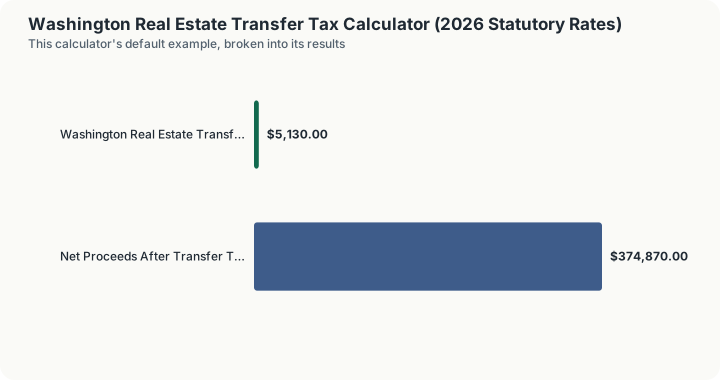
Quick Answer: A $380,000 home sale in Washington owes $5,130.00 in combined state and local Real Estate Excise Tax, an effective 1.35% rate from the first graduated state bracket plus the standard local REET rate.
Overview
Washington's Real Estate Excise Tax under RCW 82.45.060 is a marginal bracket schedule that climbs sharply at the top: 1.1% on the portion of the sale price up to $525,000, 1.28% up to $1,525,000, then a much steeper 2.75% up to $3,025,000, and 3.0% on anything above that, thresholds that adjust for inflation every four years. Most cities and counties separately impose the maximum permitted local rate of 0.25% on top of the state brackets, so nearly every Washington transaction carries that local add-on as a practical matter rather than an exception.
The excise tax is customarily paid by the seller at closing, consistent with how it is structured under RCW 82.45, though the specific allocation can be addressed in the purchase contract. Among the bracketed states in this dataset, Washington's top marginal rate of 3.0% is exceeded only by New Jersey's mansion fee cliff at 3.5% on its highest tier.
How This Is Calculated
Washington has the steepest graduated transfer tax in the country, topping out at 3% state rate, and it adjusts its bracket thresholds for inflation every four years.
| Portion of Sale Price | State Rate | With the 0.25% local rate |
|---|---|---|
| $0 to $525,000 | 1.10% | 1.35% |
| $525,000 to $1,525,000 | 1.28% | 1.53% |
| $1,525,000 to $3,025,000 | 2.75% | 3.00% |
| Above $3,025,000 | 3.00% | 3.25% |
The state piece is marginal: each rate touches only the dollars inside its own band. The local Real Estate Excise Tax is a flat 0.25% of the full price, which most cities and counties levy at the maximum, so the right-hand column above is what a sale in that band effectively pays at the margin. The engine walks the state brackets, adds the flat local component, and sums.
Timberland and agricultural land are taxed at a flat 1.28% instead of on this ladder, and that case is not modeled here.
Worked Example
Washington's REET is a four-bracket state tax plus a flat local one. The baseline sale stays inside the first state bracket.
Step 1 -- The consideration. Contract sale price = $380,000
Step 2 -- State bracket 1, the first $525,000 at 1.10%. $380,000 x 0.011 = $4,180.00
Step 3 -- State REET subtotal. No higher bracket is reached, so the state total is $4,180.00
Step 4 -- The local REET, applied to the full price at 0.25%. $380,000 x 0.0025 = $950.00
Step 5 -- Total excise tax due. $4,180.00 + $950.00 = $5,130.00
Step 6 -- Net proceeds after tax. $380,000.00 - $5,130.00 = $374,870.00
Step 7 -- The effective rate. $5,130.00 / $380,000 = 1.350%
Now the calculator's $1,500,000 scenario, an ordinary Seattle or Bellevue price, which crosses into the second bracket.
Step 8 -- State bracket 1 filled to its ceiling. $525,000 x 0.011 = $5,775.00
Step 9 -- State bracket 2, $525,000 to $1,500,000 at 1.28%. $975,000 x 0.0128 = $12,480.00
Step 10 -- State REET subtotal. $5,775.00 + $12,480.00 = $18,255.00
Step 11 -- Local REET on the full price. $1,500,000 x 0.0025 = $3,750.00
Step 12 -- Total on the luxury sale. $18,255.00 + $3,750.00 = $22,005.00
Step 13 -- The effective rate at $1.5M. $22,005.00 / $1,500,000 = 1.467%
Washington's brackets are marginal, so the $525,000 boundary produces no jump: a $524,000 sale owes $7,074.00, a $526,000 sale owes $7,102.80, a difference of $28.80 on $2,000 of price. The brackets that matter for the effective rate are the higher ones. Above $1,525,000 the state rate more than doubles to 2.75%, and above $3,025,000 it reaches 3.00%, which is why Washington's top-end effective rate outruns almost every other state's despite a first bracket that is unremarkable. The seller pays REET in Washington, so Step 6 is the seller's figure. The bracket thresholds are CPI-adjusted every four years and are current for 2026; timberland and agricultural land use a flat 1.28% instead and are not modelled here.
What This Does Not Account For
- Jurisdictions charging less than the maximum local REET. A small number of Washington cities and counties impose a local REET rate below the 0.25% maximum this calculator uses as its baseline, which would modestly lower the effective total in those specific areas.
- The flat rate for timberland and agricultural land. Washington taxes qualifying timberland and agricultural property at a flat 1.28% state rate instead of the graduated bracket schedule, a distinct classification this calculator does not model.
- Exemptions for certain transfer types. Washington exempts certain transfers, including those between spouses or domestic partners, into revocable trusts, and by operation of law, from REET. This calculator assumes a standard taxable arm's-length sale.
- Additional voter-approved local REET for specific purposes. Some Washington jurisdictions have authorized supplemental REET increments for affordable housing or conservation funding beyond the standard local rate, which are not modeled in this calculator's baseline.
Common Pitfalls
- Applying the top bracket's combined rate to the entire sale price. Washington's REET is marginal at every tier, so only the portion of the price within each bracket is taxed at that bracket's rate; applying 3.25% to the full price of a $4,000,000 sale instead of just the amount above $3,025,000 substantially overstates the tax.
- Forgetting the local REET component. The state bracket schedule alone understates total tax due, since nearly every Washington jurisdiction adds its own local REET on top of the state brackets.
- Assuming every jurisdiction charges exactly 0.25% locally. While 0.25% is the maximum and most common local rate, a handful of jurisdictions charge less, and confirming the exact local rate with the county treasurer avoids a small but real discrepancy.
- Confusing REET's marginal structure with a cliff-style mansion tax. Unlike New York's or New Jersey's mansion tax, where crossing a threshold can apply a rate to the full price, Washington's REET brackets are genuinely marginal at every tier, so liability increases smoothly rather than jumping at each threshold.
Frequently Asked Questions
What is Washington's real estate transfer tax rate?
Who pays the Real Estate Excise Tax in Washington?
Is Washington's REET marginal or a flat cliff like New York's mansion tax?
How does the effective rate change as sale price increases in Washington?
Does every Washington city and county charge the same local REET rate?
Sources
- Washington State Department of Revenue, the official state tax authority for Washington rates, rules and forms. dor.wa.gov
Also consulted: Washington Department of Revenue: Real Estate Excise Tax guidance under RCW 82.45.060.