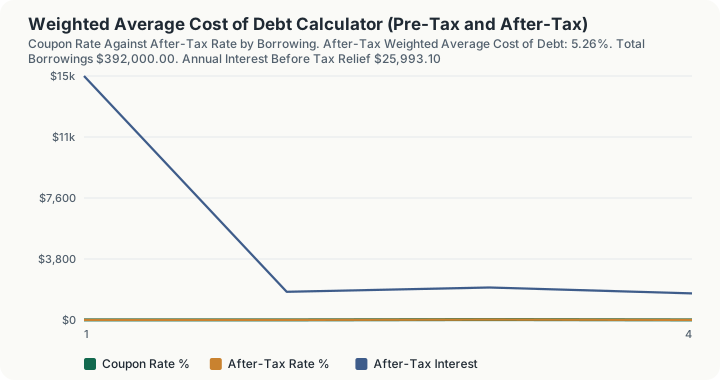
Quick Answer: A $320,000 mortgage at 6.25%, a $42,000 student loan at 5.5%, a $9,000 credit card at 22.49% and a $21,000 auto loan at 7.9% average 6.63% before tax and 5.26% after it, at a 24% marginal rate. Deductibility on 92.3% of the balance cuts 1.37 percentage points off the average. The costliest line after tax is the credit card at 22.49%.
What does this calculator do?
A household with four debts does not have four interest rates in any meaningful sense. It has one cost of borrowing, and that single number is the balance-weighted blend of the rates, which is what the pre-tax weighted average computes.
Deductibility changes the answer, and it changes it unevenly. Where the interest is deductible against income taxed at a marginal rate, each dollar of interest is offset by that many cents of tax saved, so the economic cost of that borrowing is the rate multiplied by one minus the tax rate. Where it is not deductible, the after-tax cost is simply the rate. Blending those per-line after-tax rates by balance gives the number that should actually drive decisions.
That distinction matters most when the question is what to repay first, or whether to repay at all rather than invest. A 6.25% mortgage that is deductible at 24% costs 4.75%. A 5.5% student loan on the same basis costs 4.18%. A 22.49% credit card costs 22.49%, because nothing offsets it. The gap between the cheapest and dearest line here is more than eighteen percentage points, and the weighted average of 5.26% sits close to the mortgage simply because the mortgage is most of the balance.
That is the second thing to take from the page. The average tells you what your borrowing costs in aggregate. It does not tell you where to act, because a small balance at a punishing rate barely moves the average while dominating the cost per dollar. Both numbers are on this page for that reason.
How is this calculated?
WACD_pre = (∑_j Bⱼrⱼ)/(∑_j Bⱼ); WACD_after = (∑_j Bⱼrⱼ(dⱼ?1 − t:1))/(∑_j Bⱼ)
where Bⱼ is each balance, rⱼ its rate, dⱼ whether its interest is deductible, and $t$ the marginal tax rate.
Step 1: Compute annual interest on each line. Mortgage: $320,000 x 6.25% = $20,000.00 Student loan: $42,000 x 5.5% = $2,310.00 Credit card: $9,000 x 22.49% = $2,024.10 Auto loan: $21,000 x 7.9% = $1,659.00
Step 2: Total the balances and the interest. $320,000 + $42,000 + $9,000 + $21,000 = $392,000.00 $20,000.00 + $2,310.00 + $2,024.10 + $1,659.00 = $25,993.10
Step 3: Compute the pre-tax weighted average. $25,993.10 / $392,000.00 = 6.63%
Step 4: Compute the tax shield on the deductible lines only. Deductible interest: $20,000.00 + $2,310.00 = $22,310.00 $22,310.00 x 24% = $5,354.40 The credit card and the auto loan generate no shield.
Step 5: Compute after-tax interest. $25,993.10 - $5,354.40 = $20,638.70
Step 6: Compute the after-tax weighted average. $20,638.70 / $392,000.00 = 5.26%
Step 7: Measure what deductibility bought. 6.63% - 5.26% = 1.37 percentage points
Step 8: Compute the after-tax rate on each line separately. Mortgage: 6.25% x (1 - 0.24) = 4.75% Student loan: 5.5% x (1 - 0.24) = 4.18% Credit card: not deductible, so 22.49% Auto loan: not deductible, so 7.90%
Step 9: Note the deductible share of the balance. ($320,000 + $42,000) / $392,000 = 92.4% of the balance That is why the average lands so close to the mortgage's after-tax rate.
Step 10: Identify the line to repay first. The highest after-tax rate is the credit card at 22.49%, against a lowest of 4.18% on the student loan.
Worked Example
The average is not the action, and the clearest way to see it is to price what repaying $9,000 does in two different places.
Step 1: Repay the credit card. $9,000 of balance at 22.49%, none of it deductible: $9,000 x 22.49% = $2,024.10 a year of after-tax interest saved
Step 2: Repay $9,000 of the mortgage instead. $9,000 x 6.25% = $562.50 of interest, of which 24% comes back as a deduction: $562.50 x (1 - 0.24) = $427.50 a year of after-tax interest saved
Step 3: Compare. $2,024.10 / $427.50 = 4.7 times as much, for the same $9,000.
Step 4: Now look at what each does to the weighted average. Repaying the card leaves $383,000 of balance and $18,614.60 of after-tax interest, an average of 4.86%. Repaying $9,000 of mortgage leaves $383,000 and $20,211.20 of after-tax interest, an average of 5.28%.
Step 5: Notice the trap. Repaying the card cut the average by 0.40 points; repaying the mortgage raised it by 0.02. Both moves reduced total interest, and the average moved in opposite directions, because the average is a statement about the mix rather than about the money. Optimising the average is not the same as optimising the cost, and where they conflict, the cost is what you pay.
Step 6: Check the credit card's weight against its cost. The card is 2.30% of the balance and contributes 0.52 percentage points to the 5.26% average, being nearly a tenth of it from under a fortieth of the balance. Small balances at punishing rates barely move the average and dominate the cost per dollar.
What does this calculator not account for?
- Statutory limits on deductibility. The US mortgage interest principal limit, the business interest limitation under section 163(j), and the investment interest expense ceiling are none of them applied. Deductibility here is a flat yes or no per line.
- The student loan interest deduction's own rules, including its annual dollar cap and its income phase-out. The default marks the student loan deductible, and for many borrowers it will not be, or will be only partly.
- Whether you itemise at all. Mortgage interest is deductible only to the extent you itemise, and the deduction is worth nothing to a household taking the standard deduction. Setting the deductible flag to 1 assumes you claim it and have income to absorb it.
- State income tax, and any difference between federal and state deductibility.
- Amortisation. Balances are treated as constant for the year. An amortising loan's interest falls over time, so the annual interest figures are a snapshot, not a forecast.
- Variable and promotional rates, including a 0% card that reverts, and any rate that resets.
- Fees, points, prepayment penalties and closing costs, none of which are in any rate here.
- Any comparison against an investment return. The after-tax cost of debt is one side of that decision and this page computes only that side.
- Risk and liquidity. A fixed-rate mortgage and a revolving credit line at the same after-tax cost are not the same obligation.
What mistakes do people make with this?
- Marking mortgage interest deductible when you take the standard deduction. For a large share of US households the mortgage deduction is worth nothing, and marking it deductible here understates the true cost by nearly a point and a half.
- Using the average to decide what to repay. The average is 5.26% and the credit card costs 22.49%. Repaying against the average is repaying against a number that describes nothing you can act on.
- Optimising the weighted average rather than the interest bill. Repaying the cheapest debt lowers the average and saves the least money. The example above shows the average moving the wrong way on the better decision.
- Comparing a pre-tax investment return to an after-tax cost of debt, or the reverse. Both sides must be on the same basis. 6.63% and 5.26% are the same debts and only one of them is comparable to an after-tax return.
- Assuming student loan interest is deductible. It is capped and phased out by income, and neither is modelled here.
- Entering a bracket rate that you do not actually face on the marginal dollar, which overstates every tax shield on the page.
- Forgetting that the deduction is worth the rate, not the interest. A 24% taxpayer with $22,310 of deductible interest saves $5,354.40, not $22,310.
Frequently Asked Questions
What is the weighted average cost of debt?
Why does the after-tax rate matter more than the stated rate?
How do I calculate the after-tax cost of debt?
Which debt should I pay off first?
Is mortgage interest actually deductible?
Why does my credit card barely change the weighted average?
Sources
- The deduction is modelled as a flat marginal-rate offset. It assumes the interest is deductible in full, that you itemise or are a business, and that there is enough taxable income to absorb the deduction. Statutory caps are not applied: the mortgage interest principal limitation at Internal Revenue Code section 163(h)(3), the business interest limitation at section 163(j), the investment interest expense ceiling at section 163(d), and the student loan interest deduction cap and phase-out at section 221 are all outside this model. law.cornell.edu/uscode/text/26/163
- Regulation Z (Truth in Lending), 12 CFR Part 1026, including the Appendix J annual percentage rate computation. ecfr.gov/current/title-12/chapter-X/part-1026
This calculator uses no statutory data and no published tables. Every balance, rate, deductibility flag and the marginal tax rate are all supplied by the user, which is why the page is not tax-year sensitive.
Also consulted: The pre-tax figure is the balance-weighted blend computed by the shared blended-rate primitive, reused rather than restated.