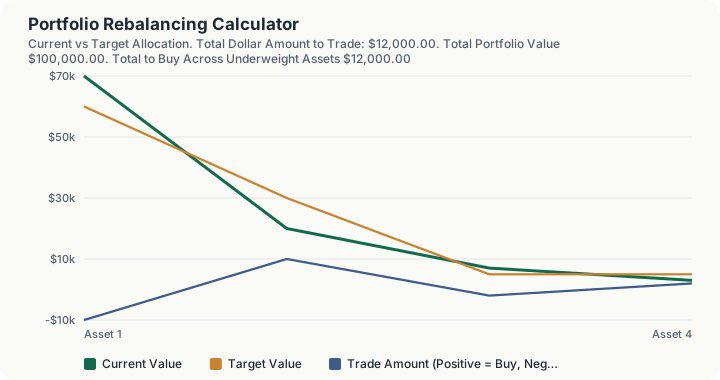
Quick Answer: On the calculator's baseline $100,000 portfolio, targeting 60% stocks, 30% bonds, 5% real estate, and 5% cash but currently sitting at $70,000, $20,000, $7,000, and $3,000, getting back to target takes $12,000 of trading: sell $10,000 of stocks and $2,000 of real estate, buy $10,000 of bonds and $2,000 of cash. Buys always equal sells, since rebalancing only moves money already in the portfolio.
Overview
A target asset allocation, such as 60% stocks and 40% bonds, is a decision made once and then eroded silently over time. Stocks and bonds do not move in lockstep, so whichever asset class performs better in a given stretch grows to represent a larger share of the total portfolio than originally intended, while the laggard shrinks in relative weight even if its dollar value also grew. Left unchecked, a portfolio built around a moderate 60/40 risk profile can drift into something closer to 80/20 after a strong multi-year stock run, carrying meaningfully more risk than the investor originally signed up for without a single new trade being placed.
Rebalancing is the periodic act of selling a portion of the overweight asset classes and buying more of the underweight ones to restore the original target percentages. It is one of the few disciplined, mechanical ways to enforce "buy low, sell high" behavior, since rebalancing systematically trims whatever has recently outperformed and adds to whatever has recently lagged, without requiring any prediction about what will happen next.
This calculator supports up to four asset class slots, covering common splits like stocks/bonds, or more granular breakdowns like US stocks/international stocks/bonds/cash or stocks/bonds/real estate/cash. Enter the current dollar balance and target percentage for each asset class in use, and leave unused slots at $0 and 0%.
How This Is Calculated
Step 1: Total portfolio value. Sum the current dollar value across every asset class.
Step 2: Current allocation percentage. For each asset class, Current % = Asset's Current Value ÷ Total Portfolio Value.
Step 3: Drift. Drift (Percentage Points) = Current % − Target %. A positive drift means the asset class is overweight relative to target; a negative drift means it is underweight.
Step 4: Target dollar value. Target Value = Total Portfolio Value × Target %.
Step 5: Trade amount. Trade Amount = Target Value − Current Value. A positive result means buy that amount; a negative result means sell that amount. Because every asset class's target dollar value is calculated against the same fixed total portfolio value, the sum of all buy amounts exactly equals the sum of all sell amounts, a check the calculator confirms internally: rebalancing between existing holdings is a zero-sum reshuffling of the same total pool of money, not new money entering the portfolio.
Worked Example
An investor has a $100,000 portfolio targeting 60% stocks, 30% bonds, 5% real estate, and 5% cash. After a strong year for stocks, the current balances are $70,000 stocks, $20,000 bonds, $7,000 real estate, and $3,000 cash.
Step 1: Total = $70,000 + $20,000 + $7,000 + $3,000 = $100,000.
Step 2: Current allocations: Stocks 70%, Bonds 20%, Real Estate 7%, Cash 3%.
Step 3: Drift: Stocks +10pp (overweight), Bonds −10pp (underweight), Real Estate +2pp (overweight), Cash −2pp (underweight).
Step 4: Target values: Stocks $60,000, Bonds $30,000, Real Estate $5,000, Cash $5,000.
Step 5: Trades: sell $10,000 of stocks, buy $10,000 of bonds, sell $2,000 of real estate, buy $2,000 of cash. Total bought ($12,000) equals total sold ($12,000), as expected.
Rebalancing Approaches and Frequency
There is no single mandated rebalancing schedule; most advisors and target-date fund managers use one of two general approaches, sometimes combined. Calendar-based rebalancing checks and rebalances on a fixed schedule, commonly annually or semi-annually, regardless of how far allocations have drifted. Threshold-based rebalancing instead rebalances whenever any asset class drifts beyond a chosen band, commonly 5 percentage points, regardless of how much time has passed. Threshold rebalancing responds faster to sharp market moves but requires more frequent monitoring; calendar rebalancing is simpler to automate but can let drift run further between check-ins during volatile periods. Many practitioners combine both: check on a calendar schedule, but only actually trade if drift exceeds the threshold, avoiding unnecessary transaction costs and tax events from rebalancing a portfolio that has barely moved.
What This Does Not Account For
This calculator computes the dollar amounts needed to rebalance holdings that already exist; it does not account for transaction costs, bid-ask spreads, or trading commissions, which can matter for frequent rebalancing of small accounts. It does not account for the tax consequences of selling appreciated positions in a taxable brokerage account, where realizing a rebalancing trade as a sale can trigger capital gains tax; rebalancing inside tax-advantaged accounts like a 401(k) or IRA avoids this entirely, and is generally the preferred place to do it when available. It treats each asset class as a single lump sum rather than accounting for the tax-lot-level detail of exactly which shares get sold, which matters for minimizing realized gains. It does not model rebalancing via new contributions (directing new deposits toward underweight asset classes instead of selling overweight ones), which is often a more tax-efficient way to rebalance a taxable account gradually over time rather than through outright sales.
Common Pitfalls
- Rebalancing too frequently in a taxable account. Constant rebalancing in a taxable brokerage account can generate avoidable capital gains taxes and trading costs that outweigh the benefit of staying precisely on target.
- Ignoring transaction costs on small trades. A calculated $200 trade on an asset class with a wide bid-ask spread or a flat trading fee may not be worth executing on its own.
- Forgetting that target percentages must sum to 100%. If your entered target percentages do not add up to 100%, the calculated target dollar values will not reconcile correctly against your total portfolio value.
- Rebalancing by selling only, ignoring new contributions. In a portfolio that receives regular new deposits, directing those deposits toward underweight asset classes can accomplish most of the rebalancing without selling anything, which is more tax-efficient.
- Treating a single point-in-time snapshot as a permanent target. Target allocations are usually meant to be revisited periodically as an investor's time horizon, risk tolerance, or goals change, not treated as fixed forever.
Frequently Asked Questions
How often should I rebalance my portfolio?
Does rebalancing guarantee better returns?
Should I rebalance inside a taxable account the same way as a 401(k) or IRA?
What if my target percentages don't add up to 100%?
Can I use this for more than four asset classes?
Sources
- CFA Institute, Portfolio Management: Rebalancing Strategies, CFA Program Curriculum. cfainstitute.org
- U.S. Securities and Exchange Commission, Investor.gov, Rebalancing: Tips for Diversifying Your Portfolio. investor.gov
Also consulted: Vanguard Research, Best Practices for Portfolio Rebalancing.